

Explanatory Memorandum
(Circulated by authority of the Assistant Minister for Competition, Charities and Treasury, the Hon Dr Andrew Leigh MP)Glossary
This Explanatory Memorandum uses the following abbreviations and acronyms.
| Abbreviation | Definition |
| AASB | Australian Accounting Standards Board |
| Activities Test | Activities Test as defined in the GloBE Rules |
| ADJR Act 1977 | Administrative Decisions (Judicial Review) Act 1977 |
| Acceptable FAS | Acceptable Financial Accounting Standard |
| Agreed Administrative Guidance | The following collection of documents:
|
| Assessment Bill | Taxation (Multinational—Global and Domestic Minimum Tax) Bill 2024 |
| ATO | Australian Taxation Office |
| Authorised FAS | Authorised Financial Accounting Standard |
| CFS | Consolidated Financial Statements |
| Commentary | Tax Challenges Arising from the Digitalisation of the Economy – Commentary to the Global Anti-Base Erosion Model Rules (Pillar Two) published by the OECD on 14 March 2022 and amended from time to time |
| Commissioner | Commissioner of Taxation |
| Consequential Bill | Treasury Laws Amendment (Multinational—Global and Domestic Minimum Tax) (Consequential) Bill 2024 |
| DMT | Domestic Minimum Tax |
| ETR | Effective Tax Rate |
| FANIL | Financial Accounting Net Income or Loss |
| FITO | Foreign Income Tax Offset |
| GloBE Rules | OECD GloBE Model Rules (as modified by the Commentary, Agreed Administrative Guidance and Safe Harbour Rules) |
| IIR | Income Inclusion Rule as defined in the GloBE Rules |
| Imposition Bill | Taxation (Multinational—Global and Domestic Minimum Tax) Imposition Bill 2024 |
| ITAA 1936 | Income Tax Assessment Act 1936 |
| ITAA 1997 | Income Tax Assessment Act 1997 |
| JV | Joint Venture |
| LTCE | Low-Taxed Constituent Entity |
| Minimum Tax law | Imposition Bill, Assessment Bill and Consequential Bill |
| MOCE | Minority-owned Constituent Entity |
| MNE | Multinational Enterprise |
| MNE Group | MNE Group as defined in the GloBE Rules |
| OECD | Organisation for Economic Cooperation and Development |
| OECD GloBE Model Rules | Tax Challenges Arising from the Digitalisation of the Economy – Global Anti-Base Erosion Model Rules (Pillar Two) published by the OECD on 20 December 2021 |
| OECD Model Tax Convention | OECD (2017), Model Tax Convention on Income and on Capital: Condensed Version 2017 |
| QIIR | Qualified Income Inclusion Rule |
| RBA | Reserve Bank of Australia |
| Rules | The Rules empowered to be made under the Assessment Bill or Consequential Bill. |
| Safe Harbour Rules | Safe Harbours and Penalty Relief: Global Anti-Base Erosion Rules (Pillar Two) published by the OECD on 20 December 2022 as well as Agreed Administrative Guidance published by the OECD on 17 July 2023 and 18 December 2023 |
| TAA | Taxation Administration Act 1953 |
| UPE | Ultimate Parent Entity as defined in the GloBE Rules |
| UTPR | Undertaxed Profits Rules as defined in the GloBE Rules |
Overview and context for the Two-Pillar Solution in Australia
On 8 October 2021, Australia and 135 other members of the OECD/G20 Inclusive Framework on Base Erosion and Profit Shifting (the Inclusive Framework) agreed to the 'Statement on the Two-Pillar Solution to Address the Tax Challenges Arising from the Digitalisation of the Economy' (the Two-Pillar Solution). The Two-Pillar Solution seeks to reform the international taxation rules and ensure that MNEs pay a fair share of tax wherever they operate and generate profits in today's digitalised and globalised world economy. The Two-Pillar Solution is a result of an OECD and G20 policy process with involvement of 140 countries and jurisdictions.
The Two-Pillar Solution is intended to be achieved through a series of tax reforms, including through the ratification of multilateral conventions and instruments. Different reforms are scheduled on different timeframes but are generally to be implemented as a coordinated approach across jurisdictions, with the earliest reforms taking effect from 1 January 2024.
The Two-Pillar Solution is comprised of Pillar 1 and Pillar 2. Pillar 1 aims to ensure a fairer distribution of profits and taxing rights among countries with respect to certain large MNEs. The GloBE Rules under Pillar 2 ensure that in-scope MNEs will be subject to a global minimum tax rate of 15 per cent. This is achieved through a set of rules which identify low taxed pools of income within a MNE Group and which allow parent jurisdictions, or in some cases, other jurisdictions, to claim taxing rights over that income.
The Australian Government announced its intention to implement key aspects of Pillar 2 in the 2023-24 Budget, as part of its continuing efforts to ensure MNEs pay their fair share of tax.
The charging provisions in the GloBE Rules are composed of the IIR and the UTPR.
The Assessment Bill also implements a domestic minimum top-up tax in respect of Constituent Entities located in Australia that are subject to an ETR below the 15 per cent minimum rate.
The IIR applies by allocating the top-up tax to the Parent Entity generally closest to the top of the corporate structure (the 'top-down' approach). The top-up tax relates to LTCEs that are subject to an ETR below the 15 per cent minimum rate in that jurisdiction.
The UTPR serves as a backstop to the IIR. It permits other jurisdictions to impose top-up tax (by denying deductions or an equivalent adjustment) on certain Constituent Entities to the extent that an LTCE in the MNE Group is not subject to tax under an IIR.
The two sets of rules provide a systematic solution to ensure all in-scope MNE Groups are subject to a minimum of 15 per cent ETR in the jurisdictions in which they operate.
These three Bills form part of a set of legislation required to implement a global and domestic minimum tax in Australia:
- •
- Imposition Bill: Taxation (Multinational—Global and Domestic Minimum Tax) Imposition Bill 2024;
- •
- Assessment Bill: Taxation (Multinational—Global and Domestic Minimum Tax) Bill 2024; and
- •
- Consequential Bill: Treasury Laws Amendment (Multinational—Global and Domestic Minimum Tax) (Consequential) Bill 2024.
The Imposition Bill imposes top-up tax, namely Australian DMT tax, Australian IIR tax and Australian UTPR tax.
The Assessment Bill implements the framework for imposition of top-up tax for the IIR, UTPR and the DMT consistent with the GloBE Rules.
The Consequential Bill contains consequential and miscellaneous provisions necessary for the administration of top-up tax, consistent with the existing administrative framework under Australian tax law and the GloBE Rules.
Australian DMT tax and Australian IIR tax apply for Fiscal Years beginning on or after 1 January 2024. Australian UTPR tax applies for Fiscal Years beginning on or after 1 January 2025.
General outline and financial impact
Chapter 1: Taxation (Multinational—Global and Domestic Minimum Tax) Bills
Outline
Chapter 2 The Bills implement a 15 per cent global minimum tax and Australian domestic minimum tax on certain MNEs with annual global revenue of at least EUR 750 million.
Date of effect
The Assessment Bill commences the day after Royal Assent.
For Australian IIR tax and Australian DMT tax, the Assessment Act applies in relation to Fiscal Years starting on or after 1 January 2024. For Australian UTPR tax, the Assessment Act applies in relation to Fiscal Years starting on or after 1 January 2025.
The Consequential and Imposition Bills commence at the same time as the Assessment Bill. However, the provisions of those Bills do not commence at all if the Assessment Bill does not commence. Similarly, these provisions apply in relation to Fiscal Years commencing on or after 1 January 2024, with the exception of the amendment to the International Tax Agreement Act 1953 applying on a prospective basis only. This amendment provides a legislative instrument making power to determine that a certain provision of one of Australia's bilateral double tax agreements (such as the Exchange of Information Article) takes priority over other tax laws.
Proposal announced
The Bills fully implement the 'Implementation of a global minimum tax and a domestic minimum tax' measure in the 2023-24 Budget.
Financial impact
The Bills have the following estimated revenue implications:
All figures in this table represent amounts in $m.
| 2022-23 | 2023-24 | 2024-25 | 2025-26 | 2026-27 |
| - | - | - | 160.0 | 210.0 |
Impact Analysis
The Office of Impact Analysis (OIA) has been consulted an impact analysis (IA) is required, OIA reference Number: 22-01540
Human rights implications
The Assessment Bill, the Consequential Bill and the Imposition Bill do not engage human rights issues. See Statement of Compatibility with Human Rights — Chapter 4.
Compliance cost impact
The Bills are expected to increase compliance costs for in-scope MNEs.
Chapter 1: Taxation (Multinational - Global and Domestic Minimum Tax) Imposition Bill 2024
Outline of chapter
1.1 This Chapter explains the operation of the Taxation (Multinational—Global and Domestic Minimum Tax) Imposition Bill 2024 (Imposition Bill).
Summary of new law
1.2 The Imposition Bill is a taxation bill which imposes global and domestic minimum taxes in respect of profits of MNEs that have been undertaxed. In these explanatory materials, these taxes are referred to as top-up taxes.
Detailed explanation of new law
1.3 To comply with section 55 of the Constitution the Imposition bill deals only with the imposition of top-up tax.
1.4 The top-up tax is as follows:
- •
- Tax payable in accordance with subsection 8(1) of the Assessment Bill (Australian DMT tax) is imposed.
- •
- Tax payable in accordance with subsection 6(1) of the Assessment Bill (Australian IIR tax) is imposed.
- •
- Tax payable in accordance with subsection 10(1) of the Assessment Bill (Australian UTPR tax) is imposed. [Section 3 of the Imposition Bill]
Commencement, application, and transitional provisions
1.5 The Imposition Bill commences at the same time as the Assessment Bill. [Table item 1 in subsection 2(1) of the Imposition Bill]
1.6 However, if the Assessment Bill does not receive Royal Assent, then the Imposition Bill does not commence and top-up tax cannot apply. This ensures that all related legislation must be enacted before top-up tax can apply. The effect of this is that, if Royal Assent is obtained, Australian DMT tax and Australian IIR tax imposed under subsections 8(1) and 6(1) of the Assessment Bill respectively, apply for Fiscal Years commencing on or after 1 January 2024 and Australian UTPR tax, imposed under subsection 10(1) of the Assessment Bill, applies for Fiscal Years commencing on or after 1 January 2025, when each of those provisions of the Assessment Bill take effect. [Table item 1 in subsection 2(1) of the Imposition Bill]
Chapter 2: Taxation (Multinational - Global and Domestic Minimum Tax) Bill 2024
Outline of chapter
2.1 This Chapter explains the operation of the Taxation (Multinational—Global and Domestic Minimum Tax) Bill 2024 (Assessment Bill).
2.2 The Assessment Bill establishes a new taxation framework to implement the GloBE Rules and an Australian DMT for certain MNE Groups. The framework establishes rules for assessing the global and domestic minimum top-up tax liabilities of certain MNEs as a part of a coordinated global approach. The Assessment Bill ensures that MNEs within scope of the GloBE Rules have an ETR of at least 15 per cent in respect of the GloBE income arising in each jurisdiction in which they operate, consistent with the GloBE Rules.
Summary of new law
2.3 The Assessment Bill sets out a framework for the entities that are liable to top-up tax in a way that seeks to achieve outcomes consistent with the GloBE Rules. This includes establishing the entities that are within scope of the GloBE Rules, relevant definitions that are used to support the framework and the description of taxes that may be charged to an entity. A list of defined terms and their definitions is included at Error! Reference source not found. .
2.4 It is intended that the substantive computation of top-up tax, consistent with the GloBE Rules, is to be determined via Rules made under the Minister's rule-making power. This approach ensures that future Agreed Administrative Guidance released by the OECD can be more readily incorporated into the Australian regime in a timely and efficient manner, while retaining an appropriate level of parliamentary oversight. This Bill contains empowering provisions to ensure such Rules can sufficiently provide the requirements for computing an ETR. Provisions consistent with the ancillary Chapters 6 and 7 of the GloBE Rules are intended to be contained in the Rules to support the ETR computations for special entities. The safe harbours and transitional provisions from Chapters 8 and 9 of the GloBE Rules are intended to be contained in the Rules.
Detailed explanation of new law
Objective
2.5 The objective of the Assessment Bill is to ensure MNE groups pay a minimum level of tax on the income arising in each of the jurisdictions where they operate. It does so by imposing top-up tax on profits made in a jurisdiction whenever the ETR, that is determined for that jurisdiction, is below the 15 percent global minimum rate.
2.6 The Assessment Bill provides the framework for the imposition of these minimum taxes, namely Australian IIR tax, Australian DMT tax and Australian UTPR tax. It sets out the entities, groups and other arrangements that are within scope of such taxes, as well as providing for entities that are excluded from the minimum tax regime. This framework is designed to be wholly consistent with the GloBE Rules to ensure Australia plays its part in the coordinated global approach to combat multinational tax avoidance being led by the OECD.
2.7 Collection mechanism, lodgment and secondary liability provisions, including instances where other entities in the MNE Group are jointly and severally liable for such top-up taxes, are included in Schedule 1 to the TAA. Further explanation of these provisions is provided in Chapter 3:.
Liability to tax
2.8 The starting point for the imposition of Australia's global and domestic minimum taxes is provided in the Assessment Bill, which provides that tax is payable by entities with a 'top-up tax amount'. Specifically, this Bill provides that the following tax is payable by an Entity if the Entity has a 'top-up tax amount' for the Fiscal Year:
- •
- Australian DMT tax equal to the sum of its Domestic Top-up Tax Amounts;
- •
- Australian IIR tax equal to the sum of its IIR Top-up Tax Amounts; and
- •
- Australian UTPR tax equal to the sum of its UTPR Top-up Tax Amount.
The meaning of Entity is discussed at paragraph 2.27 below. [Sections 6, 8 and 10 of the Assessment Bill]
2.9 To ensure Australia's framework is sufficiently flexible, the meaning of top-up tax amount for each of these top-up taxes is delegated to the Rules. This flexibility is necessary to ensure that Australia is best placed to accommodate internationally agreed developments in a timely and efficient manner, while still retaining sufficient parliamentary oversight of our domestic law. [Sections 7, 9 and 11 of the Assessment Bill]
2.10 The imposition of Australian DMT tax allows Australia to collect additional tax on excess profits of Constituent Entities of MNE Groups located in Australia in order to bring the ETR up to the 15 per cent minimum rate.
2.11 Australian IIR tax is to be imposed on certain parent entities of MNE Groups that are within scope of the Minimum Tax law in respect of undertaxed profits of Constituent Entities within the MNE Group that operate in low-tax jurisdictions.
2.12 Where a jurisdiction, that has the right to impose IIR top-up tax in respect of another jurisdiction's low-tax income, does not exercise that right, top-up tax is collected by all jurisdictions that have implemented a UTPR top-up tax regime. In accordance with the GloBE Rules, the total amount of top-up tax is allocated among jurisdictions by reference to a substance-based allocation key. Implementing jurisdictions can collect the top-up tax by applying the UTPR top-up tax as a denial of deduction under its existing corporate income tax, or through an equivalent mechanism. In Australia, an equivalent mechanism rather than a denial of deduction is to be adopted.
Group, MNE Group and Applicable MNE Group
2.13 Top-up tax computations are applicable to a MNE Group that satisfies the GloBE Threshold (see from paragraph 2.19 below for an explanation of this term). An MNE Group consists of a Group that includes at least one Entity or Permanent Establishment that is not located in the jurisdiction of the UPE of the Group. A Group, broadly, refers to the UPE and all those Entities related through ownership or control with the UPE, whose assets, liabilities, income, expenses and cashflows are consolidated in the financial statements of the UPE, or are excluded from the UPE's Consolidated Financial Statements due to the Entity's size, being immaterial or being held for sale. Each of these Entities is referred to as a Group Entity and provided the Entity is not an Excluded Entity, it is a Constituent Entity of the MNE Group. The meaning of an Entity is explained from paragraph 2.27 below and the meaning of a Constituent Entity is explained at paragraph 2.31 below. [Sections 14, 15 and 17 of the Assessment Bill]
2.14 Each Entity that is excluded from the CFS of the UPE solely due to their size or materiality or that are held for sale are treated as part of the Group.
2.15 Where a Group consists of multiple Group Entities, any of those Group Entities that carries on business at or through a Permanent Establishment in one or more other jurisdictions and includes the Financial Accounting Net Income or Loss of those Permanent Establishments in its financial statements, is the Main Entity in respect of those Permanent Establishments. Provided the Main Entity is not an Excluded Entity, those Permanent Establishments are Constituent Entities, separate from the Main Entity and from each other Permanent Establishment. While the Main Entity is a Group Entity, those Permanent Establishments are not Group Entities as they are not Entities. [Subsections 17(1), 18(1) to (3) and 19(1) and (2) and 20 of the Assessment Bill]
2.16 The term MNE Group also extends to a single Main Entity together with its Permanent Establishments. A Main Entity in respect of one or more Permanent Establishments that are located in other jurisdictions, is treated as a Group, with each Permanent Establishment and the Main Entity being separate Constituent Entities of an MNE Group, provided the Main Entity is not an Excluded Entity. [Subsections 14(1), 18(4) 19(1) and 19(2) and paragraphs 14(2)(b), 15(b), 16(1)(b) of the Assessment Bill]
2.17 While, for the purposes of this Assessment Bill, Permanent Establishments are treated as Constituent Entities, separate from the Main Entity and separate from any other Permanent Establishment of the Main Entity, these deeming rules create a legal fiction, that is unique to this taxation framework, to implement the GloBE Rules and a DMT for certain MNE Groups. It has no impact on any other Australian taxation laws. The concept of a Permanent Establishment being a Constituent Entity is also not relevant for the purposes of the TAA.
2.18 An MNE Group subject to the Minimum Tax law is called an Applicable MNE Group. A MNE Group will be an Applicable MNE Group for a Fiscal Year if, for at least 2 of the 4 Fiscal Years immediately preceding that year, the annual revenue of the MNE Group shown in the Consolidated Financial Statements of the UPE is at least EUR 750 million. Where any of those preceding Fiscal Years is less than a 12-month period, the annual revenue amount is pro-rated on a monthly basis. If the annual revenue is expressed in a currency other than EUR, it must be translated to EUR in accordance with the relevant currency translation method provided in the Rules. [Subsections 12(1), (2) and (4) of the Assessment Bill]
2.19 The consolidated annual revenue of the MNE Group is referred to as the GloBE Threshold. The EUR 750 million GloBE threshold includes revenue from any Excluded Entities in the MNE Group and income from international shipping as well as the portion of revenue from Joint Operations consolidated in the CFS of the UPE. [Subsections 12(2) and (3) of the Assessment Bill]
2.20 The annual revenue of the MNE Group is the amount determined in accordance with relevant accounting standards that represents the amount disclosed in the CFS as annual revenue of the MNE Group, which may allow for netting of discounts, returns and allowances, which are generally reflected in the profit and loss statement. Revenue amounts include the inflow of economic benefits arising from delivering or producing goods, rendering services, or other activities that constitute the MNE Group's ordinary activities. All MNE Groups must include net gains from investments (whether realised or unrealised) reflected in the profit and loss statement of the CFS and income or gains separately presented as extraordinary or non-recurring items. [Subsection 12(2) of the Assessment Bill]
2.21 Where an MNE Group's consolidated profit and loss statement presents gross gains from investments and gross losses from investments separately, then the MNE Group must reduce revenues by the amount of such gross losses to the extent of gross gains from investments in determining revenues for the GloBE threshold.
2.22 For financial entities, which may not record gross amounts from transactions in their financial statements with respect to certain items, the item(s) considered similar to revenue under the UPE's financial accounting standards should be used in the context of financial activities. Those items could be labelled as 'net banking product', 'net revenues', or others depending on the financial accounting standard. For example, if the income or gains from a financial transaction, such as an interest rate swap, is appropriately reported on a net basis under the UPE's financial accounting standards, the term 'revenue' means the net amount from the transaction.
2.23 Where the UPE does not prepare a CFS, the CFS of the UPE are instead those that would have been prepared if such Entity were required to prepare such statements in accordance with an Authorised FAS adjusted for Material Competitive Distortions. [Definition of Consolidated Financial Statements in section 34 of the Assessment Bill]
2.24 The Rules are intended to prescribe how to translate other currencies into Euros for the purposes of determining whether the GloBE Threshold is met or exceeded. [Subsections 12(3) and (4) of the Assessment Bill]
2.25 The GloBE Rules outline relevant guidelines regarding the GloBE Threshold for mergers and acquisitions. Therefore, the Assessment Bill empowers conditions for being an Applicable MNE Group to be specified in the Rules. [Paragraph 12(1)(b) of the Assessment Bill]
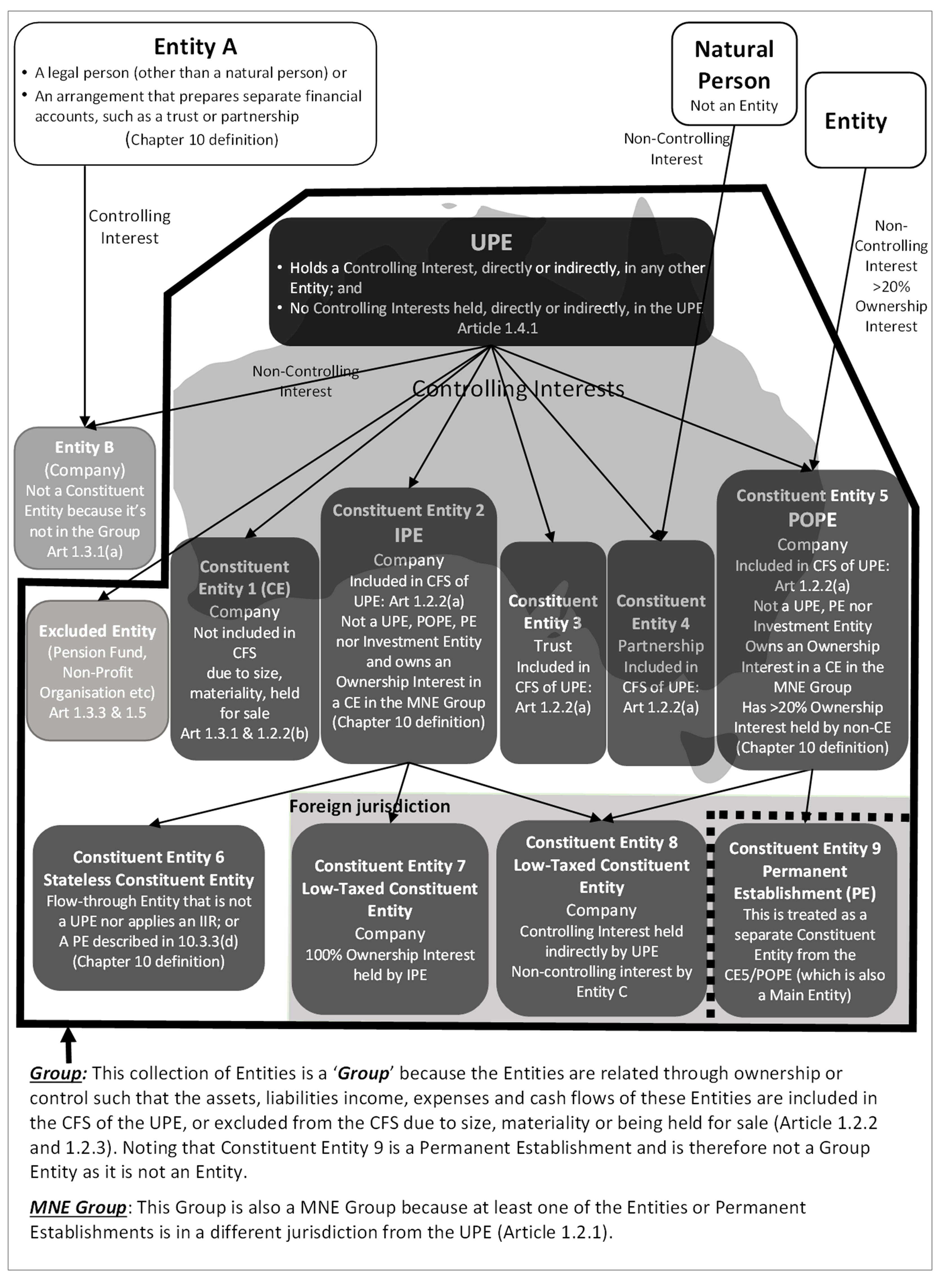
2.26 Diagram 2.1 illustrates the concepts of an MNE Group and a Group. Relevantly, a Permanent Establishment is not an Entity, but is deemed to be a Constituent Entity of the MNE Group and a Group Entity separate from the Main Entity. As noted in the diagram, the Group is also a MNE Group because at least one of the Entities or Permanent Establishments is in a different jurisdiction from the UPE. [Subsection 14(1) of the Assessment Bill]
Diagram 2.1
Entities
2.27 An Entity is any legal person (other than a natural person). To ensure partnerships, trusts and other arrangements are captured, the definition of Entity also extends to an arrangement that prepares separate financial accounts. Given the reliance on the CFS, each Entity can only be in one MNE Group consolidated on a line-by-line basis. [Subsections 13(1) and (2) of the Assessment Bill]
UPE
2.28 A UPE is either a sole Main Entity, which is deemed to be a Group with its Permanent Establishments in other jurisdictions, or an Entity which satisfies both of the following:
- •
- it directly or indirectly holds a Controlling Interest in another Entity; and
- •
- no Controlling Interest in it is held directly or indirectly by another Entity. [Subsections 13(3) and 18(4) of the Assessment Bill]
2.29 The terms 'Controlling Interest' and 'Ownership Interest' are used for different purposes within the GloBE Rules. In general, where a UPE holds a Controlling Interest in another Entity, the UPE will consolidate the Entity's assets, liabilities, income, expenses and cash flows, on a line-by-line basis, into its CFS pursuant to the Acceptable FAS. The Main Entity in respect of one or more Permanent Establishments is deemed to hold a Controlling Interest in each Permanent Establishment. [Paragraph 18(2)(b) and subsection 38(4) of the Assessment Bill]
2.30 In contrast, an Ownership Interest is any equity interest that carries rights to the profits, capital or reserves of an entity, including the profits, capital or reserves of a Main Entity's Permanent Establishment. Ownership Interest is used for the purposes of determining a Parent Entity's Allocable Share of top-up tax. [Paragraph 38(1)(a) and subsections 38(4) and 39(5), (6) and (7) of the Assessment Bill]
Constituent Entity
2.31 A Constituent Entity is an Entity that is included in the MNE Group and is not an Excluded Entity. A Permanent Establishment is deemed to be a Constituent Entity so that it is captured within the MNE Group and subject to top-up tax. An Excluded Entity is not a Constituent Entity. [Section 16, subsection 17(4) and paragraph 18(4)(b) of the Assessment Bill]
Permanent establishments and main entities
2.32 A Permanent Establishment is a place of business (including a deemed place of business) of the Main Entity, carried on in a jurisdiction other than where the Main Entity is located, and where the income attributable to that Permanent Establishment is taxed in that jurisdiction in accordance with the Business Profits Article, or similar provision, of an applicable Tax Treaty or on a net basis under the income tax laws of that jurisdiction. If a jurisdiction has no corporate income tax system, a place of business (including a deemed place of business) is a Permanent Establishment if the jurisdiction would have had a right to tax the income attributable of that place of business in accordance the Business Profits Article of the OECD Model Tax Convention. Where none of these definitions are satisfied, a place of business (including a deemed place of business) is also a Permanent Establishment if such business operations are conducted outside the jurisdiction where the Main Entity is located and the income attributed to those operations is exempt from income tax in that jurisdiction. [Subsection 19(1) of the Assessment Bill]
Example 2.1 There is an applicable tax treaty in force
A Constituent Entity resident in Country R is dedicated to the operation of aircraft in international traffic and has an office in Country S through which it carries on part of its business. Assume that the R-S treaty follows the OECD Model Tax Convention. In accordance with Article 5 of the treaty, this Constituent Entity has a Permanent Establishment in Country S. However, by virtue of Article 7(4) and Article 8 of the OECD Model Tax Convention, Country S is not able to tax the profits of the Permanent Establishment. In that case, a Permanent Establishment does not exist for purposes of the Minimum Tax law in accordance with section 19 of the Assessment Bill, regardless of the fact that it meets the definition of a Permanent Establishment of the treaty. [Subsection 19(1)(a) of the Assessment Bill, Commentary p.209-210 para 97-102]
Example 2.2 Where there is no applicable tax treaty in force a Permanent Establishment can be recognised under domestic law:
A Co and B Co are Constituent Entities resident in foreign Country A and B respectively, and the sole partners of a partnership in Australia. There is no Tax Treaty in force between Country A and Australia, nor Country B and Australia. Under the domestic law of Australia, the partnership is considered as tax transparent, and A Co and B Co are taxed on their share of the income attributed to the partnership on a net basis in Australia. In this case, paragraph 19(1)(b) of the Assessment Bill recognises the existence of two Permanent Establishments as two separate Constituent Entities. [Paragraph 19(1)(b) of the Assessment Bill, Commentary p.210 para 103-107]
Example 2.3 A Permanent Establishment can be recognised in a country with no corporate income tax system
An Australian resident carries on business in Country X, a jurisdiction with no corporate income tax system. As Country X has no corporate income tax system, a hypothetical analysis is required to determine whether the Australian resident's place of business in Country X is a Permanent Establishment for the purposes of the Minimum Tax law. On the assumption that a Tax Treaty, that replicates the last version of the OECD Model Tax Convention, exists between Australia and Country X, the place of business would not satisfy the definition of Permanent Establishment under that treaty. However, in a later year, the OECD Model Tax Convention is amended such that the place of business satisfies the definition of permanent establishment under the treaty and Country X would have a right to tax the income attributable to those business operations. In this later Fiscal Year, the Australian resident is taken to have a Permanent Establishment in Country X for the purposes of the Minimum Tax law. [Paragraph 19(1)(c) of the Assessment Bill, Commentary p.210-211, para 108-110]
Example 2.4 A Permanent Establishment can be recognised where the income attributed to business operations is exempt in the residence jurisdiction
A Co is located in Australia and conducts activities in jurisdiction B through a person that habitually concludes contracts in the name of A Co. Jurisdiction B has adopted the definition of a Permanent Establishment of Article 5 of the OECD Model Tax Convention into its domestic law and taxes the income attributable to it. The income attributable to those business operations is exempt from income tax in Australia under the foreign branch exemption in section 23AH of the ITAA 1936. Australia and Jurisdiction B have not entered into a bilateral Tax Treaty. In this case, paragraph 19(1)(b) is satisfied because jurisdiction B taxes the income attributable to a Permanent Establishment in accordance with its domestic law. While paragraph 19(1)(d) is also satisfied because Australia exempts the income attributable to those operations, it does not apply because a Permanent Establishment is recognised under paragraph 19(1)(b). If, however, jurisdiction B does not treat an agent that habitually concludes contracts in the name of its principal as giving rise to a Permanent Establishment under local law then paragraph 19(1)(d) would apply, but the Permanent Establishment would be stateless, and treated on a standalone basis, for the purposes of the Minimum Tax law without the ability to blend the income attributed to the Permanent Establishment with other Constituent Entities located in jurisdiction B. [Paragraphs 19(1)(b) and (d) of the Assessment Bill, Commentary p.211-212, para 111-114]
2.33 For the purposes of paragraph 19(1)(d) of the Assessment Bill, "operations are conducted outside the jurisdiction" can be interpreted to also mean "activities conducted outside the jurisdiction". [Paragraph 19(1)(d) of the Assessment Bill]
Joint Ventures
2.34 JV arrangements, where a UPE of an MNE Group holds at least 50% of the ownership interests in an Entity (directly or indirectly) and the financial results of the Entity are reported under the equity method in the CFS of the UPE for the Fiscal Year, are subject to the Minimum tax law and top-up tax where any of profits of the JV Group are undertaxed. In this case, the Entity is a JV of the MNE Group. [Subsection 26(1) of the Assessment Bill]
2.35 A JV of an MNE Group does not include a UPE of an Applicable MNE Group. This precludes the UPE of one MNE Group that accounts for a UPE of a second MNE Group under the equity method in its CFS and holds an Ownership Interest Percentage in that second UPE of at least 50%. This avoids treating a UPE of an MNE Group that is already subject to the Minimum Tax law as a JV of another MNE Group and therefore, potentially subject to taxation by two jurisdictions (once as a standalone MNE Group and another to the second MNE Group). [Subsection 26(2) of the Assessment Bill]
2.36 An Entity is not a JV if it is an Excluded Entity, or the Ownership Interests in the Entity held by the MNE Group are held directly by an Excluded Entity or held indirectly through Excluded Entities. [Subsection 26(2) of the Assessment Bill]
2.37 A JV Group consists of the JV and its JV Subsidiaries. A JV Subsidiary include any Entity whose assets, liabilities, income, expenses and cash flows are consolidated by the JV under an Acceptable Financial Accounting Standard, or would have been had the JV been required to under that Standard. A JV Subsidiary is excluded from being a JV. [Paragraph 26(2)(e) and section 27 of the Assessment Bill]
2.38 In determining whether an Entity is a JV, the reference to Indirect Ownership Interests 'held through' an Excluded Entity is intended to cover situations where there are multiple Excluded Entities interposed between the UPE of the MNE Group and the Entity. It covers situations where an Excluded Entity of the MNE group holds a Direct Ownership Interest in an Entity and the activities conducted by the Entity either satisfies the 'Activities Test' (see from paragraph 2.59 below for an explanation of the Activities Test) or a description as prescribed by the Rules. [Paragraph 26(2)(c) and subsections 38(1), (2) and (5) of the Assessment Bill]
2.39 The GloBE Rules require top-up tax of JVs and JV Subsidiaries to be calculated separately from the MNE Group. It is intended that the Rules will prescribe for the computation of top-up tax of the JV separately from MNE Group to ensure that the GloBE income or loss and covered taxes of the JV and JV Subsidiaries are not combined with the Constituent Entities of the broader MNE Group. [Paragraph 33(1)(j) of the Assessment Bill]
Multi-Parented MNE Groups
2.40 The GloBE Rules stipulate special rules that apply for Multi-Parented MNE Group. To provide for those special rules, section 28 of the Assessment Bill provides an empowering provision for the Rules to set out the manner in which the Assessment Bill applies in relation to such MNE Groups. The Rules are intended to provide a definition of Multi-Parented MNE Group. In the event of any inconsistency between the Assessment Bill and the Rules, the Assessment Bill applies subject to the Rules. [Section 28 and definition of Multi-Parented MNE Group in section 34 of the Assessment Bill]
2.41 This empowering provision is necessary to ensure sufficient flexibility and adaptability in the Minimum Tax law to accommodate the requirements of the OECD Two-Pillar Solution. Failing compliance with such requirements may put at risk the qualifying status of Australia's Minimum Tax law, contrary to the intended policy outcome to contribute to the global approach to combat multinational tax avoidance and to ensure protection of Australian taxing rights under this approach.
Excluded Entity
2.42 The GloBE Rules stipulate that an Excluded Entity is not subject to the GloBE Rules. The Assessment Bill prescribes, consistent with the GloBE Rules, the definition of an Excluded Entity. However, the revenue of an Excluded Entity is included in ascertaining whether the EUR 750 million GloBE Threshold has been satisfied. [Sections 12 and 20 of the Assessment Bill]
2.43 Excluded Entities who are Group Entities of an MNE Group are excluded from being Constituent Entities of an MNE Group. A subsidiary of an Excluded Entity that is not an Excluded Entity itself is not an Excluded Entity. [Subsection 17(4) of the Assessment Bill]
2.44 The following entities are defined as Excluded Entities:
- •
- a Governmental Entity;
- •
- an International Organisation;
- •
- a Non-profit Organisation;
- •
- a Pension Fund;
- •
- an Investment Fund that is an UPE;
- •
- a Real Estate Investment Vehicle that is an UPE;
- •
- an Excluded Service Entity; and
- •
- an Entity prescribed by the Rules. [Subsection 20(1) of the Assessment Bill]
2.45 If a Main Entity is an Excluded Entity, the Permanent Establishment is also treated as an Excluded Entity for the purposes of the Assessment Bill. This deeming does not result in the Permanent Establishment being treated as an Entity for the purposes of the Assessment Bill. [Subsections 20(2) and (3) of the Assessment Bill]
Sovereign wealth funds and Government Entities
2.46 Sovereign wealth funds are commonly established by governments to hold or manage investments on behalf of the government or jurisdiction. A sovereign wealth fund which meets the definition of a Governmental Entity, such as Australia's Future Fund, cannot be a UPE and will not be considered part of an MNE Group. Because some sovereign wealth funds can hold a controlling interest in another Entity, it is possible for an Entity to be controlled by a sovereign wealth fund and included in the CFS of a sovereign wealth fund. This specific exclusion ensures that such a sovereign wealth fund cannot be a UPE of an MNE Group. [Subsections 13(3), 21(2) and section 18 of the Assessment Bill]
2.47 Generally, an Excluded Entity can be a UPE if it holds a controlling interest in another Entity. However, where the Excluded Entity is a Government Entity, it will not be a UPE. This is because Government Entities are not typically required to consolidate the financial results of non-Government Entities they own on a line-by-line basis. This is also because the term Entity does not include central, state, or local government or their administration or agencies that carry out government functions. [Section 13 and definition of Controlling Interest in section 34 of the Assessment Bill]
2.48 An Entity that is wholly or partially owned by a government is a Governmental Entity if:
- •
- the principal purpose of the Entity is to either fulfill a government purpose or to manage or invest the government's assets, and the Entity does not engage in any other trade or business;
- •
- it is accountable on its overall performance, and provides annual reporting information, to the government; and
- •
- its assets vest in the government upon dissolution and any distributions of net earnings are made solely to the government. [Subsection 21(1) of the Assessment Bill]
International Organisations and Non-profit Organisations
2.49 Similar to Governmental Entities, International Organisations are Excluded Entities for the purposes of the Minimum Tax law. International Organisations include organisations that are comprised primarily of governments, are subject to privileges and immunities in those jurisdictions and its income is precluded from benefitting private persons. In addition, a subsidiary of such an organisation is also an International Organisation provided its income is also precluded from benefitting private persons. [Subsection 22(1) of the Assessment Bill]
2.50 A Non-profit Organisation is also an Excluded Entity on the basis that it is established exclusively for religious, charitable scientific, artistic, cultural, athletic, educational or other similar purposes or for the promotion of social welfare and substantially all of its income from its operations is exempt from tax in the jurisdiction in which it is created and managed. It is precluded from carrying on any trade or business apart from that directly related to the purpose for which the Organisation is established. It must not have any shareholders or members with a proprietary interest in its income or assets nor can its income benefit private persons or a non-charitable Entity apart from providing benefits, or compensation for services rendered or property purchased, as part of its ordinary operations. Upon winding up, all of its assets must be distributed or diverted to the government or a Non-profit Organisation. [Subsection 22(2) of the Assessment Bill]
Pension Funds and Pension Services Entity
2.51 The definition of Pension Fund aligns with the definition of 'recognised pension fund' in the OECD Model Tax Convention but does not require the Fund to be taxable as a separate person in the jurisdiction of formation so as to cater for trusts. A Pension Fund is a government-regulated Entity established exclusively, or almost exclusively, for the purpose of administering and providing retirement-type benefits to individuals. The government regulation must provide for the protection of such benefits and a protected pool of assets must secure the funding of those corresponding pension obligations. [Subsection 23(1) of the Assessment Bill]
2.52 It is generally expected that an Australian complying superannuation fund (within the meaning of complying superannuation fund in section 45 of the Superannuation Industry (Supervision) Act 1993) would meet the definition of Pension Fund.
2.53 Similar to the OECD Model Tax Convention, a Pension Services Entity is an Entity or a group of such Entities, that alone or together, are established and operated exclusively, or almost exclusively, to invest funds for the benefit of Pension Funds. [Subsection 23(2) of the Assessment Bill]
Real Estate Investment Vehicles and Investment Funds
2.54 A Real Estate Investment Vehicle is a separate category of an Excluded Entity, that must satisfy three conditions, being that it is widely held, it holds predominantly immovable property and it achieves a single level of taxation, either in the hands of the vehicle or its equity interest holders. This definition of real estate investment vehicle draws on the "special tax regime" provision included in the Commentary on Article 1 of the OECD Model Tax Convention. [Subsection 24(1) of the Assessment Bill]
2.55 An Investment Fund is an Entity that:
- •
- is designed to pool financial and non-financial assets of investors, some of whom are not connected;
- •
- has, and invests in accordance with, a defined investment policy;
- •
- allows its investors to reduce transaction, research and analytical costs or to spread risk collectively;
- •
- is designed to either generate investment income or gains, rather than operating income, such as dividends, interest, rent, returns from other Investment Funds and capital gains, or to protect against a specific event or outcome, such as in the insurance industry;
- •
- entitles its investors to a right of return based on their contributions;
- •
- is, or the fund manager is, subject to a prudential regulatory regime in the jurisdiction in which the fund is established or managed;
- •
- is managed by investment fund management professionals, such as independent fund managers that are subject to a national fund-management regulatory regime and whose compensation for services rendered to the fund is partly based on the performance of the fund. [Subsection 24(2) of the Assessment Bill]
2.56 The definition of investment fund requires that at least some investors are not connected, which is determined based on a facts and circumstances test. Individual investors are connected if they are 'closely related' to another investor in accordance with paragraph 8 of Article 5 of the OECD Model Tax Convention or are part of the same family including a spouse or de facto partner, siblings, parents, and ancestors and lineal descendants such as grandparents and grandchildren. [Subsections 24(3) and (4) of the Assessment Bill]
Excluded Service Entity
2.57 An Entity can be an Excluded Service Entity depending on the value of the Entity owned by Excluded Entities, other than a Pension Services Entity, and the activities conducted by the Entity satisfy what the GloBE Rules refer to as the 'Activities Test' (see from paragraph 2.59 below for an explanation of the Activities Test).
2.58 The 'value of the Entity' refers to the aggregate value of the Ownership Interests held by the Excluded Entity in the Entity as a percentage of the overall value of the Ownership Interests issued by the Entity. This should be tested on the date of the most recent change in the Excluded Entity's relative Ownership Interests in the Entity and should take into account all Ownership Interests held by the Excluded Entity. Unrealised movements in the comparative value between different class of shares should not affect the application of this test. [Paragraph 25(a) of the Assessment Bill]
Example 2.5
Base case: Value of entity
A newly formed Entity issues 200 ordinary shares worth EUR 1 each and 100 preferred shares worth EUR 2 each.
An Excluded Entity shareholder receives all the ordinary shares and 90 of the preferred shares.
The value of the Entity would be 400 and the Excluded Entity shareholder owns 95% (380/400) of the value of the Entity.
Modification: Value of ownership interests decrease
If the value of the Ownership Interests of the Entity fell to 300 such that the ordinary shares are now worth only 100, the Excluded Entity should still be treated as holding 95% of the value of the Entity despite the fact that the total market value of its shares is 93% (280/300) of the Entity as a whole.
2.59 An Excluded Service Entity must have at least 95 per cent of its value owned by Excluded Entities and meet one, or both, of the following criteria, which is referred to in the GloBE Rules as the Activities Test:
- •
- the Entity operates exclusively or almost exclusively to hold assets or invest funds for the benefit of the Excluded Entities; and
- •
- the Entity only carries out activities that are ancillary to those carried out by the Excluded Entities. [Paragraph 25(b) of the Assessment Bill, Commentary p.22 para 52-56]
2.60 The words "exclusively or almost exclusively" denote a facts and circumstances test that requires all or almost all of the Entity's activities to be related to holding assets or investing funds. This precludes Entities that might be wholly-owned, or almost wholly-owned, by an Excluded Entities, but that carry on commercial business operations. In this case, because the Entity carries on commercial business activities that go beyond holding assets or investing funds, that Entity would not satisfy the Activities Test. [Subparagraph 25(b)(i) of the Assessment Bill, Commentary p.22 para 53]
Alternatively, the Activities Test is also met if the Entity only carries out activities that are ancillary to the activities carried out by the Excluded Entities that hold Ownership Interests in the Entity (other than a Pension Service Entity). Where the Entity carries on such ancillary activities in addition to other activities, provided those other activities fall within the first limb of the Activities Test, the Entity will be an Excluded Services Entity. [Subparagraphs 25(b)(i) and (ii) of the Assessment Bill]
2.61 This rule applies to Excluded Service Entities that are Permanent Establishments. Where an Entity meets the definition of an Excluded Entity based on the totality of the activities of the Entity, any activities undertaken by its Permanent Establishment are not considered separate when applying the Activities Test. Where a Main Entity meets the definition of an Excluded Entity, its Permanent Establishment will also be an Excluded Entity (noting that this deeming does not mean that the Permanent Establishment is an Entity or a Group Entity). [Subsections 20(2) and (3) of the Assessment Bill]
2.62 For an Entity that is considered to be an Excluded Service Entity, a Filing Constituent Entity can make a Five-Year Election not to treat that Entity as an Excluded Entity. If an election is made, the Entity would be treated as a Constituent Entity and not an Excluded entity. [Subsections 20(4) to (6) of the Assessment Bill]
2.63 If an election is made, it will be a Five-Year Election, which means that it cannot be revoked with respect to a Fiscal Year (election year) or the four succeeding years immediately after the election year. The election will remain in effect indefinitely until it is revoked with respect to a Fiscal Year (the revocation year), from which point the MNE Group cannot make another election for the four succeeding years immediately after the revocation year. [Section 36 of the Assessment Bill]
2.64 It is intended for MNE Groups to be able to make an election to treat an Entity as not being an Excluded Entity so that Australian IIR tax can apply in respect of Constituent Entities in other low-tax jurisdictions and therefore preclude UTPR top-up tax being imposed in respect of that Constituent Entity. [Subsections 20(4) and (5) of the Assessment Bill]
Ownership interests
2.65 Both direct and indirect Ownership Interests are taken into account when determining which Entities are within scope of the Minimum Tax law. Direct Ownership Interests are broadly defined as interests that carry rights to the share of profits, capital and/or reserves in an Entity and that would be classified as equity under the relevant financial accounting standard. The relevant financial accounting standard is the financial accounting standard used in the preparation of the relevant CFS. [Subsections 38(1) and (2) of the Assessment Bill]
2.66 The Rules may prescribe that an interest is not a Direct Ownership Interest in an entity. This is a necessary and appropriate function for the Rules in the event future Agreed Administrative Guidance is released which would enable Australia to maintain consistency with the GloBE Rules. [Subsections 38(3) of the Assessment Bill]
Example 2.6 Ownership interests
a. Identifying whether an indirect ownership interest exists
Scenario A: Entity A holds a Direct Ownership Interest in Entity B. Entity B holds a Direct Ownership Interest in Entity C.
Outcome: Therefore, Entity A holds an Indirect Ownership Interest in Entity C. [Subsection 38(5) of the Assessment Bill]
b. Calculating the proportion of a direct ownership interest
Scenario B: Entity A issues ownership interests of two types, profit units which carry equal rights to the profits of the entity and capital units which carry equal rights to the capital of the entity in liquidation. These units are held by 3 other entities, B, C and D. Entity B holds 50% of the issued profit units and 80% of the issued capital units. Entity C holds 50% of the profit units. Entity D holds the remaining 20% of capital units.
Outcome: Entity B's ownership interest amounts to the average of its ownership interests in Entity A:

Entity C has 25% of the ownership interest in A:

Entity D has the remaining 10%:

[Subsections 39(1) and (2) of the Assessment Bill]
c. Calculating the proportion of an indirect ownership interest
Scenario C: Entity A directly owns 70% of the shares in Entity B which directly owns 40% of shares in Entity C.
Outcome: Entity A has an indirect ownership interest of 28% in Entity C, held through Entity B:

[Subsections 39(1) and (2) of the Assessment Bill]
Interpretation
2.67 The provisions of the Assessment Bill, including the Rules made for the purposes of provisions under the Assessment Bill, are to be interpreted in a manner consistent with the GloBE Rules, Commentary, Agreed Administrative Guidance, Safe Harbour Rules, and a document, or part of a document prescribed by the Rules. This does not affect the application of section 15AB of the Acts Interpretation Act 1901. [Subsections 3(1), (3) and (5) of the Assessment Bill]
2.68 This interpretation is necessary because the effectiveness of the GloBE Rules depends on a coordinated global common approach. This means that OECD Inclusive Framework members are not required to adopt the GloBE rules. But, if they choose to do so, then they:
- •
- must implement and administer the rules in a way that is consistent with the Model Rules and Guidance agreed to by the OECD Inclusive Framework; and
- •
- must accept the application of the GloBE Rules applied by other OECD Inclusive Framework members including agreement as to rule order and the application of any agreed safe harbours.
2.69 Such alignment and consistency is being enforced through an OECD Inclusive Framework Peer-Review Process.
2.70 The Rules may also prescribe that a document or part of a document be disregarded in interpreting the Assessment Bill. This provides for the circumstances where it is necessary to interpret a provision of the Assessment Bill in a manner that is inconsistent with parts of a document. It can also be used to resolve inconsistencies between documents for the purposes of interpreting the Assessment Bill. [Subsection 3(2) of the Assessment Bill]
2.71 The provisions of the Assessment Bill and the Rules also use common financial accounting terms that are not defined. When principles that rely on financial accounting, or financial accounting terminology or concepts that are not defined are used, such terms and concepts should be interpreted consistently with the meaning given to them in financial accounting standards and guidance.
2.72 The GloBE Rules, Commentary and Agreed Administrative Guidance published by the OECD are defined with reference to their full titles. [Subsection 3(4) of the Assessment Bill]
Rule-making powers
2.73 The Minister may, by legislative instrument, make Rules related to computation of top-up tax. [Sections 29 and 33 of the Assessment Bill]
2.74 This Rule making power has been included to ensure that any OECD Administrative Guidance can be incorporated efficiently and in a timely manner, while still retaining an appropriate level of parliamentary oversight. The Rules are subject to disallowance, which will enable Parliament to exercise control over the legislative power delegated to the Minister.
2.75 The Rules may, via reference, incorporate extrinsic materials in force at the time the Rules are made at a fixed point in time. However, this is limited to the extent that it is consistent with the approved OECD documents, such as Agreed Administrative Guidance. [Section 31 of the Assessment Bill]
2.76 This is appropriate given that the GloBE Rules are designed to provide for a coordinated system of taxation in the global and digitalised economy and intended to be implemented as part of a global common approach. The release of any OECD Agreed Administrative Guidance or other official documents related to the Two-Pillar solution are freely available from the OECD website.
2.77 If a legislative instrument or notifiable instrument, or a provision of such an instrument, commences before the instrument is registered, the instrument implementing the Rules may apply from the time of commencement, rather than the time of registration. This is necessary to ensure consistency with the GloBE Rules to maintain qualified status. The Rules are limited in that they are not able to modify or prescribe the operation of the Assessment Bill. However, in the event of ambiguity in the interpretation of the legislative instruments, the meaning prescribed by the Rules shall prevail. [Section 32 of the Assessment Bill]
2.78 The Rules may confer a power or function relating to the operation, application, or administration of the Rules, which may be exercised via a legislative instrument or notifiable instrument. However, only the Minister may make a legislative instrument in the Rules, which cannot be delegated. Similarly, only the Minister, Secretary or Commissioner may make a notifiable instrument, which can only be delegated to an SES employee within the Department or the ATO. This delegation is appropriate as the SES will have the relevant experience and expertise in making a notifiable instrument, should the need arise. [Section 30 of the Assessment Bill]
2.79 Subsection 12(3) of the Legislation Act 2003 allows legislative instruments to apply retrospectively if the enabling legislation expressly provides. The Assessment Bill expressly allows for such retrospective application to ensure that regulation amendments may operate retrospectively to comply with the OECD Agreed Administrative Guidance as they evolve over time. It is important for the Rule making power to apply retrospectively to ensure that tax that is payable in accordance with the Rules is collected and that Australia remains consistent with the GloBE Inclusive Framework, even as Agreed Administrative Guidance evolves over time to reduce ambiguities within the OECD GloBE Model Rules. Prompt application of the Rules facilitates an early and correct understanding of the law for stakeholders. [Section 32 of the Assessment Bill]
2.80 Any legislative instruments made under the Rules can also be retrospective. Given that the OECD envisage further refinements to the OECD GloBE Model Rules via the distribution of Agreed Administrative Guidance. It is imperative that legislative instruments have the option to be retrospective to be in line with the release of documents approved by the OECD Inclusive Framework. This design approach is necessary and appropriate to keep the legislation focused, easily accessible and flexible and to ensure certainty for taxpayers about the interpretation and operation of the Minimum Tax law. [Section 32 of the Assessment Bill]
2.81 The ability for the Rules and legislative instruments made under the Rules to apply retrospectively is an important feature of Australia's incorporation of the GloBE Rules, as qualified status can only be achieved if the Rules are implemented in a manner consistent with the GloBE Rules and ongoing release of further OECD Agreed Administrative Guidance. The retrospective application will not be to the detriment of individuals, as the retrospective application does not allow for the making of regulations that apply retrospectively to make a person liable to an offence or civil penalty, and the Rules apply in the main to MNE Groups. The retrospective application also does not allow for the imposition of a new tax or to directly amend the text of the Assessment Bill. Retrospective application of the Rules is limited to the extent it complies with the Agreed Administrative Guidance. This provides a safeguard that retrospectivity will only occur to maintain qualified status at the OECD level.
Location of an Entity
2.82 Each Constituent Entity is treated as being located in a particular jurisdiction. The principle underlying the provisions that determine the location of an Entity is to follow the treatment under local law. However, certain Constituent Entities may not be liable for tax anywhere and may be treated as "Stateless Entities". The provisions apply for opaque Entities, Flow-through Entities and Permanent Establishments. Where an Entity changes its location during the Fiscal Year, it is taken to be located in the jurisdiction in which it was located at the start of that Fiscal Year. [Sections 40 to 42 and 44 of the Assessment Bill]
2.83 Following this principle, an Entity that is not a Flow-through Entity will be treated as being located in Australia if it is an 'Australian entity' within the meaning of the ITAA 1997. This definition takes the meaning of that term as provided in section 336 of the ITAA 1936, which covers an entity that is a Part X Australian resident. The effect of this is that an Entity that is not a Flow-through Entity is an Australian entity and is therefore located in Australia if it is an Australian resident within the meaning of section 6 of the ITAA 1936 and it is not deemed to be a resident of a foreign jurisdiction by any applicable tie-breaker rules in an Australian tax treaty. [Subsection 40(1) and paragraph 40(2)(a) of the Assessment Bill]
2.84 If an Entity that is not a Flow-through Entity is resident in a jurisdiction outside of Australia based on its place of management, place of creation, or similar criterion, it will be treated as being located in that jurisdiction. [Subsection 40(1) and paragraph 40(2)(b) of the Assessment Bill]
2.85 If such Entity, falls into neither of these above categories, it is located in the jurisdiction where it is created. [Subsection 40(1) and paragraph 40(2)(c) of the Assessment Bill]
Location of a Flow-through Entity
2.86 An Entity that is a Flow-through Entity is located in the jurisdiction where it was created if the Entity is either a UPE, or it is required to apply a Qualified IIR. This allows jurisdictions to impose a Qualified IIR on Flow-through Entities that are created in that jurisdiction. [Section 41 of the Assessment Bill]
2.87 Where a Flow-through Entity is not a UPE and is not required to apply a Qualified IIR in a particular jurisdiction, it is a Stateless Constituent Entity of the MNE Group. [Subsections 41(2) and (3) of the Assessment Bill]
Location of a Permanent Establishment
2.88 The location of a Permanent Establishment is determined with reference to the definition of Permanent Establishment under the Assessment Bill, which broadly covers a Permanent Establishment under any applicable tax treaty or the OECD Model Tax Convention, or the jurisdiction that taxes the income from the carrying on of business in that jurisdiction. If any of these situations apply, as set out in paragraphs (a), (b) or (c) of the definition of Permanent Establishment, the Permanent Establishment is located in the jurisdiction mentioned in that paragraph. These provisions ensure that the location of a Permanent Establishment can be determined even where different jurisdictions may treat places of business differently. [Paragraphs 19(1)(a), (b) and (c) and subsections 42(1) and (2) of the Assessment Bill]
2.89 Paragraph (d) applies where the residence jurisdiction exempts the income from a resident's operations (or a portion of its operations) on the grounds that they are conducted outside of the residence jurisdiction. In this case, the Permanent Establishment will be treated as a Stateless Constituent Entity. [Paragraph 19(2)(d) and subsection 42(3) of the Assessment Bill]
Dual-located entities
2.90 For the purposes of the ETR and top-up tax computation, the tax attributes of a Constituent Entity can only be considered in one jurisdiction. Additionally, to avoid double taxation, a Constituent Entity can only be required to apply an IIR or UTPR top-up tax in one jurisdiction.
2.91 To address situations where a Constituent Entity, other than a Permanent Establishment, is located in two or more jurisdictions, a Constituent Entity is taken to be located, for the Fiscal Year, in the jurisdiction worked out in accordance with the Rules, unless it is a Stateless Constituent Entity. [Section 43 of the Assessment Bill]
Commencement, application, and transitional provisions
2.92 The Assessment Bill commences on the day after it receives Royal Assent and applies in relation to Fiscal Years starting on or after 1 January 2024, with the exception of the provision for Australian UTPR tax under subsection 10(1) which applies in relation to Fiscal Years starting on or after 1 January 2025. [Subsections 5(1) and (2) of the Assessment Bill]
2.93 The Assessment Bill extends to every external Territory and acts, omissions, matters and things outside Australia. This ensures that the Minimum Tax law appropriately applies as part of the OECD-led, coordinated global approach to combat multinational tax avoidance. [Section 4 of the Assessment Bill]
Chapter 3: Treasury Laws Amendment (Multinational - Global and Domestic Minimum Tax) (Consequential) Bill 2024
Outline of chapter
3.1 This Chapter explains the operation of the Treasury Laws Amendment (Multinational—Global and Domestic Minimum Tax) (Consequential) Bill 2024 (Consequential Bill).
3.2 The Consequential Bill sets out the consequential and miscellaneous provisions necessary for the collection and recovery of Australian IIR/UTPR tax and Australian DMT tax. Both Australian IIR/UTPR tax and Australian DMT tax link into the existing machinery provisions in the TAA.
3.3 The Commissioner has general administration of the Assessment Bill. Giving the Commissioner general administration brings the Assessment Bill within the definition of taxation law and ensures that a liability to pay either Australian IIR/UTPR tax or Australian DMT tax is a tax- related liability.
3.4 The amendments provide for the lodgment of returns, assessments and collection for both Australian IIR/UTPR tax and Australian DMT tax. Shortfall interest charge, general interest charge and penalties can apply in respect of liabilities that arise under the Assessment Bill.
3.5 The amendments allow the Commissioner to issue rulings about the operation of the Assessment Bill, either as public rulings or as private rulings upon application and allows taxpayers to object and appeal against assessments.
3.6 The amendments provide obligations to keep records for Australian IIR/UTPR tax and Australian DMT tax.
Summary of new law
3.7 These consequential and miscellaneous amendments are necessary for the administration of Australian IIR/UTPR tax and Australian DMT tax.
3.8 To reduce the compliance burden on taxpayers, the amendments link into the existing administrative framework in the TAA with few modifications except as required to be consistent with the GloBE Rules.
Detailed explanation of new law
General Administration of the Assessment Bill
3.9 The Commissioner has general administration of the Assessment Bill. This brings the Assessment Bill within the definition of taxation law as defined in subsection 995-1(1) of the ITAA 1997 and consequently enlivens a number of provisions within the existing administrative framework used by the Commissioner in the administration of these taxation laws. [Schedule 1, item 57, subdivision 356-D in Schedule 1 to the TAA]
3.10 As the Assessment Bill is a taxation law, several existing provisions of the TAA apply in relation to the Assessment Bill, including provisions relating to information gathering and penalties.
3.11 The Commissioner's powers to obtain information and evidence in relation to a taxation law in Subdivision 353-A in Schedule 1 to the TAA apply in relation to the Assessment Bill. This includes the Commissioner's ability to exercise the powers in sections 353-10 and 353-15 to gather information for purposes connected with the Assessment Bill.
3.12 Information gathered for purposes related to the Assessment Bill is protected information as defined in section 355-30 in Schedule 1 to the TAA. This ensures this information is covered by the secrecy provisions in Division 355 in Schedule 1 to the TAA.
3.13 Administrative penalty provisions in Schedule 1 to the TAA which refer to a taxation law will apply in relation to the Assessment Bill. These include penalties for making a false and misleading statement under Subdivision 284-B and penalties for failing to lodge under Division 286.
3.14 Where an administrative penalty is imposed under Part 4-25 in Schedule 1 to the TAA in relation to the Assessment Bill, as part of the process of assessing the amount of the penalty, the Commissioner is required to determine if remission is appropriate under section 298-20 in Schedule 1 to the TAA. Where a penalty is imposed, the taxpayer has objection rights in certain circumstances, consistent with subsection 298-20(3) in Schedule 1 to the TAA.
3.15 Offences which refer to a taxation law also apply in relation to the Assessment Bill.
3.16 A liability raised under the Assessment Bill is a tax-related liability as defined in section 255-1 in Schedule 1 to the TAA. This ensures that:
- •
- the Commissioner can recover debts arising from the non-payment of these liabilities;
- •
- the Commissioner can issue an offshore information notice under section 353-25 in Schedule 1 to the TAA to collect information relevant to the assessment of Australian IIR/UTPR tax and Australian DMT tax;
- •
- the penalties for failing to lodge a document necessary to determine a tax-related liability under subsection 284-75(3) in Schedule 1 to the TAA may apply; and
- •
- the Commissioner may allocate an entity's liability for Australian IIR/UTPR tax and Australian DMT tax to the entity's running balance account under Part IIB of the TAA so that any available credit may offset these top-up tax liabilities.
3.17 The amendments include new Division 127 in Schedule 1 to the TAA providing rules for tax returns and tax assessments, and new Division 128 in Schedule 1 to the TAA providing rules imposing onto other entities the obligations and liabilities of various entities under the Minimum Tax law.
3.18 For top-up tax purposes, the Minimum Tax law recognises Permanent Establishments as Constituent Entities. For lodgment and payment obligations, those liabilities and obligations are placed on the Main Entity because the Permanent Establishment has no legal capacity. A Main Entity is a Group Entity. For this reason, Division 127 in Schedule 1 to the TAA refers to Group Entity. While the Minimum Tax law treats Permanent Establishments as Constituent Entities, this fiction is not carried through to the administrative provisions in the TAA. Ensuring these liabilities and obligations are always imposed on the Main Entity in respect of a Permanent Establishment ensures consistent treatment of such entities within the TAA.
3.19 The amendments insert new terms in the Dictionary definitions in Division 995 of the ITAA 1997. Many of these include terms beginning with "GloBE" to distinguish the term from a similar term in the tax law, for example GloBE Entity is a new term that is different from entity in the ITAA 1997. [Schedule 1, items 27, 28 and 29, subsection 995-1(1) of the ITAA 1997]
Returns
3.20 The Consequential Bill inserts Subdivision 127-A in Schedule 1 to the TAA to require the following returns to be given to the Commissioner:
- •
- A GloBE Information Return – an obligation to lodge this standardised return with the Commissioner is consistent with the GloBE Rules.
- •
- An Australian IIR/UTPR Tax Return – this return supplements the GloBE Information Return and contains information for the purposes of administering, assessing and collecting Australian IIR/UTPR tax.
- •
- An Australian DMT Tax Return – this return supplements the GloBE Information Return and contains information for the purposes of administering, assessing and collecting Australian DMT tax. [Schedule 1, item 35, Division 127, sections 127-1 to 127-65 in Schedule 1 to the TAA]
3.21 The obligation to prepare a GloBE Information Return is separate from the requirement to declare information and pay taxes for the purposes of assessment under a tax return. That is, a GloBE Information Return is not a tax return giving rise to an assessment. The Australian IIR/UTPR Tax Return and Australian DMT Tax Return form the basis of the Commissioner's assessment of Australian IIR/UTPR tax and Australian DMT tax, respectively. [Schedule 1, item 35, subsections 127-5(1), 127-35(1) and (2) and 127-45(1) and (2) in Schedule 1 to the TAA]
3.22 A GloBE Information Return, Australian IIR/UTPR Tax Return and Australian DMT Tax Return must be lodged electronically and be in the approved form. As the Assessment Bill is a 'taxation law', an administrative penalty under section 286-75 in Schedule 1 to the TAA applies for each return not lodged. [Schedule 1, item 35, subsections 127-5(2), 127-35(3) and 127-45(3) in Schedule 1 to the TAA]
3.23 The due date for lodgment of the returns is harmonised. The Australian IIR/UTPR Tax Return and the Australian DMT Tax Return must be lodged within the time that is specified for the lodgment of the GloBE Information Return. This is consistent with the GloBE Rules, which stipulate lodgment to be within 15 months after the end of every Fiscal Year. However, an exception applies for the first Fiscal Year in which a jurisdiction's domestic law implementation of the GloBE Rules is applied by an MNE Group, where the return must be given within 18 months after the end of the Fiscal Year. [Schedule 1, item 35, subsections 127-60(1) and (2) in Schedule 1 to the TAA]
3.24 A transitional provision for short Reporting Fiscal Years is explained from paragraph 3.139.
3.25 The Commissioner does not have discretion to defer time for lodgment of the GloBE Information Return or for providing notification that a GloBE information Return has been provided to a foreign government agency. This is consistent with the due date for filing under the GloBE Rules. The Commissioner may defer the time for lodgment of the Australian IIR/UTPR Tax Return and Australian DMT Tax Return. [Schedule 1, item 35, subsection 127-60(3) in Schedule 1 to the TAA]
3.26 If a Constituent Entity is a Permanent Establishment, the Main Entity in relation to that Permanent Establishment is required to give to the Commissioner a GloBE Information Return, an Australian IIR/UTPR Tax Return and an Australian DMT Tax Return in respect of that Permanent Establishment. [Schedule 1, item 35, section 127-65 in Schedule 1 to the TAA]
3.27 Where a GloBE Information Return is given to a foreign government agency, the obligation on a Group Entity located in Australia to provide the Commissioner with a GloBE Information Return is discharged when the UPE or a Designated Filing Entity files the GloBE Information Return with the tax administration of the foreign jurisdiction where it is located. That foreign jurisdiction must have a Qualifying Competent Authority Agreement with Australia. [Schedule 1, items 27 and 35, the definition of Designated Filing Entity in subsection 995-1(1) of the ITAA 1997, sections 127-20 and 127-25 in Schedule 1 to the TAA]
3.28 A Qualifying Competent Authority Agreement is an agreement between two competent authorities regarding the automatic exchange of GloBE Information Returns. At least one of the authorities must be a Competent Authority of Australia. [Schedule 1, items 29 and 35, the definition of Qualifying Competent Authority Agreement in subsection 995-1(1) of the ITAA 1997 and subsection 127-20(3) in Schedule 1 to the TAA]
3.29 In this way, the return filing obligations operate so that the UPE or a Designated Filing Entity of the MNE Group can file a single GloBE Information Return covering all Constituent Entities in the MNE Group, which can be provided to all tax administrations with at least one Constituent Entity located in their jurisdiction through appropriate information exchange mechanisms.
3.30 If a GloBE Information Return is given to a foreign government agency, the Commissioner must be notified within the time specified. The notification must be in the approved form and lodged electronically. It must state the identity and jurisdiction of the UPE or Designated Filing Entity that filed the GloBE Information Return. Each Group Entity of the MNE Group located in Australia is required to give such notice. However, where a Designated Local Entity gives the notice all other Group Entities that are located in Australia for that Fiscal year are taken to have given such notice. [Schedule 1, item 35, subsections 127-30(1), (2) and (3) in Schedule 1 to the TAA]
GloBE Information Return
3.31 The GloBE Information Return is a standardised form that provides each jurisdiction's tax administration with the information required to assess an entity's tax liability consistent with the GloBE Rules. It is in accordance with the standardised return developed in accordance with the GloBE Implementation Framework. Currently, that return is the standardised return published by the OECD on 17 July 2023. In this way, the GloBE Information Return is consistent for information reporting requirements across implementing jurisdictions. Where relevant, due consideration should be given to the Guidance to the GloBE Information Return, published by the OECD Inclusive Framework on 17 July 2023.
3.32 As set out in the GloBE Rules, the GloBE Information Return is intended to capture general information, corporate structure, the ETR computation, computation and allocation of top-up tax liabilities and any elections made for the relevant Fiscal Year, subject to the dissemination approach for the GloBE Information Return detailed in the standardised return published by the OECD on 17 July 2023, as amended from time to time. The dissemination approach refers to the approach agreed upon by the OECD Inclusive Framework for categorising information available to each implementing jurisdiction based on their GloBE taxing rights. These taxing rights depend on whether Constituent Entities are located in that jurisdiction and the rule order applying to the MNE Group structure. However, the dissemination approach does not preclude the GloBE Information Return from being lodged in an approved form.
Content requirements of the GloBE Information Return
3.33 Each Group Entity of an Applicable MNE Group that is located in Australia at the start of the Fiscal Year must lodge a GloBE Information Return that is in accordance with the GloBE Implementation Framework and includes the following information:
- •
- identification number of the Constituent Entity;
- •
- location of the Constituent Entity;
- •
- status of the Constituent Entity under the GloBE Rules;
- •
- information on the overall corporate structure of the group including controlling interests;
- •
- all information relevant to the determination of the following in relation to the Applicable MNE Group:
- -
- ETR for each jurisdiction
- -
- top-up tax of each Constituent Entity
- -
- top-up-tax of a member of the JV Group (under Chapter 6 of the GloBE Rules); and
- -
- allocation of top-up-tax for each for the Fiscal Year (under Chapter 2 of the GloBE Rules);
- •
- annual elections, five -year elections and other elections made under the relevant provisions; and
- •
- other relevant information agreed as part of the GloBE Implementation Framework and is necessary to carry out the administration of the GloBE Rules. [Schedule 1, item 35, paragraph 127-5(3)(c) in Schedule 1 to the TAA]
Obligation to lodge a GloBE Information Return
3.34 A Group Entity is required to give a GloBE Information Return to the Commissioner even if the amount of Australian IIR/UTPR tax or Australian DMT tax that the Group Entity is liable to pay is nil. [Schedule 1, item 35, subsection 127-5(1) in Schedule 1 to the TAA]
3.35 The GloBE Information Return must be lodged electronically and must be in the approved form, which must reflect any amendments to the standardised form made by the GloBE Implementation Framework. [Schedule 1, item 35, subsections 127-5(2) and (3) in Schedule 1 to the TAA]
3.36 The Commissioner may, by legislative instrument, make a determination specifying requirements for a GloBE Information Return. If such a determination is made, the GloBE Information Return given to the Commissioner must be in accordance with those requirements. [Schedule 1, item 35, paragraph 127-5(3)(a) and subsection 127-5(4) in Schedule 1 to the TAA]
3.37 The power for the Commissioner to make a determination that specifies the requirements of the GloBE Information Return is an alternative to relying on the OECD's GloBE information return requirements that is incorporated as it is amended. The Commissioner's power is to ensure there is a level oversight within Australia, rather than relying on an international organisation. The Commissioner's determination will be consistent with the amended requirements in the GloBE Information Return which will ultimately maintain qualified status.
3.38 Entities that are excluded from applying the GloBE Rules generally have no administrative obligations, however, to the extent that such Excluded Entities form part of an MNE Group, those entities must be identified as part of the overall corporate structure of the Applicable MNE Group.
3.39 A Group Entity's obligation to lodge a GloBE Information Return is met if the Designated Filing Entity has lodged the GloBE Information Return on behalf of the Applicable MNE Group. The Group Entity is taken to give the GloBE Information Return to the Commissioner at the time the Designated Filing Entity gives it to the Commissioner. [Schedule 1, item 35, subsections 127-10 in Schedule 1 to the TAA]
3.40 A Group Entity's obligation to lodge a GloBE Information Return is met if the UPE or a Designated Filing Entity located in a foreign jurisdiction that has a Qualifying Competent Authority Agreement with Australia has lodged the GloBE Information Return in a jurisdiction within 15 months of the end of the Fiscal Year (or within 18 months of the end of the first Fiscal Year that the GloBE Rules apply for an Applicable MNE Group). If that return is lodged in a foreign jurisdiction after the due date specified in section 127-60 in Schedule 1 to the TAA, the Group Entity located in Australia will not have been taken to have met its Australian lodgment obligation. Penalties for failing to lodge the return under Subdivision 286-C in Schedule 1 to the TAA can apply in such scenarios. [Schedule 1, item 35, sections 127-20 and 127-60 in Schedule 1 to the TAA]
3.41 Where a GloBE Information Return is filed in a foreign jurisdiction, the Group Entity located in Australia with an obligation to lodge the return must notify the Commissioner of the identity of the UPE or Designated Filing Entity that has lodged the GloBE Information Return and the foreign jurisdiction in which that filing entity is located. The notification must be made in writing and electronically, in the approved form. It must be made by the due date for lodging the GloBE Information Return (i.e., 15 months after the end of the Fiscal Year, or within 18 months after the end of the Fiscal Year for the first Fiscal Year in which the GloBE Rules apply for the MNE Group) in respect of a jurisdiction. If the Designated Local Entity notifies the Commissioner of the identity of the UPE or Designated Filing Entity that gives the GloBE Information Return to the foreign government agency, the obligation of each Group Entity located in Australia to give the notification to the Commissioner is satisfied. [Schedule 1, items 27 and 35, the definition of Designated Local Entity in subsection 995-1(1) of the ITAA 1997 and sections 127-10 and 127-15 in Schedule 1 to the TAA]
3.42 There could be a circumstance where the GloBE Information Return is not received from the foreign government agency within the time period specified in the Qualifying Competent Authority Agreement, notwithstanding the GloBE Information Return being filed by the UPE or a Designated Filing Entity. In this circumstance, the Commissioner may by written notice require a Group Entity to lodge the GloBE Information Return electronically and in the approved form within 21 days after the Commissioner provides such notice. Penalties for failing to lodge the return under Subdivision 286-C in Schedule 1 to the TAA can apply if the GloBE Information Return is not lodged by the Group Entity within the required time. [Schedule 1, item 35, subsections 127-20(4), (5) and (6) in Schedule 1 to the TAA]
Australian IIR/UTPR Tax Return
3.43 The Australian IIR/UTPR Tax Return is an Australian-specific tax return that forms the basis of the Commissioner's assessment of Australian IIR/UTPR tax. [Schedule 1, item 35, subsection 127-35(1) in Schedule 1 to the TAA]
3.44 A Group Entity of an Applicable MNE Group that is located in Australia is required to give an Australian IIR/UTPR tax return to the Commissioner within the time period required for lodging the GloBE Information Return. The return must be lodged electronically and be in the approved form. [Schedule 1, item 35, subsections 127-35(2) and (3) in Schedule 1 to the TAA]
3.45 A Group Entity of an Applicable MNE Group that is liable for top-up tax for a Fiscal Year, is required to give an Australian IIR/UTPR Tax Return to the Commissioner even if a nil amount of Australian IIR/UTPR tax is payable. [Schedule 1, item 35, subsection 127-35(2) in Schedule 1 to the TAA]
3.46 A Main Entity in respect of a Permanent Establishment has the obligation to give an Australian IIR/UTPR tax return to the Commissioner in respect of that Permanent Establishment. [Schedule 1, item 35, subsections 127-35(1) and (2) and 127-65(1) and (2) in Schedule 1 to the TAA]
3.47 A Group Entity's obligation to lodge an Australian IIR/UTPR Tax Return may be met by a Designated Local Entity. A Designated Local Entity of an Applicable MNE Group may be appointed by all Group Entities of an Applicable MNE Group to lodge the Australian IIR/UTPR tax return on behalf of each of those Group Entities who have an obligation to lodge, provided the Designated Local Entity is not a Permanent Establishment. Similar to GloBE Information Returns given by a Designated Local Entity, the appointment must be for all Group Entities with an obligation to lodge an Australian IIR/UTPR tax return and is a separate appointment that would operate in addition to that in respect of the GloBE Information Return. The Group Entity is taken to have given the return to the Commissioner at the time the Designated Local Entity gives the return to the Commissioner. [Schedule 1, item 35, subsection 127-40 in Schedule 1 to the TAA]
3.48 The Australian IIR/UTPR tax return must be lodged within the required period (15 months after the end of the Fiscal Year, or within 18 months after the end of the Fiscal Year for the first Fiscal Year in which the GloBE Rules apply for the Applicable MNE Group). [Schedule 1, item 35, section 127-60 in Schedule 1 to the TAA]
3.49 The Commissioner may, by legislative instrument, specify circumstances in which a Group Entity is exempt from giving an Australian IIR/UTPR tax return for a Fiscal Year to the Commissioner. Part IVC of the TAA applies to allow Group Entities to object to a decision by the Commissioner not to exempt a Group Entity. [Schedule 1, item 35, subsections 127-35(4) and (5) in Schedule 1 to the TAA]
Australian DMT Tax Return
3.50 The Australian DMT Tax Return is an Australian-specific return that forms the basis of the Commissioner's assessment of Australian DMT tax for Australian tax purposes. [Schedule 1, item 35, subsection 127-45(1) in Schedule 1 to the TAA]
3.51 A Group Entity of an Applicable MNE Group that is located in Australia is required to give an Australian DMT tax return to the Commissioner within the time period required for lodging the GloBE Information Return. The return must be lodged electronically and be in the approved form. [Schedule 1, item 35, subsections 127-45(2) and (3) in Schedule 1 to the TAA]
3.52 A Group Entity that is required to give an Australian DMT tax return to the Commissioner must give that return to the Commissioner within the required period even if a nil amount of Australian DMT tax is payable by the relevant Constituent Entity. [Schedule 1, item 35, subsection 127-45(2) and section 127-60 in Schedule 1 to the TAA]
3.53 A Group Entity's obligation to lodge an Australian DMT tax return may be met by a Designated Local Entity. A Designated Local Entity of an Applicable MNE Group is an Entity that is appointed by all Group Entities of an Applicable MNE Group to lodge the Australian DMT tax return on behalf of each of those Group Entities who have an obligation to lodge. The Designated Local Entity cannot be a Permanent Establishment. Similar to GloBE Information Returns given by a Designated Local Entity, the appointment to lodge the Australian DMT tax return must apply for all Group Entities that are required to lodge an Australian DMT tax return and is a separate appointment that would operate in addition to that in respect of the GloBE Information Return. A Group Entity that is required to lodge an Australian DMT tax return is taken to give the return to the Commissioner at the time the Designated Local Entity gives it to the Commissioner. [Schedule 1, item 35, section 127-50 in Schedule 1 to the TAA]
3.54 A Main Entity in respect of a Permanent Establishment has the obligation to give an Australian DMT tax return to the Commissioner in respect of that Permanent Establishment. [Schedule 1, item 35, section 127-65 in Schedule 1 to the TAA]
3.55 The Commissioner may, by legislative instrument, specify circumstances in which a Group Entity is exempt from giving an Australian DMT tax return for a Fiscal Year to the Commissioner. Part IVC of the TAA applies to allow Group Entities to object to a decision by the Commissioner not to exempt a Group Entity. [Schedule 1, item 35, subsections 127-45(4) and (5) in Schedule 1 to the TAA]
Lodgment for Joint Ventures
3.56 For the purposes of lodging an Australian DMT tax return, the lodgment obligations that apply in relation to a Group Entity of an Applicable MNE Group for a Fiscal Year apply in the same way to a JV of an Applicable MNE Group and its JV Subsidiaries for a Fiscal Year. For these purposes, the JV and its JV Subsidiaries are treated as Group Entities of a separate Applicable MNE Group for the Fiscal Year. The JV is treated as the UPE of that Applicable MNE Group. [Schedule 1, item 35, subsections 127-55(1), (2) and (3) in Schedule 1 to the TAA]
Assessments
Original assessments
3.57 The Consequential Bill inserts Subdivision 127-B in Schedule 1 to the TAA to provide for when Australian IIR/UTPR tax and Australian DMT tax and related charges are due and payable, and for the making of assessments. [Schedule 1, items 35, section 127-70 and 127-75 in Schedule 1 to the TAA]
3.58 An assessment will be deemed to have been made upon the lodgment of the relevant return – an Australian DMT tax return for a liability for an amount of Australian DMT tax and an Australian IIR/UTPR tax return for liability for an amount of Australian IIR/UTPR tax. [Schedule 1, item 37, items 6 and 7 of the table in subsection 155-15(1) in Schedule 1 to the TAA]
3.59 Where an Australian DMT tax return or Australian IIR/UTPR tax return is filed on behalf of other entities by a Designated Local Entity, an assessment of tax is deemed to have been made in respect of, and given to, each of those entities upon the lodgment of the return by the Designated Local Entity. [Schedule 1, item 35, section 127-10 in Schedule 1 to the TAA]
3.60 Section 155-5 in Schedule 1 to the TAA provides that the Commissioner can make an assessment of an assessable amount. Australian IIR/UTPR tax and Australian DMT tax is listed in this section giving the Commissioner the power to make an assessment of the Australian IIR/UTPR tax and Australian DMT tax in accordance with Australia's self-assessment regime. This ensures the Commissioner can also make a default assessment of these amounts in the case of entities failing to lodge their return or provide sufficient information in their return. [Schedule 1, item 36, paragraphs 155-5(2)(ia) and (ia) in Schedule 1 to the TAA]
3.61 An amount of Australian IIR/UTPR tax or an amount of Australian DMT tax is due and payable on the last day of the 15th month after the end of the Fiscal Year (this is the same day the return that gives rise to the assessment is due). [Schedule 1, item 35, subsection 127-70(1) in Schedule 1 to the TAA]
3.62 In the Transition Year, an amount is due and payable on the last day of the 18th month after the end of the Fiscal Year. [Schedule 1, item 35, subsection 127-70(2) in Schedule 1 to the TAA]
3.63 A transitional provision provides for short Reporting Fiscal Years, as explained from paragraph 3.140.
Amended assessments, objections and review
3.64 The existing provisions in Subdivision 155-B in Schedule 1 to the TAA, which gives the Commissioner the power to amend assessments, apply to assessments of Australian IIR/UTPR tax or Australian DMT tax, subject to the period of review. If the Commissioner amends an assessment, any extra amount is due and payable 21 days after the Commissioner gives the notice of amended assessment. [Schedule 1, item 35, subsection 127-70(3) in Schedule 1 to the TAA]
3.65 The existing provisions in Division 3 of Part IVC of the TAA concerning taxation objections apply in relation to assessments of Australian IIR/UTPR tax or Australian DMT tax. Section 155-90 in Schedule 1 to the TAA provides that a taxpayer may object to an assessment using the provisions of Part IVC of the TAA. Objections in relation to an assessment of an amount of Australian IIR/UTPR tax or Australian DMT tax need to be made within 60 days after the notice of assessment is issued. [Schedule 1, items 33 and 34, paragraphs 14ZW(1)(bg) and (bgb) in Schedule 1 to the TAA]
3.66 To facilitate assessments for Australian IIR/UTPR tax or Australian DMT tax, decisions made in the process leading up to those assessments will be excluded from review under the ADJR Act 1977 in line with the standard operation for decisions which can be challenged under Part IVC of the TAA. Currently, the ADJR Act 1977 does not apply to tax assessment decisions, and only applies to a limited number of other taxation decisions. [Schedule 1, items 1 and 2, paragraph (e) of Schedule 1 to the ADJR Act 1977]
3.67 Part IVC of the TAA contains the standard review process for taxation matters that ensures an internal and consistent review is completed before presenting the case externally. This is a comprehensive review scheme, which provides for both merits and judicial review, is accessible to applicants, and may achieve the same or better results in terms of remedies than the ADJR Act 1977. Applicants can make 'objections' to decisions via an internal review process, and subsequently apply for review in the Administrative Review Tribunal. Appeals from the Administrative Review Tribunal on questions of law are heard in the Federal Court. Alternatively, direct appeals can be made to the Federal Court. Given the existence of this scheme and the large volume of taxation litigation, this exemption from review under the ADJR Act 1977 due to the already established review system under Part IVC makes the system more efficient and effective overall both for taxpayers and the Commissioner.
3.68 In achieving consistent outcomes and ensuring decisions are subject to the same internal review process within the ATO, Part 3-18 of Schedule 1 of the TAA deals with administration and lodgment obligations for the Australian IIR/UTPR tax and Australian DMT tax. Exempting Part 3-18 in Schedule 1 to the TAA from the general judicial review process maintains alignment between the Australian DMT/IIR/UTPR tax with the exemption for decisions made under other Parts of the TAA and existing taxation laws. [Schedule 1, items 1 and 2, paragraph (e) of Schedule 1 to the ADJR Act 1977]
3.69 The period of review for an amount of Australian IIR/UTPR tax or Australian DMT tax is 4 years or as so extended by subsection 155-35 in Schedule 1 to the TAA. For Australian IIR/UTPR tax, the period of review commences from the later of when the GloBE Information Return or the Australian IIR/UTPR tax return is lodged with the Commissioner. For Australian DMT tax, the period of review commences from the later of when the GloBE Information Return or the Australian DMT tax return is lodged with the Commissioner. [Schedule 1, item 37, section 127-75 in Schedule 1 to the TAA]
3.70 A note is added at the end of the definition of period of review noting that the definition is modified by section 127-75 in Schedule 1 to the TAA. [Schedule 1, item 28, the definition of period of review in subsection 995-1(1) of the ITAA 1997]
Top-up tax collection mechanism
Additional liabilities of Entities in a Group or JV Group
3.71 Division 128 inserts provisions providing for joint and several liability of tax-related liabilities amongst Group Entities and JV Groups. These provisions are necessary to ensure the effective and efficient collection of top-up tax, and other tax-related liabilities. Otherwise, an Applicable MNE Group could locate its assets in jurisdictions beyond the reach of the Commissioner, frustrating the collection of these liabilities or making collection challenging and inefficient. The operation of these integrity provisions, which may involve the application of a number of these provisions sequentially, ensures that the Commissioner can collect on these tax-related debts in an efficient and timely manner. [Schedule 1, item 35, Division 128, sections 128-1 to 128-30 in Schedule 1 to the TAA]
3.72 All references in Division 127 and Division 128 to a Group Entity does not include an Excluded Entity within the meaning of the Minimum Tax Act. This ensures that no lodgment or payment obligations are imposed on Entities that are excluded from the imposition of top-up tax. [Schedule 1, item 35, sections 127-80 and 128-30 in Schedule 1 to the TAA]
Group Entities
3.73 Where a Group Entity of an Applicable MNE Group is liable to pay an amount under the Minimum Tax law, all Group Entities of the Applicable MNE Group are jointly and severally liable to pay that amount. [Schedule 1, item 35, subsection 128-5(1) in Schedule 1 to the TAA]
3.74 An exception to joint and several liability for tax-related liabilities applies for any Group Entity that is prohibited according to the effect of an Australian law from incurring a liability, such as a company in liquidation. [Schedule 1, item 35, subsection 128-5(2) in Schedule 1 to the TAA]
JV Groups
3.75 Where a JV of an Applicable MNE Group or its JV Subsidiary is liable to pay an amount under the Minimum Tax law, the JV, each of the JV Subsidiaries and a Group Entity of the Applicable MNE Group that holds a Direct Ownership Interest in the JV, is jointly and severally liable to pay that amount. [Schedule 1, item 35, subsections 128-10(1) and (2) in Schedule 1 to the TAA]
3.76 Similarly to the Group Entity provisions, an exception to joint and several liability for tax-related liabilities applies for any Entity that is prohibited according to the effect of an Australian law from incurring a liability. [Schedule 1, item 35, subsection 128-10(3) in Schedule 1 to the TAA]
Collection from specific entities
3.77 Targeted rules are designed to accommodate partnerships, JVs, trusts and other arrangements, to ensure obligations and liabilities imposed under the Minimum Tax law can be enforced and collected effectively and efficiently. These rules are necessary where such arrangements are treated as Entities under the Minimum Tax law but that legal fiction lacks legal capacity. These targeted rules identify the legal entity behind each of these deemed Entities, upon whom obligations can be enforced and against whom liabilities can be collected. Obligations and primary liabilities are imposed under the Minimum Tax law on the following types of Entities:
- •
- trusts;
- •
- partnerships;
- •
- JVs (which may be a company, trust or partnership);
- •
- JV subsidiaries (which may be a company, trust or partnership);
- •
- an Entity that prepares financial statements, in arrangements not covered by any of the types of Entities listed above.
Trusts
3.78 Obligations imposed on a trust under the Minimum Tax law are imposed on each trustee of the trust at the time the obligation arises, as well as any future trustee until the obligation has been discharged. The obligation may be discharged by any of these trustees. Trustees of a trust will be jointly and severally liable to pay an amount of Australian IIR/UTPR tax, Australian DMT tax or interest in respect of such taxes imposed on the trust under the Minimum Tax law, regardless of whether or not the trustee is a member of the MNE Group. This joint and several liability extends to the trustee of a trust at the end of the Fiscal Year for which such liability arises, as well as a trustee of the trust after that time until the tax or interest is paid. [Schedule 1, item 35, subsections 128-15(1) and (2) in Schedule 1 to the TAA]
3.79 To ensure payment by a trustee, the Commissioner has the same remedies against the property of the trust as the Commissioner would have against the property of the trustee. A trustee that pays such a liability is entitled to be indemnified out of the assets of the trust for the liability. [Schedule 1, item 35, subsections 128-15(3) and (4) in Schedule 1 to the TAA]
3.80 Any offence against the Minimum Tax law that is committed by a trust is taken to have been committed by each of the trustees of that trust. It is a defence to the prosecution of a trustee for such an offence, if the trustee proves that it had no involvement in or knowledge of the relevant act or omission that constitutes the offence. These defences provide a safeguard for trustees in circumstances where an act or omission by another trustee results in the offence being committed by the trust. [Schedule 1, item 35, subsections 128-15(5) and (6) in Schedule 1 to the TAA]
GloBE Partnerships
3.81 Obligations imposed on a GloBE partnership (that is not a JV or JV Subsidiary) under the Minimum Tax law are imposed on each partner in that partnership. The obligation may be discharged by any of these partners. A GloBE Partnership is a partnership within the meaning of paragraph 13(1)(b) of the Minimum Tax Act. The term partnership in that Act takes its ordinary meaning. The term 'GloBE partnership' is distinguished from references to 'partnership' in Schedule 1 to the TAA, which is defined in subsection 995-1(1) of the ITAA 1997. Subsection 128-20(6) clarifies, for the avoidance of doubt, that section 94K of the ITAA 1936 does not apply, which means references to GloBE partnership include corporate limited partnerships. [Schedule 1, item 35, subsections 128-20(1), (2), (6) and (7) in Schedule 1 to the TAA]
3.82 The liability for top-up tax is imposed on the GloBE partnership and the partners in that partnership are jointly and severally liable for this primary liability. The partners are jointly and severally liable to pay the amount of that liability, regardless of whether or not the partner is a member of the Applicable MNE Group. In contrast, for GLoBE partnerships that are JVs or JV Subsidiaries, only partners that are Group Entities of the Applicable MNE Group are jointly and severally liable to pay the amount of that liability. [Schedule 1, item 35, subsection 128-20(3) and table items 1 and 3 in subsection 128-25(5) in Schedule 1 to the TAA]
3.83 Any offence against the Minimum Tax law that is committed by the GloBE partnership is taken to have been committed by each partner of the GloBE partnership. It is a defence to the prosecution of a partner for such an offence, if the partner proves that it had no involvement in or knowledge of the relevant act or omission that constitutes the offence. Similar to the corresponding trust provisions, these defences provide a safeguard for partners in circumstances where an act or omission by another partner results in the offence being committed by the GloBE partnership. [Schedule 1, item 35, subsections 128-20(4) and (5) in Schedule 1 to the TAA]
Joint Ventures
3.84 Where an unincorporated JV of an Applicable MNE Group is a GloBE partnership and liable to pay an amount under the Minimum Tax law, each partner of that JV is jointly and severally liable to pay that amount provided the partner is a Group Entity of the Applicable MNE Group. [Schedule 1, item 35, subsections 128-25(1) and (2) and item 1 of the table in subsection 128-25(5) in Schedule 1 to the TAA]
3.85 Similarly, where an unincorporated JV Subsidiary of a JV of an Applicable MNE Group, is a GloBE partnership and liable to pay an amount under the Minimum Tax law, each partner of that JV Subsidiary that is the JV, another JV Subsidiary or a Group Entity of the Applicable MNE Group, is jointly and severally liable to pay that amount. [Schedule 1, item 35, subsection 128-25(1) and (2) and table item 3 in subsection 128-25(5) in Schedule 1 to the TAA]
3.86 For unincorporated JVs and JV Subsidiaries that are neither trusts nor GloBE partnerships, and that are liable to pay an amount under the Minimum Tax law, similar rules apply to impose joint and several liability to pay that amount on each Group Entity that holds a Direct Ownership Interest in that JV or that JV Subsidiary. The JV will also be jointly and severally liable to the amount a JV Subsidiary is liable to pay under the Minimum Tax law. [Schedule 1, item 35, subsection 128-25(1) and (2) and table items 2 and 4 in subsection 128-25(5) in Schedule 1 to the TAA]
3.87 Any offence against the Minimum Tax law that is committed by a JV or JV Subsidiary is taken to have been committed by the same entities on whom joint and several liability to pay an amount is conferred. It is a defence to the prosecution of each such entity, if the entity proves that it had no involvement in or knowledge of the relevant act or omission that constitutes the offence. Similar to the corresponding trust and GloBE partnership provisions, these defences provide a safeguard for entities in circumstances where an act or omission by another entity results in the offence being committed by the JV or JV Subsidiary. [Schedule 1, item 35, subsections 128-25(3), (4) and (5) in Schedule 1 to the TAA]
Other entities
3.88 For any other unincorporated Group Entity of an Applicable MNE Group, such as an arrangement that is not a GloBE partnership, trust or JV, that is liable to pay an amount under the Minimum Tax law, joint and several liability to pay that amount is imposed on each Group Entity of the Applicable MNE Group who either includes a portion of that unincorporated Group Entity's assets, income, expenses, cashflows and liabilities in its CFS under the proportional consolidated method, or is a member of the committee of management of that unincorporated Group Entity. [Schedule 1, item 35, subsection 128-25(1)and (2) and table item 5 in subsection 128-25(5) in Schedule 1 to the TAA]
3.89 Each Group Entity that is made jointly and severally liable to pay such amount, will also be taken to have committed any offence that the unincorporated Group Entity commits against the Minimum Tax law. Similar to the corresponding provisions for other such Entities, it is a defence for the Group Entity if it proves that it had no involvement in or knowledge of the act or omission that constitutes the offence. [Schedule 1, item 35, subsections 128-25(3) and (4) and table item 5 in subsection 128-25(5) in Schedule 1 to the TAA]
Consequential changes
3.90 Consequential changes are made to existing partnership and trust liability provisions in the TAA to exclude obligations imposed and amounts payable under, and offences against, the Minimum Tax law. This ensures that these existing liability provisions and the Minimum Tax law liability provisions work in a complimentary manner. [Schedule 1, items 61 to 64, subsections 444-5(4), 444-30(5) and 444-120(1) and (2) in Schedule 1 to the TAA)
Keeping of records
3.91 The Consequential Bill inserts Subdivision 382-C in Schedule 1 to the TAA to provide record keeping requirements in respect of the Minimum Tax law. Record keeping requirements apply to Group Entities, JVs and JV Subsidiaries. . [Schedule 1, item 60, subsections 382-20(1), (5) and (6) in Schedule 1 to the TAA]
3.92 A Group Entity of an Applicable MNE Group is required to keep records that fully explain whether the Group Entity has complied with the Minimum Tax law. The requirement to keep records applies to Group Entities located in Australia notwithstanding that the GloBE Information Return may be lodged in a foreign jurisdiction and then exchanged with the Commissioner. [Schedule 1, item 60, subsection 382-20(1) in Schedule 1 to the TAA]
3.93 This obligation to keep records relates to records in respect of the operation and application of the provisions of the Minimum Tax law. Records must be kept in writing in English, or so as to enable the records to be readily accessible and convertible to English and must enable the Group Entity's liability to top-up tax to be readily ascertainable. A Group Entity includes an Excluded Entity and despite these Entities being excluded from the scope of the Minimum Tax law and not having obligations to lodge a GloBE Information Return, Australian IIR/UTPR tax return or Australian DMT tax return, Excluded Entities are required to keep records to explain their determination as being an Excluded Entity, which excludes them from having to compute top-up tax. [Schedule 1, item, 60, section 382-20 in Schedule 1 to the TAA]
3.94 For the purposes of whether a Group Entity has complied with the Minimum Tax law, such records that must be kept include (but are not limited to) all records that explain and show the basis of every disclosure in the GloBE Information Return lodged or exchanged with the Commissioner.
3.95 Records must be kept until the end of 8 years after those records were prepared or obtained, or the completion of the transactions or acts to which those records relate, whichever is the later. The length of this record keeping retention period is necessary given the extended period of time the treatment and calculations under the Assessment Bill operate, as well as the relatively long timeframes for lodgment and exchange of the GloBE Information Return. [Schedule 1, item 60, subsection 382-20(1)(b) in Schedule 1 to the TAA]
3.96 The retention period is extended where the underlying period of review is extended. The records must be kept until the later of the original 8-year period or the end of the period of review as extended. [Schedule 1, item 60, subparagraph 328-20(1)(b)(iii) in Schedule 1 to the TAA]
3.97 Failure to meet the obligations to keep records is an offence of strict liability, with the penalty being 30 penalty units. [Schedule 1, item 60, subsections 382-20(3) and (4) in Schedule 1 to the TAA]
3.98 As the Assessment Bill is a 'taxation law', the existing administrative penalty for a failure to keep or retain records, in section 288-25 of Schedule 1 to TAA may apply in respect of this record-keeping requirement. The current penalty is 20 penalty units. Further, the existing record-keeping offences in sections 8L, 8Q and 8T of the TAA may apply where the relevant elements are met.
Penalties
3.99 As the Assessment Bill is a taxation law in respect of which the administrative penalties regime may apply, the Consequential Bill amends the TAA to ensure these administrative penalties extend to the Minimum Tax law. Amendments are made to ensure liability to penalties for making a false and misleading statement, for taking a position that is not reasonably arguable and for failing to lodge a return (including provisions for the calculation of shortfall amounts and base penalty amount) operate as intended. [Schedule 1, items 38 to 52, the table in subsection 250-10(2), subsections 280-1, 280-50, 280-102E, 280-110(1), 284-75(2), 284-80(1), the table in subsection 284-90(1), subsections 284-90(1C), (3A) and (4) and paragraph 284-220(1)(d) in Schedule 1 to the TAA]
3.100 For the purpose of Division 284 in Schedule 1 to the TAA, if a Group Entity of an Applicable MNE Group is taken to give a GloBE Information Return, Australian IIR/UTPR tax return or Australian DMT tax return to the Commissioner because a Designated Filing Entity, UPE or Designated Local Entity gives the return to the Commissioner or foreign government agency, statements made in or related to that return are taken to be made by the filing entity as an agent of the Group Entity. This ensures that administrative penalties may apply for the Group Entity or the filing entity in respect of statements made in those returns. [Schedule 1, item 43, section 284-27 in Schedule 1 to the TAA]
3.101 Statements made in or related to a GloBE Information Return lodged in a foreign jurisdiction in respect of a MNE Group and exchanged with Australia under a Qualified Competent Authority Agreement are taken to be statements made to the Commissioner by each Group Entity located in Australia of that same Applicable MNE Group. [Schedule 1, item 43, subsections 284-27(1) and (2) in Schedule 1 to the TAA]
3.102 Administrative penalties that apply to a Group Entity of an Applicable MNE Group in respect of false and misleading statements about Australian IIR/UTPR tax or Australian DMT tax liabilities of the MNE Group are doubled. Administrative penalties that apply for failing to lodge a return, notice or other document in relation to Australian IIR/UTPR tax or Australian DMT tax liabilities are 500 times the base penalty amount to align with the administrative penalties that apply to significant global entities. [Schedule 1, items 49, 53, and 54, subsection 284-90(1C), paragraph 286-80(1)(b) and subsection 286-80(4C) in Schedule 1 to the TAA]
3.103 The OECD published the Safe Harbour Rules on 20 December 2022, which outlined a common understanding on transitional penalty relief for implementing jurisdictions. This included that tax administrations should consider not applying penalties or sanctions in connection with the filing of the GloBE Information Return during a Transition Period where a tax administration considers that an MNE Group has taken "reasonable measures" to ensure the correct application of the GloBE Rules. The approach also contemplated that in many cases jurisdictions already provide, as a matter of law or administrative practice, for penalty relief in accordance with the common understanding.
Further machinery provisions
3.104 The amendments ensure that entities will be able to seek rulings on the application of the Assessment Bill. [Schedule 1, item 58, subsections 357-55(fg) and (fh) in Schedule 1 to the TAA]
3.105 The Commissioner has discretion to decline to rule where it is not reasonable to comply with the application for a private binding ruling. Paragraph 359-35(2)(c) provides additional grounds for the Commissioner to decline to provide rulings. The provision is broad. There may be a number of circumstances where the Commissioner would consider it would not be reasonable to comply with the application for a ruling and decline to rule. [Schedule 1, item 59, subsection 359-35(2) in Schedule 1 to the TAA]
3.106 Below are some examples of when the Commissioner might decide it is not reasonable to comply with the application for a private binding ruling:
- •
- where the OECD Inclusive Framework has published new Administrative Guidance which Australia is planning on incorporating into domestic law but has not yet done so;
- •
- where the OECD Inclusive Framework has identified an issue which requires Administrative Guidance, or is drafting Administrative Guidance on a GloBE or DMT issue, and has yet to publish an agreed version of that Administrative Guidance; or
- •
- where issuing a ruling would require assumptions to be made on how other jurisdictions apply their respective domestic rules implementing the GloBE Rules and DMT.
Example 3.1 Where OECD is deliberating about information required for GloBE Information Return
MNE Group A is an Applicable MNE Group and required to file a GloBE Information return. In the lead up to MNE Group A filing the GloBE Information Return, several media sources start reporting that the OECD Inclusive Framework is deliberating on a particular matter that is relevant to MNE Group's A disclosures in the GloBE Information Return and that additional Administrative Guidance could be imminent. This is confirmed by an OECD Secretariat staff member during a presentation to stakeholders.
MNE Group A lodges a private binding ruling application relating to this matter. The Commissioner considers that it is not reasonable to comply with the application in the circumstances and declines to provide a ruling to MNE Group A.
3.107 The amendments ensure that general interest charge applies to the late payment of any tax-related liability that arises under the Assessment Bill. [Schedule 1, item 32, the table in subsection 8AAB(4) of the TAA]
3.108 The amendments ensure that shortfall interest charge applies to any shortfall that arises as a result of amendments made by the Commissioner. [Schedule 1, items 39 to 42, sections 280-1, 280-50 and 280-102E and subsection 280-110(1) in Schedule 1 to the TAA]
Franking credits
3.109 As Australian DMT tax is an Australian domestic tax, the payment of Australian DMT tax will give rise to franking credits in the entity's franking account. An entity pays Australian DMT tax, for the purposes of the imputation regime, if the entity has a liability to pay the tax and either makes a payment of that tax (in whole or part) or a credit or RBA surplus is applied to discharge or reduce that liability. [Schedule 1, items 10 to 12, item 9 of the table in subsection 205-15(1), the heading to section 205-20 and subsection 205-20(3B) of the ITAA 1997]
3.110 Similarly, a refund of an Australian DMT tax will result in a debit to the entity's franking account. An entity receives a refund of Australian DMT tax if either the entity receives a refund amount, or a credit or RBA surplus is applied against liabilities of the entity, representing the refund of the Australian DMT tax paid. [Schedule 1, items 13 to 16, item 14 of the table in subsection 205-30(1), the heading to section 205-35 and subsections 205-35(1B) and (2) of the ITAA 1997]
3.111 As Foreign GloBE tax is a top-up tax for low taxation in countries outside Australia, it is an international form of tax and will not give rise to franking credits.
No deduction for Australian IIR/UTPR tax or Australian DMT tax
3.112 The amendments prevent taxpayers from deducting payments of Australian IIR/UTPR tax and Australian DMT tax. This is to avoid doubt that these payments would be deductible in the absence of a specific deduction denial provision. [Schedule 1, items 6 and 9, sections 12-5 and 26-99C of the ITAA 1997]
3.113 Outgoings incurred in managing Australian GloBE tax affairs and complying with the obligations relating to Australian GloBE tax affairs, other than the payments of those tax liabilities, will be deductible. This includes expenditure incurred to seek advice on whether an entity is a Constituent Entity of an MNE Group. [Schedule 1, item 7, paragraphs 25-5(1)(e) and (f) of the ITAA 1997]
3.114 Expenditure is not capital expenditure merely because the Australian GloBE tax affairs concerned relate to matters of a capital nature. [Schedule 1, item 8, subsection 25-5(4) of the ITAA 1997]
Confidentiality of taxpayer information
3.115 The Consequential Bill amends the tax secrecy provisions under Division 355 in Schedule 1 to the TAA to ensure that taxation officers do not commit an offence where they disclose protected information in the course of administering the Minimum Tax law. [Schedule 1, items 55 and 56, paragraph 355-25(1)(b)(ii) and subsection 355-25(3) in Schedule 1 to the TAA]
3.116 The exemption allows taxation officers to disclose protected information about one Group Entity (the primary entity) to another Group Entity (the covered entity) of the same Applicable MNE Group where the protected information relates to the Australian GloBE tax affairs of any entity that has been a Group Entity of that Applicable MNE Group. [Schedule 1, item 56, paragraph 355-25(3)(a) in Schedule 1 to the TAA]
3.117 The amendments also allow taxation officers to disclose protected information about a JV or JV Subsidiary (the primary entity) to another entity within the same JV Group, or to a Group Entity of the Applicable MNE Group that holds the relevant interest in that JV or JV subsidiary (each a covered entity). The protected information must relate to the Australian GloBE tax affairs of the JV or JV subsidiary. [Schedule 1, item 56, paragraphs 355-25(3)(b), (c) and (d) in Schedule 1 to the TAA]
3.118 The exemption also extends to disclosing such protected information to a registered tax agent or legal practitioner of the covered entity. [Schedule 1, item 56, paragraphs 355-25(3)(e) and (f) in Schedule 1 to the TAA]
Compatibility with tax treaties
3.119 The Consequential Bill amends the International Tax Agreements Act 1953 to ensure that integrity provisions, that exclude or reduce an obligation for Australia to provide a FITO in relation to foreign GloBE tax paid, prevail over any obligation under that Act to provide double taxation relief. [Schedule 1, item 30, subsection 4(3) of the International Tax Agreements Act 1953]
3.120 Subsection 5(3) of the International Tax Agreements Act 1953 already provides that laws imposing taxes, other than Australian tax, prevail over the provisions of the International Tax Agreements Act in the event of any inconsistency between them. The Minimum Tax law does not fall within the definition of 'Australian tax' under that Act and therefore the provisions of Australia's bilateral tax treaties do not prevent the operation of the Minimum Tax law. Tax treaties that are given the force of law under provisions other than subsection 5(1) of the International Tax Agreements Act 1953, will also not prevent the operation of the Minimum Tax law, as those treaties are given the force of law so far as the provisions of those treaties affect 'Australian tax'.
3.121 Given this, the Consequential Bill inserts a Ministerial legislative instrument making power into the International Tax Agreements Act 1953 to ensure provisions, such as the Exchange of Information Article in Australia's tax treaties can be determined to prevail over other laws in the event of any inconsistency. This power ensures Australia can, via the Ministerial legislative instrument, access administrative provisions of its tax treaties to assist in the collection of top-up tax and the exchange of information relevant to the Minimum Tax law. This approach is consistent with the OECD Inclusive Framework's intention for GloBE tax to be compatible with international tax agreements based on the OECD Model Tax Convention. [Schedule 1, item 31, subsections 5(4) and (5) of the International Tax Agreements Act 1953]
Cross-border tax interactions: Hybrids, CFCs and FITOs
Hybrids
3.122 Amendments are made to Division 830 and 832 of the ITAA 1997 to ensure that the operation of the Australian hybrid rules and targeted integrity rule, remain unaffected by foreign GloBE tax. New terms in the Dictionary definitions in Division 995 of the ITAA 1997 are inserted to support these amendments. Many of these include terms beginning with "foreign" to distinguish the term from a similar term in the tax law, for example foreign GloBE tax is a new term that is different from Australian GloBE tax in the ITAA 1997. [Schedule 1, item 27 subsection 995-1(1) of the ITAA 1997]
3.123 The list of foreign taxes to be disregarded for the purposes of Division 832 is extended to include foreign DMT tax, foreign IIR tax, foreign UTPR tax and other foreign minimum tax. Foreign minimum tax includes a tax specified in the Regulations. This ensure that foreign GloBE tax is disregarded for the purposes of testing whether the payment is subject to foreign income tax in the targeted integrity rule in section 832-725 of the ITAA 1997. However, the application of such tax may still be a relevant fact and circumstance to be considered in applying the principal purpose test under paragraph 832-725(1)(h). [Schedule 1, items 25 and 26, subsections 832-130(7) and (8) ITAA 1997]
3.124 Australia's foreign hybrid rules in Division 830 of the ITAA 1997 ensure that an entity that qualifies as a 'foreign hybrid' is treated as a partnership (rather than a company) for Australian tax purposes. A requirement of a 'foreign hybrid' is that foreign income tax is imposed on the partners/shareholders instead of the foreign hybrid itself. The amendments provide that references to 'foreign income tax' in section 830-10 and 830-15 do not include foreign GloBE tax and other foreign minimum tax. This ensures that tax continues to be appropriately imposed on the relevant partners of the foreign hybrid as the mere imposition of such taxes on the foreign hybrid, instead of on its partners, should not change the operation of Australia's foreign hybrid rules. [Schedule 1, items 21 to 24, sections 830-10, 830-15 and 830-17 of the ITAA 1997]
Controlled Foreign Companies (CFC)
3.125 The amendments ensure that a notional allowable deduction will only be allowed under section 393 of the ITAA 1936 for foreign DMT tax, not for foreign IIR tax, foreign UTPR tax or a tax specified in the Regulations. The amendments to section 393 operate in tandem with Division 770 of the ITAA 1997 to allow a FITO to be claimed in respect of foreign DMT tax paid by a CFC. [Schedule 1, item 5 17, and 19 subsection 393(2), paragraph 717-10(1)(c) and subsection 770-135(3A) of the ITAA 1936]
Foreign income tax offset (FITO)
3.126 The amendments ensure that a FITO can only be claimed in respect of a foreign DMT tax (and not in respect of a foreign IIR tax or foreign UPTR tax). [Schedule 1, items 18 and 20, subsection 770-10(6) and section 770-150 of the ITAA 1997]
3.127 However, where a Group Entity, JV or JV Subsidiary of the Applicable MNE Group has paid an amount of foreign DMT tax and is entitled to a benefit in a foreign jurisdiction (effectively compensating or reversing the economic effect of that foreign DMT tax), the amount of foreign DMT tax which the entity is treated as having paid is reduced by the amount of any of the following benefits in respect of the entity:
- •
- the amount of a refundable tax credit that is refunded to an entity because the credit exceeds income tax liability;
- •
- consideration received for the transfer of a transferable tax credit to which the entity was entitled in respect of a foreign income tax of that jurisdiction;
- •
- cash or cash equivalent amounts recognised as government grants under International Accounting Standard 20 (or a comparable accounting standard applicable under a foreign law); and
- •
- a benefit of a kind specified by the Minister in respect of a specified jurisdiction. [Schedule 1, item 20, section 770-145 of the ITAA 1997]
3.128 The Minister may, by legislative instrument, make a determination specifying a benefit in respect of a specified foreign country. In making the determination, the Minister must have regard to the following:
- •
- the extent (if any) to which the benefit has been designed to be available to Applicable MNE Groups;
- •
- the extent (if any) to which the benefit could increase the amount of foreign DMT tax payable in the foreign country;
- •
- the extent (if any) to which the benefit could increase the amount of a tax offset under this Division;
- •
- the nature of any other benefit specified in the determination. [Schedule 1, item 20, subsection 770-145(3) and (4) of the ITAA 1997]
3.129 Broadly, the benefits seek to capture amounts of cash or cash equivalent received by the entity (or another entity in respect of the first entity) from the government by way of refunds from refundable tax credits, sale proceeds from the disposal of transferable tax credits and government grants.
3.130 Subparagraph 770-145(1)(d)(i) ensures that where a refundable tax credit reduces the entity's income tax liability to an amount above nil, but without resulting in a refund (and the entity is not entitled to any other benefit described in paragraph 770-145(1)(d)), any FITO in respect of foreign DMT tax paid is not reduced. [Schedule 1, item 20, section 770-145 of the ITAA 1997]
3.131 The foreign income tax paid and the reciprocal benefits recognised in Australia must be in relation to the same foreign tax period (as defined in the ITAA 1997). In determining when the same foreign tax period applies, the timing of the entitlement to the benefit should be considered. [Schedule 1, item 20, paragraph 770-145(1)(e) of the ITAA 1997]
Example 3.2 Reduce FITO by amount of any benefit, capped at foreign DMT tax paid
Entity A (a Constituent Entity located in Jurisdiction A) is a CFC, wholly owned by Aus Co, which is part of the same MNE Group.
Entity A:
- •
- pays $10 of corporate income tax in Jurisdiction A,
- •
- pays $5 of foreign DMT tax in Jurisdiction A; and
- •
- receives a $6 government grant.
Assuming the relevant conditions in Division 770 are satisfied, the amount of FITO that could have been available for Aus Co is $15, disregarding section 770-145.
However, under section 770-145, the FITO is reduced by the government grant ($6), capped at the amount of foreign DMT tax paid ($5). Therefore, the FITO is $15 - $5 = $10.
Assuming the relevant conditions in Division 770 are satisfied, Aus Co's total entitlement to a FITO is $10, comprising of $10 in respect of corporate income tax and $0 in respect of foreign DMT tax.
Example 3.3 Refundable tax credits
Foreign Co (a Constituent Entity located in Jurisdiction A) is a CFC, wholly owned by Aus Co, which is part of the same MNE Group. The laws of Jurisdiction A allow refundable tax credits to be utilised for reducing corporate income tax payable and any excess is refunded as cash or cash equivalent.
Foreign Co has a corporate income tax liability in Jurisdiction A of $15. The liability is reduced to nil and a refund of $5 is given due to Foreign Co being entitled to a refundable tax credit of $20.
Foreign Co has also paid $12 of foreign DMT tax in Jurisdiction A.
The $5 refund is a relevant benefit as it represents the amount of the refundable tax credit of $20, that is in excess of Entity A's income tax liability of $15.
Foreign Co is treated as having paid $7 of foreign DMT tax ($12 - $5).
Assuming the relevant conditions in Division 770 are satisfied, Aus Co's total entitlement to a FITO is $7, comprising nil in respect of corporate income tax and $7 in respect of foreign DMT tax.
Example 3.4 Some refundable tax credits are not benefits
Foreign Co (a Constituent Entity located in Jurisdiction A) is a CFC, wholly owned by Aus Co, which is part of the same MNE Group. The laws of jurisdiction A allow Foreign Co to utilise a tax credit to reduce corporate income tax liability and any excess is refunded in cash or cash equivalent.
Foreign Co has a corporate income tax liability in Jurisdiction A of $15. Foreign Co is entitled to a refundable tax credit of $12. After utilising the tax credit, Foreign Co pays $3 of corporate income tax.
Foreign Co also received a government grant of $5 in Jurisdiction A for investing in certain clean energy initiatives.
Foreign Co has also paid $12 of foreign DMT tax in Jurisdiction A.
None of the $12 refundable tax credit is a benefit per subparagraph 770-145(1)(e)(i) as the whole credit of $12 has been utilised to reduce corporate income tax liability, and there is no excess of the refundable tax credit ($12) over Foreign Co's income tax liability of $15. The government grant of $5 is a relevant benefit per subparagraph 770-145(1)(e)(iii). As such, Foreign Co is treated as having paid $7 of foreign DMT tax ($12 reduced by $5). Assuming the relevant conditions in Division 770 are satisfied, Aus Co's total entitlement to a FITO is $10, comprising of $3 in respect of corporate income tax plus $7 in respect of foreign DMT tax.
Commencement, application, and transitional provisions
Commencement
3.132 The Consequential Bill commences at the same time as the Assessment Bill. [Table item # of the Consequential Bill]
3.133 However, if the Assessment Bill does not receive Royal Assent, then the Consequential Bill does not commence at all.
Application provisions
3.134 The items in the Consequential Bill, have various application provisions, where the amendments to the TAA, generally apply to fiscal years commencing on or after 1 January 2024. The amendments to the ITAA 1997 and ITAA 1936 generally apply to income years ending on or after 1 January 2024. [Schedule 1, item 65, 66 and 68 of the Consequential Bill]
3.135 Other TAA amendments that have different application dates include:
- •
- the disclosure of protected information applies after 1 January 2024; and
- •
- the Commissioner's general administration of the Act and the keeping of records applies after commencement. [Schedule 1, item 65 of the Consequential Bill]
3.136 Other ITAA 1997 provisions that have different application dates include:
- •
- the deductibility of managing Australian GloBE tax affairs and the application of a FITO in relation to expenditure incurred or foreign income tax paid, respectively, applies after 1 January 2024; and
- •
- ancillary definitional terms in relation to another amendment apply from the same time as the primary amendment. [Schedule 1, item 66 of the Consequential Bill]
3.137 The amendments inserting the Ministerial legislative instrument making power into the International Tax Agreements Act 1953 apply in relation to taxes payable on or after the commencement of the Consequential Bill. [Schedule 1, item 67 of the Consequential Bill]
3.138 The amendment to ensure that integrity provisions, that exclude or reduce an obligation for Australia to provide a FITO in relation to foreign GloBE tax paid in the International Tax Agreements Act 1953 prevail over any obligation under that Act to provide double taxation relief applies in relation to taxes payable on or after 1 January 2024. [Schedule 1, item 67 of the Consequential Bill]
Transitional
3.139 A transitional provision provides for short Reporting Fiscal Years. Where any of the three returns are required to be given to the Commissioner at a time before 30 June 2026, such returns are instead required to be given to the Commissioner no later than 30 June 2026. The transitional provision also provides for an amount of Australian IIR/UTPR tax, Australian DMT tax (including such extra tax resulting from the amendment of an assessment), or any shortfall interest charge that is due and payable before 30 June 2026 to be due and payable on 30 June 2026. [Schedule 1, item 69 of the Consequential Bill]
3.140 A transitional provision provides for short Reporting Fiscal Years. Where any amount of Australian IIR/UTPR tax or Australian DMT tax (including extra such tax resulting from the amendment of an assessment) is required to be paid to the Commissioner no later than a particular time before 30 June 2026, the amount is due and payable on 30 June 2026. That is, the deadline for payment is extended to 30 June 2026. [Schedule 1, item 69 of the Consequential Bill]
Definitions
3.141 Additional commentary on the defined terms in the Bills is set out in table 3.1. Relevant provisions of the Assessment Bill and the Consequential Bill that define certain terms include:
- •
- section 34 of the Assessment Bill;
- •
- subsection 995-1(1) of the ITAA 1997; and
- •
- Schedule 1 to the TAA.
Table 3.1
| Defined term | Explanation |
| Acceptable Financial Accounting Standard | Acceptable Financial Accounting Standard means any of the following:
|
| Agreed Administrative Guidance
section 3(4) |
Agreed Administrative Guidance is the collection of the documents that relate to the interpretation or administration of the GloBE Rules. The Administrative Guidance reflects the common understanding of the GloBE Rules and ensure that issues are addressed as they arise. The documents that comprise the administrative guidance include:
|
| Annual Election
section 37 |
An annual election is an election made by a Filing Constituent Entity in the GloBE Information Return that only applies to the Fiscal Year for which the election is made. |
| Applicable MNE Group subsection 12(1) | An MNE Group is an Applicable MNE Group for a Fiscal Year (the test year) if for at least 2 of the 4 Fiscal Years immediately preceding the test year, the MNE Group's annual revenue is equal to or greater than its GloBE Threshold for the Fiscal Year. Alternatively, an MNE group may be an Applicable MNE group if any conditions specified in the Rules are met. |
| Authorised Accounting Body | The body with legal authority in a jurisdiction to prescribe, establish or accept accounting standards for financial reporting purposes. |
| Authorised Financial Accounting Standard | Authorised Financial Accounting Standard, in respect of an Entity, means a set of generally acceptable accounting principles permitted by the Authorised Accounting Body in the jurisdiction where the Entity is located. |
| Commentary subsection 3(4) | Tax Challenges Arising from the Digitalisation of the Economy – Commentary to the Global Anti Base Erosion Model Rules (Pillar Two) published by the OECD on 14 March 2022, as amended from time to time. |
| Consolidated Financial Statements (CFS) | The definition of CFS takes into account all scenarios of how a CFS may be prepared.
Paragraph (a) is where an entity that is not the UPE, prepares financial statements in accordance with an Acceptable Financial Accounting Standard, in which the assets, liabilities, income, expenses and cash flows of that Entity and the Entities in which it has a Controlling Interest are presented as those of a single economic unit Paragraph (b) accounts for the UPE preparing financial statements in accordance with an Acceptable Financial Accounting Standard. Paragraph (c) accounts for where an entity does not strictly fall within the remit of paragraph (a) or (b), but would be covered if the financial statements were prepared in accordance with an Acceptable Financial Accounting Standard and are adjustments to prevent any Material Competitive Distortions. Paragraph (d) is a deemed consolidation test that applies where an entity does not prepare financial statements in accordance with an Authorised Financial Accounting Standard. The deemed consolidation test interacts with paragraph (b) of the controlling interest definition, which provides that an entity with an Ownership Interest in another entity is deemed to have a controlling interest if the interest holder would be required to consolidate if it had prepared CFS. |
| Constituent Entity
subsection 16(1) |
A Constituent Entity can be a UPE or Permanent Establishment, or any Entity that is related through ownership or control such that the assets, liabilities, income, expenses and cash flows of the Entity to the UPE.
However, a Constituent Entity cannot be an Excluded Entity. |
| Controlled Foreign Corporation (CFC) | The definition of CFC for the purposes of the consequential amendments takes the same meaning as in section 340 of the ITAA 1936.
This is separate to the definition of a Controlled Foreign Company Tax Regime which, as defined by the GloBE rules is a set of tax rules under which a direct or indirect shareholder of a controlled foreign company is subject to current taxation on its share of part or all of the income earned by the CFC. |
| Controlling Interest | An Ownership Interest in an Entity such that the holder of the Ownership Interest:
|
| Direct Ownership Interest
section 38 |
A Direct Ownership Interest in an Entity is an interest (whether by way of shares, other security or otherwise) that:
The Main Entity in respect of a Permanent Establishment is taken to hold a Direct Ownership Interest in the PE. |
| Direct Ownership Interest Percentage
section 39 |
Compute the Direct Ownership Interest Percentage of an Entity (the holding entity) in another Entity (the test entity) as follows:
|
| Domestic Top-up Tax Amount
section 9 |
The definition will be provided for in the Rules. |
| Entity
section 13 |
Any legal person (other than a natural person) or an arrangement that is required to prepare separate financial accounts, such as a partnership or trust. |
| Excluded Entity
section 20 |
An Excluded Entity is an Entity that is any of the following:
|
| Excluded Service Entity section 25 | At least 95% of the value of the Entity is owned (directly or through a chain of Excluded Entities) by one or more Excluded Entities mentioned in paragraphs 20(2)(a) to (f) (other than a Pension Services Entity); and the Entity satisfies either or both of the following:
|
| Filing Constituent Entity for an MNE Group | Is a Constituent Entity of the MNE Group that files a GloBE Information Return for the MNE Group. |
| Financial Accounting Net Income or Loss | The definition will be provided for in the Rules. |
| Fiscal Year | A Fiscal Year is generally an accounting period with respect to which the UPE of an MNE Group prepares its CFS. However, if paragraph (d) of the definition of CFS applies, then it is instead a calendar year. |
| Foreign Income Tax Offset (FITO) | Entities that have an assessable income earned overseas, must declare it in an Australian income tax return. If foreign tax was paid in another country, the entity may be entitled to an Australian FITO, which provides relief from double taxation, as detailed within Division 770 of the ITAA 1997. |
| Five-Year Election
section 36 |
A five year election can only be made where permitted under the Minimum Tax Law, such as under subsection 20(5) to not treat an Entity as an Excluded Entity.
A Filing Constituent Entity may make a Five-Year Election that applies for five fiscal years from the date it was recorded in the GloBE Information Return. The Filing Constituent Entity cannot revoke the election with respect to the fiscal year that it was made., If the election is revoked, the Filing Constituent Entity cannot then make another election in its place. |
| Flow through Entity | The definition will be provided for in the Rules. |
| GloBE Information Return
section 995-1 of the ITAA 1997 |
The GloBE Information Return is a document filed by a Constituent Entity and is a return that is published by the OECD on 17 July 2023, as amended from time to time. |
| GloBE Rules
subsection 3(4) |
GloBE Rules means Tax Challenges Arising from the Digitalisation of the Economy – Global Anti Base Erosion Model Rules (Pillar Two) published by the OECD on 20 December 2021. |
| GloBE threshold
subsections 12(3) and (4) |
The GloBE threshold is generally 750 million Euros over a period of 12 months.
However, if the Fiscal Year is not 12 months, the threshold (in Euros) is:
|
| Governmental entity
section 21 |
Governmental Entity means an Entity that meets all of the following criteria:
However, a sovereign wealth fund cannot be a UPE, Main entity, nor a Permanent Establishment |
| Group
subsection 14(2) and paragraph 18(4)(a) |
In general, a Group is comprised of group entities, which include:
Alternatively, it is a Main Entity that is the UPE and each Permanent Establishment that is a Constituent Entity (not a Group Entity). |
| Group entity
section 15 and subsection 17(3) |
Group Entity means:
|
| IFRS | The International Financial Reporting Standards are a collection of accounting rules for the financial statements of public companies that are intended to make financial statements consistent, transparent, and easily comparable. Use of IFRS is mandated in many jurisdictions worldwide, including Australia.
The IFRS are issued by the International Accounting Standards Board (IASB). |
| IIR Top-up Tax amount | The definition will be provided for in the Rules. |
| Indirect Ownership Interest
section 38 |
An Entity (the first entity) holds an Indirect Ownership Interest in another Entity or a Permanent Establishment (the other entity/ Permanent Establishment) if the first entity holds a Direct Ownership Interest in:
|
| Indirect Ownership Interest Percentage
subsection 39(3) and (4) |
The Indirect Ownership Interest Percentage of an Entity (the holding entity) in another Entity (the test entity) is computed by multiplying:
If there is more than is more than one intermediate entity that holds a direct ownership percentage the holding entity's Indirect Ownership Interest Percentage in the test entity is the sum of the percentages worked out above in relation to each of those intermediate entities. |
| International organisation
subsection 22(1) |
International Organisation means any of the following:
|
| Investment Fund
subsection 24(2) |
Investment Fund means an Entity that meets all of the following criteria:
|
| Joint Venture
section 26 |
An Entity is a JV if the Entity's financial results are reported under the equity method in the CFS of an UPE of an MNE Group for the Fiscal Year and the UPE's Ownership Interest Percentage in the Entity is at least 50%. |
| JV Group
subsection 27(1) |
JV Group means a JV and its JV Subsidiaries. |
| JV Subsidiary
subsection 27(2) and (3) |
JV Subsidiary, of a JV, means an Entity whose assets, liabilities, income, expenses and cash flows are consolidated by the JV under an Acceptable Financial Accounting Standard (or would have been consolidated had it been required to consolidate such items in accordance with an Acceptable Financial Accounting Standard).
If the Main Entity in respect of a Permanent Establishment is a Joint Venture or a JV Subsidiary of a Joint Venture, then any Permanent Establishments of the Main Entity are a JV Subsidiary of the Joint Venture. |
| Main Entity, in respect of a PE
subsection 19(2) |
The Entity that includes the FANIL of the Permanent Establishment in its financial statements. |
| Material Competitive Distortion | Material Competitive Distortion, in respect of Consolidated Financial Statements, means an application of a specific principle or procedure, under the set of generally accepted accounting principles used in preparing the Consolidated Financial Statements, that results in an aggregate variation greater than 75 million Euros in a Fiscal Year as compared to the amounts that would have been determined by applying the corresponding IFRS principle or procedure.
Alternatively, the Rules may provide a meaning. |
| MNE Group
subsection 14(1) |
An MNE Group is a Group that includes at least one Entity or Permanent Establishment that is not located in the jurisdiction of the UPE of the Group. |
| Multi Parented MNE Group | The Rules may set out how the Minimum Tax Law applies to Multi-Parented MNE groups. |
| Non profit Organisation
subsection 22(2) |
Non profit Organisation means an Entity that meets all of the following criteria:
|
| OECD Model Tax Convention | OECD Model Tax Convention (2017) means the Model Tax Convention on Income and on Capital published (from time to time) by the Council of the OECD. |
| Ownership Interest
section 38 |
An Ownership Interest in an Entity or in a Permanent Establishment is:
|
| Ownership Interest Percentage
section 39 |
The Ownership Interest Percentage of an Entity (the holding entity) in another Entity (the test entity) is equal to the sum of:
|
| Pension Fund
subsection 23(1) |
An Entity that is established and operated in a jurisdiction exclusively or almost exclusively to administer or provide retirement benefits and ancillary or incidental benefits to individuals.
A pension fund should have the characteristics of being regulated as such by that jurisdiction or one of its political subdivisions or local authorities and/or those benefits are secured or otherwise protected by national regulations and funded by a pool of assets held through a fiduciary arrangement or trustor to secure the fulfilment of the corresponding pension obligations against a case of insolvency of the MNE Group. |
| Pension Services Entity
subsection 23(2) |
Pension Services Entity means an Entity that is established and operated exclusively or almost exclusively:
|
| Permanent Establishment
subsection 15(2) |
A place of business (including a deemed place of business) that is situated in a jurisdiction and treated as a permanent establishment in accordance with an applicable Tax Treaty in force, if the jurisdiction taxes the income attributable to it in accordance with a provision similar to Article 7 of the OECD Model Tax Convention. If there is no applicable Tax Treaty in force—a place of business (including a deemed place of business) in respect of which a jurisdiction taxes the income attributable to that place of business under its law on a net basis similar to the manner in which it taxes its own tax residents. |
| QIIR | The definition of Qualified Income Inclusion Rule will be provided for in the Rules. |
| Real Estate Investment Vehicle
subsection 24(1) |
An Entity that meets all of the following criteria:
A Real Estate Investment Vehicle that is owned directly by a small number of other widely-held Investment Entities or Pension Funds that have numerous beneficiaries is considered to be widely-held. In some instances the interest holders could also be tax neutral vehicles such as a recognised Pension Fund. In these cases, a single level of taxation would not be achieved with a year as the distributions made to these investors could be exempted. However, the definition would still be met because the design of the tax regime was to achieve a single level of taxation. The definition also requires that the Entity holds predominantly immovable property. In some cases, such property would not be held directly but indirectly via holding a security the value of which is linked to immovable property. An Entity that holds predominantly immovable property, either directly or indirectly via such securities (or a combination of the two) will meet the condition the definition. |
| Rules
subsection 29(1) |
The Rules empowered to be made under the Assessment Bill |
| Stateless Constituent Entity
subsections 41(3), 42(3), and 43(2) |
Stateless Constituent Entity means a Constituent Entity of an MNE Group that is either:
|
| Tax Treaty | Tax Treaty means an agreement for the avoidance of double taxation with respect to taxes on income and on capital. |
| this Act
subsection 3(5) |
A reference to this Act includes a reference to the Rules. |
| Ultimate Parent Entity
subsection 13(3) |
UPE means:
|
| UTPR Top up Tax Amount
section 11 |
The definition of UTPR top-up tax amount will be provided for in the Rules. |
Chapter 4: Statement of Compatibility with Human Rights
Prepared in accordance with Part 3 of the Human Rights (Parliamentary Scrutiny) Act 2011
Taxation (Multinational—Global and Domestic Minimum Tax) Bill 2024
Overview
4.1 This Taxation (Multinational—Global and Domestic Minimum Tax) Bill 2024 (Assessment Bill), Treasury Laws Amendment (Multinational—Global and Domestic Minimum Tax) (Consequential) Bill 2024 (Consequential Bill), and Taxation (Multinational—Global and Domestic Minimum Tax) Imposition Bill 2024 (Imposition Bill) are compatible with the human rights and freedoms recognised or declared in the international instruments listed in section 3 of the Human Rights (Parliamentary Scrutiny) Act 2011.
4.2 The Imposition Bill deals only with the imposition of top-up tax and is required to comply with section 55 of the Constitution. The top-up tax is as follows:
- •
- Australian DMT tax for tax payable in accordance with subsection 8(1) of the Assessment Bill;
- •
- Australian IIR tax for tax payable in accordance with subsection 6(1) of the Assessment Bill; and
- •
- Australian UTPR tax for tax payable in accordance with subsection 10(1) of the Assessment Bill. [Section 3 of the Imposition Bill]
4.3 The Assessment Bill establishes a new taxation framework to implement the GloBE Rules and a DMT for certain MNE Groups. The framework establishes rules for assessing the domestic minimum top-up tax and the global minimum top-up tax liability of certain MNEs as a part of a coordinated global approach. The Assessment Bill ensures that MNEs within scope of the GloBE Rules have an ETR of at least 15 per cent in respect of the GloBE income arising in each jurisdiction in which they operate, consistent with the GloBE Rules.
4.4 The Consequential Bill makes amendments to the existing administrative framework in the TAA with few modifications except as required to be consistent with the GloBE Rules. These consequential and miscellaneous amendments are necessary for the administration of IIR and UTPR top-up tax and Domestic top-up tax.
Human rights implications
4.5 The Imposition Bill, Assessment Bill and Consequential Bill do not engage any of the applicable rights or freedoms.
4.6 Top-up taxes imposed under the GloBE rules generally apply to multinational corporations, and are not applicable to natural persons, therefore not engaging human rights.
Conclusion
4.7 The Imposition Bill, Assessment Bill and Consequential Bill are compatible with human rights as it does not raise any human rights issues.
Attachment 1: Conversion Table
Conversion tables for the Assessment Bill and Consequential Bill
The following conversion table has been included to assist readers in identifying the comparable legislative reference to the OECD GloBE Model Rules, Commentary and Agreed Administrative Guidance (OECD). The conversion tables identify provision in the Imposition Bill, Assessment Bill or Consequential Bill (Primary law) that correspond to an Article in the OECD GloBE Model Rules, Commentary or Agreed Administrative Guidance. Where applicable, it may also refer to sections of the Agreed Administrative Guidance and Commentary relevant for each provision and Article.
There are no equivalent GloBE model rules for provisions in the Imposition Bill.
In the conversion table:
- •
- No equivalent means that this is a new provision in the Legislative package that has no equivalent in the OECD GloBE Model Rules.
- •
- Legislation not required means that the provision of the OECD GloBE Model Rules is not appropriate for inclusion in the Legislative package.
Assessment Bill
| Assessment Bill provision | OECD |
| 1 | No equivalent |
| 2 | No equivalent |
| 3 | See Art 8.3.1 OECD GloBE Model Rules |
| 4 | No equivalent |
| 5 | No equivalent |
| 6 | See Art 2.1.1 OECD GloBE Model Rules |
| 7 | No equivalent |
| 8 | page 59 paragraph 14 Tax Challenges Arising from the Digitalisation of the Economy – Administrative Guidance on the Global Anti-Base Erosion Model Rules (Pillar Two), July 2023 published by the OECD on 17 July 2023. |
| 9 | No equivalent |
| 10 | See Articles 2.4 and 2.5 OECD GloBE Model Rules |
| 11 | No equivalent |
| 12 | See Art 1.1 OECD GloBE Model Rules
page 22- 25 paragraphs 1- 9 of the Tax Challenges Arising from the Digitalisation of the Economy – Administrative Guidance on the Global Anti-Base Erosion Model Rules (Pillar Two), December 2023 published by the OECD on 18 December 2023. page 14- 16 paragraph s4-13 and page 16 paragraphs 14-15 Commentary |
| 13(1)-(2) | Definition of Entity Art 10.1 OECD GloBE Model Rules
p. 14 paragraph 12 Tax Challenges Arising from the Digitalisation of the Economy – Administrative Guidance on the Global Anti-Base Erosion Model Rules (Pillar Two) published by the OECD on 2 February 2023 |
| 13(3) | See Art 1.4 OECD GloBE Model Rules |
| 14 | Art 1.2 OECD GloBE Model Rules |
| 15 | Definition of a Group Entity Art 10.1 OECD GloBE Model Rules |
| 16 | Art 1.2 OECD GloBE Model Rules |
| 17 | Art 1.2 OECD GloBE Model Rules |
| 18(1) | Arts 1.2.3, 1.3.1 & 1.3.2 OECD GloBE Model Rules |
| 18(2) | Definition of Permanent Establishment Art 10.1 OECD GloBE Model Rules |
| 18(3) | Definition of Main Entity Art 10.1 OECD GloBE Model Rules |
| 18(4) | Arts 1.2.3 OECD GloBE Model Rules |
| 19(1) | Definition of a Permanent Establishment Art 10.1 OECD GloBE Model Rules |
| 19(2) | Definition of a Main Entity Art 10.1 OECD GloBE Model Rules |
| 20(1)-(3) | Arts 1.5.1 & 1.5.2 OECD GloBE Model Rules
page 26 paragraph 10 of the Tax Challenges Arising from the Digitalisation of the Economy – Administrative Guidance on the Global Anti-Base Erosion Model Rules (Pillar Two) published by the OECD on 2 February 2023. |
| 20(4)-(6) | Art 1.5.3 OECD GloBE Model Rules |
| 21 | Art 1.3.3 OECD GloBE Model Rules
p.19 para 31 Commentary |
| 22 | Arts 1.5.1 & 1.5.2 OECD GloBE Model Rules
page 26 paragraph 10 of the Tax Challenges Arising from the Digitalisation of the Economy – Administrative Guidance on the Global Anti-Base Erosion Model Rules (Pillar Two) published by the OECD on 2 February 2023. |
| 23 | Arts 1.5.1 & 1.5.2 OECD GloBE Model Rules
page 26 paragraph 10 of the Tax Challenges Arising from the Digitalisation of the Economy – Administrative Guidance on the Global Anti-Base Erosion Model Rules (Pillar Two) published by the OECD on 2 February 2023. |
| 24 | Definition of a Real Estate Investment Vehicle Art 10.1 OECD GloBE Model Rules |
| 25 | No equivalent |
| 26 | Definition of JV and related definitions Art 10.1 OECD GloBE Model Rules |
| 27 | Definition of JV and related definitions Art 10.1 OECD GloBE Model Rules |
| 28 | No equivalent |
| 29 | No equivalent |
| 30 | No equivalent |
| 31 | No equivalent |
| 34 | Various definitions Art 10.1 OECD GloBE Model Rules |
| 35 | Definition of Material Competitive Distortion Art 10.1 OECD GloBE Model Rules |
| 36 | Definition of Five-Year Election Art 10.1 OECD GloBE Model Rules
Commentary page196 paragraphs 19-20 |
| 37 | Definition of Annual Election Art 10.1 OECD GloBE Model Rules |
| 38 | Definition of Ownership Interest Art 10.1.1 OECD GloBE Model Rules |
| 39 | No equivalent |
| 40 | Article 10.3.1 OECD GloBE Model Rules |
| 41 | Article 10.3.2 OECD GloBE Model Rules |
| 42 | Art 10.3.3 OECD GloBE Model Rules |
| 43 | Art 10.3.4 OECD GloBE Model Rules
page 223–225 paragraphs 195- 207 Commentary |
| 44 | Art 10.3.6 OECD GloBE Model Rules |
Consequential Bill
| Consequential Bill provision | OECD |
| 1 | No equivalent |
| 2(1) | No equivalent |
| 2(2) | No equivalent |
| 3 | No equivalent |
| Administrative Decisions (Judicial Review) Act 1977 | |
| Paragraph (e) of Schedule 1 | No equivalent |
| Income Tax Assessment Act 1936 | |
| Subsection 324(5) | No equivalent |
| Subsection 325(3) | No equivalent |
| Subsection 393(2) | No equivalent |
| Income Tax Assessment Act 1997 | |
| Section 12-5 | No equivalent |
| paragraph 25-5(1)(e) and (f) | No equivalent |
| Subsection 25-5(4) | No equivalent |
| Section 26-99C | No equivalent |
| Subsection 205-15(1) (table item 9) | No equivalent |
| Subsection 205-20(3B) | No equivalent |
| Subsection 205-30(1) (table item 14) | No equivalent |
| subsection 205-35(1B) | No equivalent |
| Subsection 205-35(2) | No equivalent |
| Paragraph 717-10(1)(c) | No equivalent |
| Subsection 770-10(6) | No equivalent |
| Subsection 770-135(3A) | No equivalent |
| Section 770-145 | No equivalent |
| Section 770-150 | No equivalent |
| paragraphs 830-10(1)(b) and (c) | No equivalent |
| Section 830-15 | No equivalent |
| Section 830-17 | No equivalent |
| Paragraph 832-130(7)(e) | No equivalent |
| Subsection 832-132(8) | No equivalent |
| Subsection 995-1(1)
Multiple definitions incorporating GloBE Rules definitions into Australian law. |
Definition of GloBE Information Return in Art 10.1 OECD GloBE Model Rules
Definition of Qualifying Competent Authority Agreement in Art 10.1 OECD GloBE Model Rules Definition of GloBE Implementation Framework in Art 10.1 OECD GloBE Model Rules Definition of Designated Filing Entity in Art 10.1 OECD GloBE Model Rules Definition of Designated Local Entity in Art 10.1 OECD GloBE Model Rules |
| International Tax Agreements Act 1953 | |
| Multiple amendments to International Tax Agreements Act 1953 | No equivalent, but see paragraph 2 Executive Summary Tax Challenges Arising from the Digitalisation of the Economy – Administrative Guidance on the Global Anti-Base Erosion Model Rules (Pillar Two) published by the OECD on 2 February 2023 |
| Taxation Administration Act 1953 | |
| Subsection 8AAB(4) (table items 45BA and 45BB) | No equivalent |
| Paragraph 14ZW(1)(bg) | No equivalent |
| Paragraph 14ZW(1)(bgb) | No equivalent |
| Part 3-18 in Schedule 1 of the TAA
Reflects the administration of the Australian IIR/UTPR tax and Australian DMT tax |
|
| Subdivision 127-A
Sections 127-5 to 127-50 and 127-65 |
See GloBE Information Return in Chapter 10.1 OECD GloBE Model Rules in relation to section 127-5(3)
See Qualifying Competent Authority Agreement in Chapter 10.1 in relation to section 127-5(8) Arts 8.1.1, 8.1.2, 8.1.4, 8.1.5 & 8.1.7 OECD GloBE Model Rules Commentary pages:
|
| Section 127-60 | Arts 8.1.6 & 9.4 OECD GloBE Model Rules
Tax Challenges Arising from the Digitalisation of the Economy – Administrative Guidance on the Global Anti-Base Erosion Model Rules (Pillar Two), December 2023 published by the OECD on 18 December 2023
Commentary page:
|
| Subdivision 127-B
Sections 127-70 and 127-75 |
No equivalent |
| Subdivision 127-C | No equivalent |
| Subdivision 128-A | No equivalent |
| Subdivision 128-B | No equivalent |
| Subdivision 128-C | No equivalent |
| Transitional provision | Arts 8.1.6 and 9.4.1 OECD GloBE Model Rules
page 34 paragraph 9 Tax Challenges Arising from the Digitalisation of the Economy – Administrative Guidance on the Global Anti-Base Erosion Model Rules (Pillar Two), December 2023 published by the OECD on 18 December 2023 |
| Other TAA machinery amendments | |
| Paragraph 155-5(2)(ia) and (ib) in Schedule 1 | No equivalent |
| Subsection 155-15(1) in Schedule 1 (table items 6 and 7) | No equivalent |
| Subsection 250-10(2) in Schedule 1 (items 136AC to 136AF) | No equivalent |
| Sections 280-1, 280-50, 280-102E, 280-110(1), 284-27, paragraphs 284-75(2)(a), (b) and (d), subsections 284-80(1) (table items 3 and 4), 284-90(1) (table item 4), 284-90(1C), (3A) and (4)(b), 284-220(1)(d), 286-80(1)(b) and (4C), paragraphs 355-25(3) in Schedule 1 | No equivalent, but see Art 8.1.8 OECD GloBE Model Rules
page 184 paragraph 28 Commentary |
| Section 356-20 in Schedule 1 | No equivalent |
| paragraph 357-55(fg) and (fh) in Schedule 1 | No equivalent |
| subsection 359-35(2)(c) in Schedule 1 | No equivalent |
| Subdivision 382-C in Schedule 1 | No equivalent |
OECD GloBE Model Rules
| OECD GloBE Model Rules | Reference to domestic primary law |
| Article 1.1 Scope of the GloBE Rules | |
| 1.1.1 | Paragraph 12(3)(a) & subsection 12(1) of the Assessment Bill |
| 1.1.2 | Paragraph 12(3)(b) of the Assessment Bill |
| 1.1.3 | Legislation not required |
| Article 1.2 MNE Group and Group | |
| 1.2.1 | Subsection 14(1) of the Assessment Bill |
| 1.2.2 | Subsections 14(2)-(5) of the Assessment Bill |
| 1.2.3 | Subparagraph 15(1)(c)(i) of the Assessment Bill |
| Article 1.3 Constituent Entity | |
| 1.3.1 | Subsections 16(1), 17(1) and 18(4) of the Assessment Bill |
| 1.3.2 | Subsection 18(4)() of the Assessment Bill |
| 1.3.3 | Subsection 16(2) of the Assessment Bill |
| Article 1.4 Ultimate parent entity | |
| 1.4.1 | Subsection 13(3) of the Assessment Bill |
| Article 1.5 Excluded entity | |
| 1.5.1 | Section 20 of the Assessment Bill |
| 1.5.2 | Section 20 Assessment Bill |
| 1.5.3 | Section 20 of the Assessment Bill |
| Article 2.1 Application of the IIR | |
| 2.1.1 | Sections 6 and 7 of the Assessment Bill |
| 2.1.2 | Deferred to the Rules |
| 2.1.3 | Deferred to the Rules |
| 2.1.4 | Deferred to the Rules |
| 2.1.5 | Deferred to the Rules |
| 2.1.6 | Deferred to the Rules |
| Article 2.2 Allocation of Top-Up Tax under the IIR | |
| 2.2.1 | Deferred to the Rules |
| 2.2.2 | Deferred to the Rules |
| 2.2.3 | Deferred to the Rules |
| 2.2.4 | Deferred to the Rules |
| Article 2.3 IIR Offset Mechanism | |
| 2.3.1 | Deferred to the Rules |
| 2.3.2 | Deferred to the Rules |
| Article 2.4 Application of the UTPR | |
| 2.4.1 | Deferred to the Rules |
| 2.4.2 | Deferred to the Rules |
| 2.4.3 | Deferred to the Rules |
| Article 2.5 UTPR top-up tax amount | |
| 2.5.1 | Deferred to the Rules |
| 2.5.2 | Deferred to the Rules |
| 2.5.3 | Deferred to the Rules |
| Article 2.6 Allocation of top-up tax for the UTPR | |
| 2.6.1 | Deferred to the Rules |
| 2.6.2 | Deferred to the Rules |
| 2.6.3 | Deferred to the Rules |
| 2.6.4 | Deferred to the Rules |
| Article 3.1 Financial Accounts | |
| 3.1.1 | Deferred to the Rules |
| 3.1.2 | Deferred to the Rules |
| 3.1.3 | Deferred to the Rules |
| Article 3.2 Adjustments to determine GloBE Income or Loss | |
| 3.2.1 | Deferred to the Rules |
| 3.2.2 | Deferred to the Rules |
| 3.2.3 | Deferred to the Rules |
| 3.2.4 | Deferred to the Rules |
| 3.2.5 | Deferred to the Rules |
| 3.2.6 | Deferred to the Rules |
| 3.2.7 | Deferred to the Rules |
| 3.2.8 | Deferred to the Rules |
| 3.2.9 | Deferred to the Rules |
| 3.2.10 | Deferred to the Rules |
| 3.2.11 | Deferred to the Rules |
| Article 3.3 Shipping Income | |
| 3.3.1 | Deferred to the Rules |
| 3.3.2 | Deferred to the Rules |
| 3.3.3 | Deferred to the Rules |
| 3.3.4 | Deferred to the Rules |
| 3.3.5 | Deferred to the Rules |
| 3.3.6 | Deferred to the Rules |
| Article 3.4 Allocation of Income or Loss between a Main Entity and a Permanent Establishment | |
| 3.4.1 | Deferred to the Rules |
| 3.4.2 | Deferred to the Rules |
| 3.4.3 | Deferred to the Rules |
| 3.4.4 | Deferred to the Rules |
| 3.4.5 | Deferred to the Rules |
| Article 3.5 Allocation rules for a flow through entity | |
| 3.5.1 | Deferred to the Rules |
| 3.5.2 | Deferred to the Rules |
| 3.5.3 | Deferred to the Rules |
| 3.5.4 | Deferred to the Rules |
| 3.5.5 | Deferred to the Rules |
| Article 4.1 Adjusted covered taxes | |
| Art.4.1 | Deferred to the Rules |
| 4.1.1 | Deferred to the Rules |
| 4.1.2 | Deferred to the Rules |
| 4.1.3 | Deferred to the Rules |
| 4.1.4 | Deferred to the Rules |
| 4.1.5 | Deferred to the Rules |
| Article 4.2 Definition of covered taxes | |
| 4.2.1 | Deferred to the Rules |
| 4.2.2 | Deferred to the Rules |
| Article 4.3 Allocation of Covered Taxes from one Constituent Entity to another Constituent Entity | |
| 4.3.1 | Deferred to the Rules |
| 4.3.2 | Deferred to the Rules |
| 4.3.3 | Deferred to the Rules |
| 4.3.4 | Deferred to the Rules |
| Article 4.4 Mechanism to address temporary differences | |
| 4.4.1 | Deferred to the Rules |
| 4.4.2 | Deferred to the Rules |
| 4.4.3 | Deferred to the Rules |
| 4.4.4 | Deferred to the Rules |
| 4.4.5 | Deferred to the Rules |
| 4.4.6 | Deferred to the Rules |
| 4.4.7 | Deferred to the Rules |
| Article 4.5 The GloBE Loss Election | |
| 4.5.1 | Deferred to the Rules |
| 4.5.2 | Deferred to the Rules |
| 4.5.3 | Deferred to the Rules |
| 4.5.4 | Deferred to the Rules |
| 4.5.5 | Deferred to the Rules |
| 4.5.6 | Deferred to the Rules |
| Article 4.6 Post-filing Adjustments and Tax Rate Changes | |
| 4.6.1 | Deferred to the Rules |
| 4.6.2 | Deferred to the Rules |
| 4.6.3 | Deferred to the Rules |
| 4.6.4 | Deferred to the Rules |
| Article 5.1 Determination of Effective Tax Rate | |
| 5.1.1 | Deferred to the Rules |
| 5.1.2 | Deferred to the Rules |
| 5.1.3 | Deferred to the Rules |
| Article 5.2 Top-up tax | |
| 5.2.1 | Deferred to the Rules |
| 5.2.2 | Deferred to the Rules |
| 5.2.3 | Deferred to the Rules |
| 5.2.4 | Deferred to the Rules |
| 5.2.5 | Deferred to the Rules |
| Article 5.3 Substance-based Income Exclusion | |
| 5.3.1 | Deferred to the Rules |
| 5.3.2 | Deferred to the Rules |
| 5.3.3 | Deferred to the Rules |
| 5.3.4 | Deferred to the Rules |
| 5.3.5 | Deferred to the Rules |
| 5.3.6 | Deferred to the Rules |
| 5.3.7 | Deferred to the Rules |
| Article 5.4 Additional Current Top-up Tax | |
| 5.4.1 | Deferred to the Rules |
| 5.4.2 | Deferred to the Rules |
| 5.4.3 | Deferred to the Rules |
| 5.4.4 | Deferred to the Rules |
| Article 5.5 De minimis exclusion | |
| 5.5.1 | Deferred to the Rules |
| 5.5.2 | Deferred to the Rules |
| 5.5.3 | Deferred to the Rules |
| 5.5.4 | Deferred to the Rules |
| Article 5.6 Minority-Owned Constituent Entities | |
| 5.6.1 | Deferred to the Rules |
| 5.6.2 | Deferred to the Rules |
| Article 6.1 Application of Consolidated Revenue Threshold to Group Mergers and Demergers | |
| 6.1.1 | Deferred to the Rules |
| 6.1.2 | Deferred to the Rules |
| 6.1.3 | Deferred to the Rules |
| Article 6.2 Constituent Entities joining and leaving an MNE Group | |
| 6.2.1 | Deferred to the Rules |
| 6.2.2 | Deferred to the Rules |
| Article 6.3 Transfer of Assets and Liabilities | |
| 6.3.1 | Deferred to the Rules |
| 6.3.2 | Deferred to the Rules |
| 6.3.3 | Deferred to the Rules |
| 6.3.4 | Deferred to the Rules |
| Article 6.4 Joint ventures | |
| 6.4.1 | Deferred to the Rules |
| Article 6.5 Multi-parented MNE groups | |
| 6.5.1 | Section 28 - defers to the Rules |
| Article 7.1 Ultimate Parent Entity that is a Flow-through Entity | |
| 7.1.1 | Deferred to the Rules |
| 7.1.2 | Deferred to the Rules |
| 7.1.3 | Deferred to the Rules |
| 7.1.4 | Deferred to the Rules |
| Article 7.2 Ultimate Parent Entity subject to Deductible Dividend Regime | |
| 7.2.1 | Deferred to the Rules |
| 7.2.2 | Deferred to the Rules |
| 7.2.3 | Deferred to the Rules |
| 7.2.4 | Deferred to the Rules |
| Article 7.3 Eligible Distribution Tax Systems | |
| 7.3.1 | Deferred to the Rules |
| 7.3.2 | Deferred to the Rules |
| 7.3.3 | Deferred to the Rules |
| 7.3.4 | Deferred to the Rules |
| 7.3.5 | Deferred to the Rules |
| 7.3.6 | Deferred to the Rules |
| 7.3.7 | Deferred to the Rules |
| 7.3.8 | Deferred to the Rules |
| Article 7.4 Effective Tax Rate Computation for Investment Entities | |
| 7.4.1 | Deferred to the Rules |
| 7.4.2 | Deferred to the Rules |
| 7.4.3 | Deferred to the Rules |
| 7.4.4 | Deferred to the Rules |
| 7.4.5 | Deferred to the Rules |
| 7.4.6 | Deferred to the Rules |
| Article 7.5 Investment entity tax transparency election | |
| 7.5.1 | Deferred to the Rules |
| 7.5.2 | Deferred to the Rules |
| Art.7.6 Taxable Distribution Method Election | |
| 7.6.1 | Deferred to the Rules |
| 7.6.2 | Deferred to the Rules |
| 7.6.3 | Deferred to the Rules |
| 7.6.4 | Deferred to the Rules |
| 7.6.5 | Deferred to the Rules |
| 7.6.6 | Deferred to the Rules |
| Article 8.1 Filing obligation | |
| 8.1.1 | Subdivision 127-A in Schedule 1 of the TAA |
| 8.1.2 | Subdivision 127-A in Schedule 1 of the TAA |
| 8.1.3 | Subdivision 127-A in Schedule 1 of the TAA |
| 8.1.4 | Subdivision 127-A in Schedule 1 of the TAA |
| 8.1.5 | Subdivision 127-A in Schedule 1 of the TAA |
| 8.1.6 | Subdivision 127-A in Schedule 1 of the TAA |
| 8.1.7 | Subdivision 127-A in Schedule 1 of the TAA |
| 8.1.8 | sections 284-75, 284-90 and 355-25 in Schedule 1 of the TAA |
| Article 8.2 Safe Harbour Rules | |
| 8.2.1 | Deferred to the Rules |
| 8.2.2 | Deferred to the Rules |
| Article 8.3 Administrative Guidance | |
| 8.3.1 | Part 4 of the Assessment Bill
Section (3) of the Assessment Bill |
| Article 9.1 Tax attributes upon transition | |
| 9.1.1 | Deferred to the Rules |
| 9.1.2 | Deferred to the Rules |
| 9.1.3 | Deferred to the Rules |
| Article 9.2 Transitional relief for the substance-based income exclusion | |
| 9.2.1 | Deferred to the Rules |
| 9.2.2 | Deferred to the Rules |
| Article 9.3 Exclusion from the UTPR of MNE Groups in the initial phase of their international activity | |
| 9.3.1 | Deferred to the Rules |
| 9.3.2 | Deferred to the Rules |
| 9.3.3 | Deferred to the Rules |
| 9.3.4 | Deferred to the Rules |
| 9.3.5 | Deferred to the Rules |
| Article 9.4 Transitional relief for filing obligations | |
| 9.4.1 | Subsection 127-60 in Schedule 1 of the TAA and transitional Provision. |
| Article 10.1 Defined terms | |
| 10.1.1 | Defined terms contained in section 34 of the Assessment Bill and section 995-1 of the ITAA 1997.
Some definitions are deferred to the Rules. |
| Article 10.2 Definitions of flow-through entity, tax transparent entity, reverse hybrid entity and hybrid entity | |
| 10.2.1 | Deferred to the Rules |
| 10.2.2 | Deferred to the Rules |
| 10.2.3 | Deferred to the Rules |
| 10.2.4 | Deferred to the Rules |
| Article 10.3 Location of an entity and permanent establishment | |
| 10.3.1 | Section 40 of the Assessment Bill |
| 10.3.2 | Section 41 of the Assessment Bill |
| 10.3.3 | Section 42 of the Assessment Bill |
| 10.3.4 | Section 43 of the Assessment Bill |
| 10.3.5 | Deferred to the Rules |
| 10.3.6 | Section 44 of the Assessment Bill |
Attachment 2: Impact Analysis
Two-Pillar Solution: addressing the tax challenges arising from the digitalisation of the economy
Executive summary
The Government, as part of its election commitment platform, has announced a multinational tax avoidance package to ensure multinationals pay their fair share of tax in Australia. This includes a commitment to support the OECD/G20 Two-Pillar Solution to address the tax challenges arising from the digitalisation of the economy.
This Impact Analysis recommends that Australia should proceed with the Government's election commitment to implement the Two-Pillar Solution, starting with the Pillar Two global minimum tax including a Domestic Minimum Tax. These reforms would improve the economic and revenue outcomes of Australia's tax system at the expense of new compliance costs for large multinational businesses.
The Two-Pillar Solution aims to address challenges that governments and multinational businesses are facing with current international corporate tax settings. It has become harder for governments around the world to raise corporate income taxation revenue from large multinationals. This arguably stems from outdated international conventions for corporate income taxation. These conventions were established a century ago and so did not account for today's levels of digitalisation and globalisation. These problems require coordinated government action and cannot be addressed by market forces.
By using digital technologies, large multinationals increasingly have the ability to operate at 'scale without mass' in countries where they earn significant revenues without needing a traditional physical presence. These 'market countries' then have limited ability to collect corporate income tax since this type of tax is generally collected in the countries where a business' employees and assets are based. Under the current system large multinationals have been also able to utilise legal tax planning strategies to shift taxable profits from higher taxing countries to low- or no-tax jurisdictions.
The emergence of 'scale without mass' digital businesses has led to several countries introducing new Digital Services Taxes, which tax revenues, unlike corporate income taxation which is based on profit (revenue minus expenses). In response, the US has expressed their willingness to take retaliatory trade action against countries that impose Digital Services Taxes on US digital companies, which it views as discriminatory. The OECD has warned of the risks for the global economy if a proliferation of Digital Services Taxes leads to 'tit for tat' trade retaliations.
Another response to globalisation and digitalisation has been a 'race to the bottom' for corporate income tax rates where countries have lowered their corporate income tax rates to attract or retain local investments from multinationals. This kind of tax competition erodes the ability of all countries to raise revenue from taxing the profits of multinationals (known as 'base erosion'). It can also give large multinationals a tax advantage over domestic businesses in relatively high tax countries.
In response to these issues, countries from around the world have been negotiating a package of corporate income taxation reforms through the OECD/G20 Inclusive Framework on Base Erosion and Profit Shifting. The package is known as the Two-Pillar Solution. Key design parameters for the Two Pillar Solution were announced in October 2021.
As its name suggests, the Two-Pillar Solution is made up of a Pillar One and Pillar Two.
Pillar One is about ensuring more of the profits of the largest and most profitable multinationals are taxed where the products or services are consumed. While Pillar One is primarily an attempt to address the problem of 'scale without mass', it is also about stabilising the international tax system, to avoid escalating trade tariffs by limiting the spread of Digital Services Taxes.
Pillar Two seeks to establish a global minimum tax on large multinationals. While it is primarily seeking to address the 'race to the bottom', it also helps to create a more level playing field between large multinationals and domestic businesses, which do not access the same profit shifting strategies.
Going forward, the options for Australia are to continue towards implementing Pillar One and Pillar Two, or not implement them. The baseline assumption is that the rest of the world will continue to work towards implementing Pillar One and Two, with or without Australia.
Should Australia implement Pillar One we will be allocated new corporate taxing rights on very large and profitable multinationals.
Pillar One also includes a proposal for simplified transfer pricing rules, which aim to provide an agreed methodology for the pricing and calculation of profits from international trade on a commercial arm's length basis for cross-border transactions between related parties. While negotiations are ongoing, depending on the final model adopted the simplified transfer pricing rules may reduce the amount of profits to be taxed by Australia for some large multinationals. Overall, successful global implementation of Pillar One will also benefit our economy, in that it helps to avert a potential global escalation of trade tariffs.
Should Australia implement Pillar Two and a qualifying domestic minimum tax, it will have new taxing rights on large multinationals where their current taxation arrangements are below the 15 per cent minimum effective tax rates. Implementation is estimated to increase receipts by $370 million and increase payments by $111 million over the five years from 2022-23. Successful global implementation of Pillar Two will also be beneficial for our economy, in that it decreases the taxation differential between Australia and other countries, therefore reducing the influence that taxation has on foreign investment decisions. It will also support Australian domestic businesses, by decreasing some of the tax advantages that are available to large multinationals.
Accordingly, the best option for Australia is to proceed towards implementing the Two Pillar Solution.
Implementation of Pillar Two will primarily involve Australia passing domestic laws that mirror agreed international model rules to bring about global minimum taxation for large multinationals effectively from 2024. With the international model rules agreed, the Government can now progress this legislation.
Implementation of Pillar One will primarily involve Australia signing a new multilateral treaty, which is expected to be ready for signature in 2023, which will be activated once a critical mass of countries has ratified. This is expected to occur in 2024 and will require a Government decision when the treaty is finalised. The full revenue and other implications of Pillar One cannot be determined at this point.
Introduction
The Government as part of its election commitment platform, announced a multinational tax avoidance package to ensure multinationals pay their fair share of tax in Australia. This included a commitment to support the OECD's Two-Pillar Solution. The Two-Pillar Solution is made up of Pillar One, which is about ensuring more of the profits of the largest multinationals are taxed where the products or services are consumed; and Pillar Two, which seeks to establish a global minimum tax on large multinationals.
This document examines the impacts and manner of implementation of the Government's election commitment.
Background information
Corporate income taxation
Corporate income taxation generally refers to taxes on business profits (revenues minus expenses). In contrast to personal income taxes, corporate income tax is collected from businesses, rather than from the individuals who own them. This type of taxation is a common feature of most countries' tax systems.
As with any tax, there are different perspectives on the role of corporate income taxation. One view justifying why we have corporate income taxation is that it exists as an integrity measure for the personal income taxation system, which can have difficulty in adequately taxing wealthier individuals, who may be able to use company structures to reduce their personal income tax. In this way, having a corporate income tax can result in more revenue being collected more fairly across a population of business owners and non-business owners. However, the purpose of corporate income taxation is more complex when it comes to businesses operating across multiple countries, as they have access to multiple strategies to shift profits to low tax jurisdictions. Over time, the ability to profit shift can lead to an erosion of a jurisdiction's tax base, as more and more taxable business entities or activities relocate to jurisdictions with low- or no-taxation. This can occur even when legal profit shifting strategies are used.
OECD and G20 negotiations
Following the financial crisis in 2008, the OECD and G20 countries prioritised addressing global tax issues, the most pressing of which was corporate taxation. This included an
Action Plan to address Base Erosion and Profit Shifting (BEPS), which led to the formation of the OECD/G20 Inclusive Framework on Base Erosion and Profit Shifting in 2016. Under the Inclusive Framework more than 130 countries and jurisdictions are collaborating with the aim of minimising tax avoidance strategies that exploit gaps and mismatches in tax rules to avoid paying tax. Much of the original BEPS Action Plan has now been implemented, however, the work on the tax challenges from digitalisation (Action One) continues to be progressed (and expanded on) as part of the proposed OECD/G20 Inclusive Framework Two Pillar Solution.
Multilateral action to address digitalisation
While the existing BEPS multilateral measures are important as integrity measures, they do not fully address the core tax challenges relating to digitalisation, the 'race to the bottom', and 'scale without mass' (explained in the problem section).
The original motivation for the Two-Pillar Solution to reform the international corporate tax system was the emergence of highly digitalised multinationals – which exacerbated some of the longer-standing challenges associated with taxing corporate profits in a globalised economy, such as profit shifting. Concerns have also been growing about the use of low- or no-tax jurisdictions, sometimes referred to as 'tax havens', and the tax planning opportunities they present to some multinationals.
| While one of the original focus areas of the OECD/G20 Two-Pillar project was the emergence of specific multinational digital business models, it has since broadened in scope to potentially affect all large multinationals. |
Through the OECD's public consultation process in 2020[1], economic analysis was released predicting that the continued build-up of these pressures and the proliferation of unilateral actions, such as Digital Services Taxes, could harm global economic growth[2]. The OECD argued that a better alternative is the Two-Pillar Solution being negotiated through the Inclusive Framework.
OECD Inclusive Framework members released a statement on 1 July 2021[3], which was updated on 8 October 2021, and was accompanied by a detailed implementation plan[4].
The OECD Inclusive Framework approach to addressing the tax challenges of international corporate taxation has focused on two separate policy streams, known as the Two Pillars.
- •
- Pillar One primarily seeks to relocate some of the profits from the largest and most profitable multinationals to countries where the goods and services are actually consumed.
- •
- Pillar Two primarily seeks to set an effective global minimum corporate tax rate of at least 15 per cent.
In designing a solution, the OECD is trying to develop a consensus that will be acceptable for all OECD Inclusive Framework members. This is a challenging project due to competing interests between more than 130 countries.
Domestic actions by Australia
The Australian Government is committed to closing loopholes exploited by multinationals and to improving transparency of their business arrangements.
The Government has committed to ongoing engagement on the multilateral Two-Pillar Solution and to implement a multinational tax avoidance package. As part of this commitment, the Government is progressing a set of measures which targets the deliberate activities of multinationals to minimise tax. These measures also enhance public reporting (transparency) initiatives to maintain public trust in the tax system.
The Government's commitments in this area of taxation build on Australia's response over the last decade to address tax planning and profit shifting arrangements. Australia's response has been substantially increased by the Australian Taxation Office's (ATO) enforcement mechanisms, including penalty type regimes to urge multinationals to better align their profit reporting system to reflect the actual location of their economic activities. However, given the global nature of these issues, efforts by one country in isolation to address profit shifting will have a limited effect.
Australia has long been a strong and active supporter of the BEPS Project. Australia has been vigilant in implementing the BEPS recommendations, including ensuring our transfer pricing laws remain world's best practice; implementing full Country-by-Country reporting (CbCR); adopting a range of integrity rules in our tax treaties through the Multilateral Instrument; and introducing new rules to prevent tax avoidance through hybrid mismatches.
Following the United Kingdom's lead, in 2015, Australia introduced domestic measures targeting international tax avoidance. These measures including implementing the Multinational Anti-avoidance Law (MAAL) and Diverted Profits Tax (DPT), doubling penalties for multinationals that seek to avoid tax, imposing tax conditions on foreign investors, strengthening thin capitalisation laws, establishing the Tax Avoidance Taskforce and establishing a domestic Voluntary Tax Transparency Code. In addition, Australia has enhanced whistle-blower protections for individuals to report tax misconduct to the ATO.
The MAAL seeks to address artificial arrangements designed to avoid a taxable presence in Australia. This is an integrity measure that allows the cancellation of certain tax benefits received by significant[5] global entities and their related parties. The Government's implementation of the MAAL encouraged many large businesses to restructure their operations to be compliant with the law. These restructures have resulted in more than $8 billion additional taxable sales being booked in Australia[6].
| Australia extended the GST to imported digital products and services (1 July 2017), low value imported goods (1 July 2018), and to offshore sellers of hotel bookings (1 July 2019). These are not considered to be Digital Services Taxes. This is because the GST is a consumption tax with a broad base that taxes value-add amounts and does not discriminate against non residents. |
The DPT is an integrity mechanism that aims to ensure that tax paid by significant global entities reflects their activities in Australia and prevents the diversion of profits offshore. It allows the Commissioner of Taxation to assess a taxpayer's diverted profits, with respect to economic substance and contrived arrangements. The tax is imposed at the rate of 40 per cent on the assessed diverted profits. The rate of 40 per cent is effectively an additional penalty rate of 10 per cent on top of Australia's headline corporate income tax rate.
Australia has also implemented several budget measures that provide additional funding to the ATO to conduct more compliance activities covering multinationals.
Historical conventions of the international corporate income tax system
A business that has a presence across multiple jurisdictions is known as a multinational. Determining income tax liability for a multinational is much more complicated compared to individuals or local businesses. This is because it involves assessing the income of legally separate, but related (through ownership or other interests), parties that operate under different rules in separate legal jurisdictions, with each jurisdiction having their own accounting, taxation, and transparency rules, as well as treaties between countries that can further impact the applicable taxation rules.
A framework has been established, through tax treaties and transfer pricing guidelines, to allocate corporate taxing rights among the countries where the value is added (i.e., where the profits were generated) in the supply chain.
| The international corporate taxation system has been designed on a principle that profits are taxed based on concepts of permanent (physical) presence of a business where it operates. Arguably, such a notion has reduced relevance in a digital economy, which has led to views that existing conventions are "outdated". |
This concept of value creation considers where and how a business is funding, developing, producing, and selling its products, rather than simply where its goods or services are finally consumed. Much of this practice traces back to 1923, when the Financial Committee of the League of Nations commissioned a report into double taxation to resolve disputes.
Currently, the international taxation system is structured in three parts: the 'source' country where the production of economic activity occurs; the 'residence' country where the ownership of the firm resides; and the 'consumer' country where the products (goods or services) are ultimately consumed. Traditionally, taxation on the consumption of products is addressed in 'consumer' countries through consumption taxes like a Value Added Tax (VAT) or Goods and Services Tax (GST) and the taxation of profits (i.e., taxable income) is shared between the 'source' and 'residence' countries.
More recently, with the digitalisation of the economy and growing amount of value being derived from intellectual property, exactly where the value is added in a true economic sense (as opposed to legal concepts) has become harder to establish. Old conventions are becoming challenged, and many countries are now starting to impose new taxes on corporate revenues, not just profits.
Problem and consequences from inaction
The 'race to the bottom' to reduce corporate tax rates
In recent decades, there have been concerns with a potential 'race to the bottom' in corporate tax rates, where countries compete with each other in order to attract investment of global capital – and possibly also headquarters of multinational firms. This 'race to the bottom' reduces the tax paid on the economic activity of multinational firms.
Multinationals care about after-tax returns, so if a country has a higher tax rate, this will be one of the factors in their decision making on where business activity will be undertaken. When countries are incentivised to lower taxes to attract and retain international investment from multinationals, it ultimately erodes the ability for all countries to generate corporate income tax revenue.
If globalisation and digitalisation trends continue, more and more of Australia's consumption will be derived from large multinationals, who will increasingly centralise their profitable activities in low- or no-tax jurisdictions – outside of Australia in countries where the corporate tax rate is lower than the corporate tax rate in Australia. In this way, the continued 'race to the bottom' could further erode Australia's ability to raise revenue from corporate income taxation.
Multinationals' ability to have 'scale without mass'
While globalisation and digitalisation of the economy have been greatly beneficial in growing the economy and improving living conditions through access to opportunities and consumption of a broad set of goods and services, it has also made profit shifting strategies much easier for multinationals to implement in scale and scope.
The ability to derive significant profits from a country without having the traditional physical presence (mass) presents challenges to governments seeking to raise revenue. For example, businesses can more easily relocate their profits to preferred jurisdictions via licensing agreements and intellectual property arrangements to minimise taxation. They can also contract directly with customers from a foreign country. This enables businesses to engage in cross-border sales with little physical presence in a jurisdiction.
|
New value creation through network effect from customers
In the context of the Two-Pillar negotiations some countries have raised whether digitalisation means that customers themselves are now adding value, through their participation - and the subsequent collection of their data – and whether this value add is appropriately taxed. Questions about who owns data or data rights are not fully resolved and will continue to be public policy issues that will be debated into the future. |
Currently, the international corporate taxation system has been designed on a principle that profits are taxed based on concepts of permanent (physical) presence of a business where it operates. Arguably, such a notion has reduced relevance in a digital economy.
However, in a digital economy, the existing boundary issues over which country a product's value was added in, or where in the supply chain the profit was generated, has been amplified. This is because it can be very hard to clearly identify the internal economy of a large vertically integrated and geographically dispersed digital business, such as determining the fair value of intellectual property licenses, meaning that digital businesses are even better placed to exploit profit shifting strategies, compared to the traditional trade of tangible goods.
A growth in the ability for multinationals to have 'scale without mass' will further erode Australia's ability to raise revenue from corporate income taxation.
|
Economic benefits of globalisation and the digital economy
When considering the tax challenges that digitalisation and multinationals create for the corporate income taxation system, it is important to keep in mind the significant economic benefits that they also bring. In general, countries that allow international trade and multinational businesses enjoy access to better and cheaper products and more lucrative investment, employment and business opportunities. These benefits have driven significant globalisation over time. The relatively recent emergence of the digital economy has continued this trend, with highly digitalised businesses now operating around the world. For example, advertising through services owned by multinationals such as Alphabet (Google) and Meta (Facebook) gives small businesses in Australia a significantly cheaper and more effective way to target their advertising than traditional mediums. This results in less costs being passed on to end-consumers, while also supporting increased competition, which also generally results in lower prices to win over customers. Online marketplaces that act as intermediaries between sellers and buyers lower traditional search costs and facilitate greater competition between manufacturers, accommodation providers, transport providers and in trade services. Digital content providers support competition with traditional media and entertainment channels as well as the traditional telecommunications market. |
Digital Services Taxes and trade considerations
The 'race to the bottom' and 'scale without mass' challenges both act to erode the ability of governments to raise revenue from corporate income tax. In response, governments around the world will continue to consider new options to raise revenue.
Digital Services Taxes are intended to address the challenges of 'scale without mass' concerns by local businesses that there is an uneven playing field with large multinationals, and observations around high levels of user participation. Most of these Digital Services Taxes are, in practice, a revenue tax on the domestic operations of large digital businesses' advertising sales. Digital Services Taxes are considered by the OECD Inclusive Framework to be unilateral actions (actions taken individually by jurisdictions).
The introduction of Digital Services Taxes globally has led the OECD to highlight the risk that the proliferation of Digital Services Taxes and other similar measures could lead to escalating trade tariffs.
The United States Trade Representative has made determinations in its assessment of a number of these taxes that they are discriminatory against US businesses. The US has further threatened retaliatory tariffs on imports for a number of countries which are considering or have implemented Digital Services Taxes, including France, the United Kingdom, Spain, Italy, Canada and Austria. The United States' tariffs were then suspended to allow the OECD multilateral negotiations to continue efforts to finalise the Two-Pillar Solution.
These threats include imposing levies of 100 per cent on US$2.4 billion worth of French goods if France decides to maintain its Digital Services Tax.
Around 42 countries have announced or passed legislation in relation to Digital Services Taxes, with varying scopes, thresholds and rates. The US Trade Representative has initiated investigations into the planned digital tax regimes of at least ten jurisdictions. The pace of these announcements has escalated as political demand for action is growing, which is an indication of the complexity that will arise for businesses in the absence of a global deal.
OECD modelling on the impacts from a proliferation of Digital Services Taxes and other similar measures
The OECD in their blueprint analysis undertook economic modelling of the world implementing the Two-Pillar Solution, which they called a 'consensus' scenario, and of the world without the Two-Pillar Solution, called the 'no consensus' scenario. In the no consensus scenario, the world economy is damaged from increasing tax and trade retaliations involving Digital Services Taxes and trade tariffs.
As the behavioural decisions of countries is highly uncertain, the OECD modelled a narrow Digital Services Tax scenario, and a scenario where Digital Services Taxes are implemented more broadly. The magnitude of these adverse effects would notably depend on the number of jurisdictions introducing Digital Services Taxes, the design and rate of these Digital Services Taxes, and the scale of the tariff retaliation and potential subsequent tariff counterretaliation by jurisdictions targeted by tariffs. Under stylised scenarios with 'narrow' Digital Services Tax implementation (i.e. only focusing on jurisdictions currently under section 301 investigation by the United States), it is estimated that the negative effect on global GDP could reach -0.1 per cent to -0.2 per cent. In scenarios with broader Digital Services Tax implementation, the negative effect on global GDP could reach -0.4 per cent to -1.2 per cent. The OECD has also argued that the continued proliferation of Digital Services Taxes will increase compliance costs on businesses, given each country will take slightly different approaches to their adoption.
Equity and Level playing field concerns
Without action there may be a reduction in the ability for small domestic businesses to compete equally with large multinationals, because multinationals can use profit shifting strategies to lower tax burdens and overall costs.
One of the key objectives of a well-designed tax system is to achieve a certain level of horizontal and vertical equity. Simplistically, vertical equity means that those earning higher income should pay proportionally more tax than those on lower incomes. Horizontal equity means those earning the same income should pay the same level of tax.
A lack of horizontal equity creates an uneven playing field in a competitive market. Simply, businesses that have the ability to pay less tax on their income can undercut other business. Over time, this lowers competition, which may be bad for economic efficiency and consumer outcomes.
In relation to corporate taxation, multinationals generally have unfair advantages over solely domestic based Australian businesses, as multinationals typically have access to additional tax minimisation strategies that are enabled from cross-border transactions with related parties. Multinationals can also take advantage of other deliberate tax concessions, such as lower tax rates specified in tax treaties and more generous capital gains taxation exemptions, which are generally designed to attract foreign investment.
Why is government action needed?
Government action is needed to implement an election commitment to support the OECD/G20 Two-Pillar Solution to address the tax challenges arising from the digitalisation of the economy.
At the global level, Government action is needed as the market acting alone will not solve the challenges in the international tax system. In fact, the market-based tax minimisation incentives for multinationals are likely to lead to the problems of the 'race to the bottom' and 'scale without mass' only becoming larger. The market can also not effectively coordinate agreement on the design of a new tax system given the vested interests of incumbent multinationals in maintaining the status quo.
The success of the Two-Pillar Solution can be judged to the extent it addresses the following objectives:
- •
- Ensuring multinationals pay a fairer share of tax globally and are appropriately taxed in proportion to their economic activity;
- •
- Equity and level playing field concerns;
- •
- Sustainability of the corporate tax base;
- •
- Economic efficiency;
- •
- Promoting the stability of and consistency in the international tax system;
- •
- Facilitation of international trade;
- •
- Providing acceptable levels of business certainty;
- •
- Avoiding excessive overlap in the allocation of taxing rights between jurisdictions; and
- •
- Facilitation of foreign investment.
Options
The options focus on whether or not to implement the Government's election commitment to implement the Two-Pillar Solution. The Two-Pillar Solution is a multilateral agreement brokered through the OECD/G20 to address the tax challenges arising from the digitalisation of the economy.
With so much momentum to date around the Two-Pillar Solution, and more than 130 countries committing to key design principles in July and October 2021, the assumption at this stage is that the Two-Pillar Solution will likely be implemented by other countries, with or without Australia.
Government decisions on different aspects of the Two-Pillar Solution are needed at different times based on specific implementation mechanisms and timeframes. On this basis, the options below separate Pillar One from Pillar Two, although the Government's election commitment and the Inclusive Framework statement view both Pillars (and their constituent elements) as a package.
Option 1: Australia to implement Pillar One
| Pillar One Summary | |
| What does it do? | Reallocates corporate income taxation rights towards countries where the end consumers are located. |
| What do multinationals do differently? | Multinationals will need to complete a new global tax return, and more closely track the location of their customers. |
| Who is in scope? | Multinationals who have greater than EUR20 billion revenue per annum and also have a profit to revenue ratio exceeding 10 per cent. |
| Major exemptions? | Extractive Industries, Regulated Financial Services and Government enterprises. |
|
Pillar One Cameo
Megacorporation has customers in nearly every country in the world, has large revenues and is highly profitable. To minimise global taxation, Megacorporation has consolidated the majority of their intellectual property and intangible assets in a low-tax jurisdiction (also known as an investment hub). The legal entity operating in the investment hub uses a profit shifting strategy of charging high fees to Megacorporation's subsidiaries operating in higher taxing countries, generally where customers are located. Once in scope of Pillar One, Megacorporation will need to file a new type of global tax return. The new global tax return will then be used to assign a portion of Megacorporation's profits to be taxed in the countries according to where revenue was derived (where consumers are located). This is opposed to the existing corporate tax system, that generally allocates taxing rights based on where profits are legally reported within Megacorporation's businesses. For a country that has consumers (also known as a 'market jurisdiction') they may have additional taxation rights allocated to them (known as Amount A). Investment hubs will have reduced taxing rights, as they will be expected to relieve double taxation. From Megacorporation's point of view, they pay slightly more tax overall, as some of the taxing rights on their profits are shifted from low-tax jurisdictions to generally higher taxed market jurisdictions. Megacorporation will not have to pay any Digital Services Taxes, as to receive the new Amount A taxing right, countries must remove and commit not to introduce a Digital Services Tax. In addition, Megacorporation also benefits from improved Tax Certainty processes, by streamlining the resolution of some of their tax disputes with individual countries. |
|
PILLAR ONE BUILDING BLOCKS
The implementation plan agreed by the OECD Inclusive Framework in October 2021 includes reference to several building blocks for Pillar One. Scope refers to which multinationals the new taxing right applies. This is set at global turnover above EUR20 billion and profit to revenue ratio above 10 per cent (with profit above this level referred to as 'residual profit'). Extractive and Regulated Financial Services are excluded. Nexus refers to the revenue threshold before a country is eligible to receive the new taxing right. This is set at EUR1 million for most countries but lower for smaller economies. Quantum refers to the size of the new taxing right. Which is 25 per cent of the profit above the 10 per cent profit to revenue ratio. As the Quantum is a percentage of a percentage, this means that only a minority of the total taxing rights are being redistributed. Revenue Sourcing refers to the mechanism to determine how much profit countries are allocated under the new taxing right. This is determined based on the end market jurisdictions where goods and services are consumed. Tax base refers to rules for how global profit is calculated. It has been agreed this will be based on the existing global financial accounting reports produced by multinationals, with a limited number of adjustments. Segmentation refers to situations where the multinational may be split up for the purposes of calculating the profitability. To be used in situations where a large multinational has business groups of varying profitability. Marketing Distribution Profits Safe Harbour is the mechanism that will cap an allocation of new taxing rights, where a country is already taxing 'residual profits'. Elimination of Double Taxation is the mechanism for deciding which countries give up taxing rights to be reallocated to other countries. This has been determined to be the countries that capture the most 'residual profit'. Tax Certainty refers to a new dispute resolution and prevention mechanism. Administration refers to the filing of the global tax return. Which can be a single entity within the multinational group. Unilateral Measure refers to Digital Services Taxes and other similar measures. It has been determined countries will need to remove Digital Services Taxes to receive the new taxing right. Implementation is the legal enforcement mechanism. Which has been determined as a Multilateral Convention. |
Under this option, Australia would enter into a Multilateral Convention (treaty), along with all other major countries, so as to create a global redistribution of corporate income taxing rights.
The Multilateral Convention aims for a fairer distribution of taxing rights among jurisdictions over the largest and most profitable multinational enterprises. More specifically, it:
- •
- Seeks to redesign the international income tax system to adapt to new business models and taxation challenges, by making changes to the outdated profit allocation rules; and
- •
- Attempts to expand the taxing rights of market jurisdictions (where the consumer is located).
The existing design will remain and be supplemented with a new reallocation of taxing rights over multinationals' profits, reallocating from investment hubs to market jurisdictions.
This will help to address the problem of 'scale without mass', where a company can make profits while paying little to no income tax in the jurisdiction where the good or service is consumed.
Key elements of Pillar One include:
- •
- Reallocation of certain taxing rights over large and highly profitable multinationals to market jurisdictions where their users and customers are located (Amount A).
- •
- Streamlined application of transfer pricing rules (based on the arm's length principle) to in-country baseline marketing and distribution activities (Amount B).
Reallocation of taxing rights (Amount A)
This would involve large and highly profitable multinationals being required to undertake a number of formulaic steps, the key ones being to determine whether they are in scope for Amount A, determining the tax base, assessing the quantum of re-allocations and attributing revenue to markets.
The amount of taxing rights to be redistributed under Pillar One is known as 'Amount A'. This redistribution would only apply where a multinational has global revenues exceeding EUR20 billion per annum and a profit before-tax to revenue ratio exceeding 10 per cent. The OECD has estimated that around 100 multinationals would be in the scope of Pillar One initially.
There is an exclusion for Extractives and Regulated Financial Services from the scope of Amount A. These exclusions reflect the policy goals of retaining source country taxing rights over economic rents from location-specific non-renewable extractive resources and returns by financial firms subject to regulated capital adequacy requirements (or similar internationally recognised regulatory regimes).
Amount A is equal to 25 per cent of the multinational's global residual profits. For the purpose of Amount A, global residual profit is defined as all profit above a 10 per cent profit to revenue ratio. For example, if a company had a total profit of $15, and total revenue of $100, then residual profit would be $5, and the size of Amount A would be $1.25. The multinational would then allocate these Amount A profits among market jurisdictions based on the proportion of their revenue sourced from each jurisdiction. The market jurisdiction would then apply their domestic corporate tax system to tax the allocated residual profits, while another 'relieving jurisdiction' would be required to effectively relinquish their taxing rights over these profits (also referred to as elimination of double taxation). Pillar One would also include a 'Marketing and Distribution Profits Safe Harbour' to cap the amount of profit reallocated to a market jurisdiction that is already able to tax the multinational's residual profits.
As a condition of joining Pillar One, countries need to remove all Digital Services Taxes and commit to not introducing similar measures in the future. This would help stabilise the international tax rules and reduce the risk of trade disputes.
Streamlined application of the arm's length principle (Amount B)
Amount B aims to simplify and streamline the process of applying transfer pricing rules under the arm's length principle for "baseline marketing and distribution activities", with a particular focus on the needs of low-capacity jurisdictions (relating to the capacity to administer complex taxation law). Baseline marketing and distribution activities essentially amounts to the downstream advertising, transport and retailing of the goods or services that typically occur near customers. Amount B is not limited to the multinationals in scope of Amount A. The details of Amount B are still being negotiated.
Option 2: Australia to implement Pillar Two
| Pillar Two Summary | |
| What does it do? | Primarily allows countries which implement Pillar Two to apply a top-up tax on multinationals where they are taxed below the global minimum rate. |
| What do multinationals do differently? | Complete a new global information return, as well as other reporting requirements to meet the new rules and possibly pay top-up taxes. |
| Who is in scope? | Multinationals who have global revenue of at least EUR750 million. |
| Major exemptions? | International shipping, Government enterprises and pension funds. |
|
Pillar Two Cameo
Megacorporation operates in nearly every country in the world, has large revenues and is highly profitable. To minimise global taxation Megacorporation has consolidated the majority of their intellectual property and intangible assets in a low-tax jurisdiction. The legal entity operating in the low-tax jurisdiction then charges fees to Megacorporation's subsidiaries in other higher taxing countries. Once in scope of Pillar Two, Megacorporation will need to file a new type of global information return. The new global information return would indicate whether they are paying tax above or below the global minimum rate of 15 per cent in each jurisdiction in which it operates. If they are being taxed below the global minimum, they will be required to pay top-up taxes in up to the point where they are paying the minimum global tax rate in each jurisdiction. For high taxing countries there may be situations where they can increase their taxation revenue through the collection of top-up taxes. However, low-tax jurisdictions may respond by increasing their tax rates, as companies operating in their country will be charged top-up taxes by other countries anyway, so they may as well tax them instead. Megacorporation will pay an overall higher amount of taxation where it does not pay the minimum rate in jurisdictions. Additionally, as Pillar Two has in effect put a floor on tax competition, it will partly reduce the financial benefits for Megacorporation to undertake profit shifting activity. |
|
Pillar Two Key elements
The implementation plan agreed by the OECD Inclusive Framework in October 2021 included the overall design for Pillar Two. Global anti-Base Erosion Model Rules , which include:
The GloBE Model Rules will operate to calculate the effective tax rate on a jurisdictional basis using a common definition of covered taxes and a tax base determined by reference to financial accounting income. The minimum tax rate used for purposes of the IIR and UTPR will be 15% and the GloBE Model Rules will operate to impose a top-up tax where the effective tax rate falls below this rate. Separately, Pillar Two also has a treaty-based rule ( the Subject to Tax Rule ) that allows source jurisdictions to impose limited source taxation on certain related party payments subject to tax below a minimum rate. |
Under this option, Australia along with other major countries would implement domestic legislation that brings about a common approach to under taxation.
Pillar Two is intended to address the 'race to the bottom' where countries are competing with each other to attract mobile capital through offering lower corporate tax rates. Pillar Two does not explicitly mandate that any country increase their corporate tax rate, rather it creates incentives for countries to do so on their own accord. It does this by granting countries the right to tax the profits of entities within a large multinational group where the group operates in a particular jurisdiction and the effective tax rate of that jurisdiction falls below the globally agreed minimum tax rate.
The Global anti-Base Erosion Rules (GloBE) Model Rules will determine whether an entity is undertaxed in a jurisdiction by calculating their effective tax rate. To make compliance simpler, safe harbours and carve-outs from the GloBE Model Rules will be provided, including for substantive tangible assets and payroll and for entities with minimal financial presence.
The stated objective for Pillar Two is that it seeks to ensure that all large and internationally operating businesses pay at least a minimum level of tax globally. More specifically, Pillar Two seeks to put a floor on tax competition on corporate income tax through the introduction of a global minimum corporate tax rate. Pillar Two sets multilaterally agreed limitations on tax competition.
The October Statement[7] set this minimum rate at 15 per cent. This is an effective tax rate, which would take into account incentives provided to multinationals that lower their effective tax rates below a jurisdiction's headline tax rate. For example, a country with a headline tax rate of 20 per cent that provides tax concessions could have an effective tax rate lower than 15 per cent for some multinationals.
The GloBE Model Rules will apply to multinational groups with consolidated revenues of at least EUR750 million. It will not apply to entities that already pay low- or no-tax for public policy reasons (e.g. government organisations, certain investment funds, pension funds and non-profit organisations). Income from international shipping operations and some related activities will also be excluded.
Implementation of Pillar Two would require domestic legislation to implement the GloBE Model Rules. It would also involve a treaty to implement a Subject to Tax Rule (STTR).
Global anti-Base Erosion (GloBE) Model Rules
The GloBE Model Rules consist of two interlocking rules: the Income Inclusion Rule (IIR) and the Undertaxed Payments Rule (UTPR). These rules are designed to collect a top-up tax on profits undertaxed in jurisdictions in which a multinational operates. These rules are discussed in more detail below.
The OECD Inclusive Framework has released the GloBE Model Rules, Commentary and Examples to inform the design of domestic legislation. An Implementation Framework, addressing high priority implementation and administration issues has also been released. Administrative guidance on issues not critical for domestic implementation will continue to be published by the Inclusive Framework in an ongoing manner.
The GloBE Model Rules also allow, but do not require, a jurisdiction which implements the rules to claim primary rights over the collection of any top-up tax on undertaxed profits in that jurisdiction. This can be achieved by that jurisdiction implementing a Domestic Minimum Tax to prevent local under-taxation.
Income Inclusion Rule (IIR)
The IIR would allow jurisdictions to apply a top-up tax on a resident multinational 'parent' company, where the group's income in another jurisdiction is being taxed below the global minimum rate of 15 per cent. For example, if a multinational had its headquarters in Australia, but its foreign subsidiaries in a particular jurisdiction were paying an effective tax rate of 10 per cent, Australia may be able to apply a top-up tax on the Australian parent company equivalent to 5 per cent of the foreign subsidiaries' profits.[8]
Undertaxed Payments Rule (UTPR)
The UTPR would allow jurisdictions to apply a top-up tax on a resident subsidiary member of a multinational group if the group's income in another jurisdiction is being taxed below the global minimum rate of 15 per cent and where no IIR applies. For example, if a multinational subsidiary in Australia had a foreign related entity paying less than the global minimum rate on its profits,[9] and there was no foreign jurisdiction applying the IIR in relation to those profits, then Australia may be able to apply the UTPR to the Australian subsidiary in respect of the under-taxation in the related entity's jurisdiction. Top-up tax would be allocated using substance-based allocation factors among countries in which the multinational group operates and that have implemented the UTPR. Broadly, a country with proportionately more tangible assets and employees will receive a larger allocation of the UTPR top-up tax.
Should Australia implement a Domestic Minimum Tax?
A sub-option in implementing Pillar Two is whether or not to introduce a Domestic Minimum Tax.
The GloBE Model Rules allow, but do not require, a jurisdiction which implements the GloBE Model Rules to adopt a Domestic Minimum Tax, giving the jurisdiction the first claim to additional taxing rights on any low-taxed domestic income.
Should Australia not introduce a Domestic Minimum Tax, then other countries could potentially gain corporate taxing rights over Australia's undertaxed profits. This would happen in certain situations where Australia's tax system taxes at an effective rate of at least 15 per cent, possibly due to tax concessions and incentives built into the system. As such there is a strong financial incentive for Australia to have a Domestic Minimum Tax since it would allow Australia to collect tax that would otherwise be collected by other jurisdictions.
It will be important that the Domestic Minimum Tax is implemented in a way that is consistent with the outcomes under the GloBE Model Rules, known as a Qualified Domestic Minimum Tax. Designing a Domestic Minimum Tax on a different basis could mean that it is non-qualified. Adopting a Qualified Domestic Minimum Tax will help lower compliance costs as well as reduce the risk other countries could take taxing rights from Australia.
Subject to Tax Rule (STTR)
The STTR is primarily intended to overcome concerns faced by developing countries that have entered into bilateral tax treaties, which have reduced their taxing rights on certain related-party income. The STTR allows those developing countries to regain such taxing rights by allowing them to tax up to the STTR minimum rate of 9 per cent, when such income is taxed below that rate.
If an Inclusive Framework member country is taxing certain income below this STTR minimum rate,[10] it is obligated to include an STTR into its bilateral tax treaty when requested to do so by the developing country treaty partner. If an STTR is included in an existing bilateral tax treaty then, broadly, the payer jurisdiction may additionally tax certain related-party payments on its gross amount where the payee jurisdiction has taxed the payment below the STTR minimum rate. This taxing right will be limited to the difference between the STTR minimum rate and the tax rate on the payment.
Option 3: Australia to not implement Pillar One
Under this option, Australia would not implement Pillar One. It is currently assumed that the remaining OECD Inclusive Framework members would continue to work towards implementation of Pillar One.
Option 4: Australia to not implement Pillar Two
Under this option, Australia would not implement Pillar Two. It is currently assumed that the remaining OECD Inclusive Framework members would continue to work towards implementation of Pillar Two.
Impacts
Impact on Australia from implementing Pillar One
Pillar One revenue impacts
With a number of detailed design elements yet to be settled, it is too early to formalise a revenue impact estimate for Australia regarding Pillar One at this stage.[11] Australia remains actively involved in the OECD negotiations.
Because there will be a net transfer of taxing rights from lower tax jurisdictions to higher tax jurisdictions, global tax paid is expected to increase. The OECD has estimated that the average percentage revenue gains from Pillar One may be greater for low-income countries than the gains for middle- and high-income countries.
At this stage, the extent to which Australia would benefit from the estimated reallocation remains dependent on factors still under negotiation, such as the Marketing and Distribution Profits Safe Harbour and Elimination of Double Taxation mechanisms. There are also theoretical impacts to revenue from positions that could be overturned through arbitration under the new Tax Certainty process of issues related to Amount A. In addition, there could also be revenue impacts from Amount B (transfer pricing simplification) to the extent negotiated changes become mandatory.
Pillar One economic impact
Benefits
Ordinarily, higher taxation on its own can be expected to decrease economic output. However, the OECD analysis indicates that if Pillar One can help avoid the current proliferation of uncoordinated unilateral tax measures (e.g. Digital Services Taxes) as well as prevent damaging tax and trade disputes, it will have a net positive impact on the global economy.[12] The OECD has estimated that the negative economic implications of a protracted tax and trade related conflict would reduce global GDP from somewhere between 0.1 per cent to 1.2 per cent.[13]
Pillar One will affect jurisdictions differently, particularly depending on whether they are investment hubs or market jurisdictions. In general, investment hubs (jurisdictions where lower corporate income tax rates attract high levels of business investment, resulting in high residual profits) will be negatively affected, as their high residual profits relevant to their local consumer base will result in reallocations of taxing rights to market jurisdictions through Pillar One's Amount A. Market jurisdictions (including many jurisdictions that have higher corporate income tax rates, lower residual profits, but many end-consumers) stand to benefit from the reforms, as these jurisdictions will receive the aforementioned re-allocated Pillar One Amount A taxing rights. In broad terms, Australia is a market jurisdiction for these purposes.
| The OECD estimates indicate that Pillar One may reallocate about US$200 billion of taxing rights towards market jurisdictions (where the consumers are located). |
Costs
The OECD has estimated that the direct negative investment impacts from higher taxation resulting from Pillar One and Pillar Two would lead to a reduction of global GDP of less than 0.1 per cent.[14] The OECD believes this cost is small and would be more than offset by other factors, such as greater investment certainty and reduced compliance costs from avoiding the proliferation of unilateral taxes.
Pillar One also works towards creating a more even playing field between the world's largest and most profitable multinationals and local businesses. A more even playing field within and between countries should, over the long-term, lead to some economic efficiency improvements, from better competition and from operational decisions being based more on economic (rather than taxation) rationales.
Pillar One impact on Australian business
Treasury estimates that no Australian headquartered multinationals currently fall in scope of Amount A. However, as a result of future changing economic conditions, profitability and revenue levels, some Australian multinationals may eventually meet the EUR20 billion revenue and 10 per cent profitability thresholds. Also, a revised EUR10 billion revenue threshold is expected to take effect if the seven-year review (around 2030) finds that Amount A has been successfully implemented. The OECD has estimated that at these thresholds, there would be about 100 multinationals globally currently in scope of Pillar One (Amount A).
Some out-of-scope multinationals may face increased compliance burdens, as they may be required to check how close they are to revenue and profitability thresholds.
For in-scope (non-Australian) multinationals, Pillar One (Amount A) is expected to have limited impact on business operations. Since Amount A reallocates taxing rights over multinational profits between countries based on the location of consumers, there is limited ability or incentive for multinationals to change their operations, especially in market jurisdictions like Australia.
Importantly the design of Pillar One reflects Australia's national interests, in that extractive activities and regulated financial services industries are excluded. These entities represent a significant component of Australia's existing corporate tax base.
Additionally, Australian subsidiaries of in-scope multinationals could be impacted to some extent by certain elements of Amount A, in particular the Elimination of Double Taxation (EODT) and the Marketing and Distribution Profits Safe Harbour (MDSH) mechanisms.
Pillar One impact on Australian consumers and employment
Pillar One is likely have little to no impact on Australians' consumer experience or employment levels. This is because Pillar One involves coordinated action to address tax distortions without discouraging economic activity in market countries. This coordination includes a mechanism to avoid double tax by reducing tax liabilities in jurisdictions with current residual profits by an amount equal to the profits allocated to market jurisdictions. This is what makes Pillar One a reallocation of taxable profits.
Overall, Pillar One should not restrict service delivery or availability to the Australian market. Since multinationals will still want to earn profits from market jurisdictions, an increase in the share of their global profits that are taxed locally should not materially impact their activities. This is particularly likely given that Pillar One (Amount A) only affects the residual profits of in-scope multinationals. These residual profits are expected to be above the level of return multinationals require to carry on their global business. In theory, these profits can be taxed at a higher rate without affecting supply.
There is a possibility that increased global tax expenses of multinationals will affect the way that these multinationals carry on their business or price their products. However, this is a far less likely outcome for Amount A's profit reallocation system compared with other designs, such as Digital Services Taxes.
Pillar One compliance costs
The OECD considers the global compliance costs from Pillar One will be relatively minor compared to the revenues of in-scope multinationals, with most of the additional activities required under Pillar One expected to leverage existing activities that a multinational group would already undertake. For example, existing tax returns, financial reports and consolidated accounting statements, as well as multilateral obligations like Country-by-Country Reporting, would be utilised for Pillar One calculations. In practice, it is likely that the vast majority of the increase in compliance costs and burdens from Pillar One will be imposed by other countries, primarily investment hub and headquarter countries.
Nonetheless, it is likely that Australian entities will see increases in compliance costs due to the need to determine if they are within scope. While no Australian headquartered multinationals are likely to be in scope of Pillar One in the near term, some stakeholders have raised concerns that the calculations needed to rely on the extraction exclusion will still add compliance costs.
Multinationals will need to invest in recruitment and training of staff to ensure that they understand the rules and are compliant where they are in scope. There is a potential that Australian subsidiary entities will be responsible for some aspects of this compliance if they are required to report to their foreign parent entities.
For Pillar One, there will be a requirement of additional record keeping systems and procedures to ensure relevant calculations can be made, but also, that it can be determined an entity is compliant with the reforms. The use of the global consolidated financial statements provides a simple starting point, however more detailed information will need to be gathered to comply with novel rules, such as in relation to revenue sourcing. Owing to the nature of the Amount A calculations, multinationals will only be aware of the Amount A liability after the relevant period, meaning there will likely be necessary adjustments to closing procedures for year-end to account for Amount A outcomes.
Additionally, Pillar One will introduce a high level of complexity in its early years. This is due to the international nature of the work requiring many stakeholders working together to understand, and comply with, the rules. The compliance complexity of Pillar One is potentially offset by the tax certainty framework and Amount B, which are intended to provide certainty to taxpayers, and simplify the transfer pricing processes respectively.
Concerns about complexity and compliance challenges have consistently been raised during public consultation. Recruitment, training, and external advisory will likely contribute to significant costs upfront.
More broadly, the OECD has argued that Pillar One could result in lower overall compliance costs on large multinationals over the long-term, compared to the alternative of a proliferation of Digital Services Taxes with inconsistent implementation.
Finally, Pillar One includes new tax certainty provisions that could reduce tax disputes over time internationally, potentially reducing costs for business and tax administrations.
Tax Certainty
A central element of Pillar One, Amount A, is a new Tax Certainty Framework that aims to reduce compliance costs for large multinationals. It seeks to provide certainty over all aspects of Amount A, including the elimination of double taxation. This eliminates the risk of uncoordinated compliance activity in potentially every jurisdiction where a multinational Group has revenues, as well as a complex and time-consuming process to eliminate the resulting double taxation. The tax certainty process includes:
- •
- A Scope Certainty Review, to provide an out-of-scope Group with certainty that it is not in scope of the rules for Amount A for a Period, removing the risk of unilateral compliance actions;
- •
- An Advance Certainty Review, to provide certainty over a Group's methodology for applying specific aspects of the new rules that are specific to Amount A, which will apply for a number of future Periods; and
- •
- A Comprehensive Certainty Review to provide an in-scope Group with binding multilateral certainty over its application of all aspects of the new rules for a Period that has ended, building on the outcomes of any advance certainty applicable for the Period.
Regulatory obligations on in-scope Pillar One companies
Under Pillar One, the ultimate parent entity of a multinational group will carry the primary obligation for compliance with the new rules. Some subsidiaries within the multinational Group – especially those entities entitled to double tax relief – will also have administrative obligations with respect to Pillar One.
While it is estimated that no Australian headquartered company will be in scope initially, Australia will still need legislative changes to implement Pillar One. This might include legislation to enable the Australian Government to collect the Pillar One taxation payments from foreign companies, who are not necessarily captured by our existing tax system. Tax certainty processes may also require Australia to collect and exchange taxpayer information with other tax administrations.
While the precise requirements on Australian businesses will depend on their role within an in-scope group, the likely steps for a multinational to comply with Amount A of Pillar One are outlined below.
Step One: Determine whether a multinational is in scope
Multinationals would need to check whether they are in scope, with global revenues exceeding EUR20 billion per annum and profitability to revenue ratios exceeding 10 per cent (regardless of whether they are 'digital' businesses or not). The scope excludes Extractives and certain Regulated Financial Services businesses.
Step Two: Determine the tax base
In-scope multinationals would then determine their total global profit, by consolidating all the financial accounts of foreign subsidiaries, with certain adjustments.
Step Three: Determine the quantum
In-scope multinationals would then identify their global profits in excess of the 10 per cent profitability threshold (known as 'residual profits') and identify 25 per cent of these residual profits, being their 'Amount A'.
Step Four: Attribute revenue sourcing
The taxing right for the Amount A profit would then be allocated by the multinational proportionally to the jurisdictions where the goods and services were consumed (the 'market jurisdictions'), providing sales meet the nexus test of EUR1 million within the jurisdiction, with a lower threshold for developing countries. The market jurisdictions would then apply their domestic corporate tax rate to the share of the Amount A profit allocated to them, receiving taxation revenue on this basis. The allocation to each jurisdiction is subject to a Marketing and Distribution Profits Safe Harbour, which may limit some of the reallocation of taxing rights where the multinational already has a profitable taxable presence within a jurisdiction.
Step Five: Eliminate double taxation
Double taxation of profit allocated to market jurisdictions will be relieved by jurisdictions with the highest amount of residual profits, according to tiers which are currently being negotiated. Negotiations will examine the form of tax relief, which could be in the form of either a tax exemption or tax credit.
Compliance costs on out-of-scope businesses
As noted above, even if a multinational ends up not being in scope of Pillar One, it may still create a compliance burden for them to check how close they are to revenue and profitability thresholds. To make this easier, it is likely global accounting firms will create guidance and tools (like a smart spreadsheet or software package) in order to help advise multinationals as to whether they are in scope. Further, it is expected that the tax certainty process would help reduce some of the costs associated with determining scope. It is presumed that large multinationals would already have global accounting firms contractually engaged, and that they would extend their existing contractual services to receive top-up specialist advice on Pillar One scope. The multinationals' employees will also need to take time to gather data for the purposes of determining scope, as well as briefing their Boards on the Pillar One design and scope matters.
| While no Australian multinationals are expected to be in scope of Pillar One at this stage, top Australian-incorporated multinationals will likely want to seek assurances that they are out of scope, as well as get a general understanding of the Pillar One regime. This may involve:
While not factored into Australian compliance cost calculations, foreign-headquartered multinationals operating in Australia can expect lower compliance costs from some aspects of Pillar One including:
Using the Office of Impact Analysis' Regulatory Burden Framework, the average annual regulatory burden is estimated to be $0.7 million. For clarity this regulatory cost reflects only the cost to a small number of Australian businesses in confirming they are not in scope of Amount A. The expected decreased costs from foreign-headquartered multinationals not needing to comply with a theoretical Australian Digital Services Tax (as such a tax is banned under Pillar One), reduced tax disputes with the ATO from new tax certainty processes, and simplified transfer pricing under Amount B have not been quantified. The remaining regulatory burden imposed on foreign-headquartered multinationals that are in scope of Pillar One is presumed to be imposed by their home country (not Australia) and would be unchanged regardless of whether Australia implements Pillar One. |
Impact on Australia from implementing Pillar Two
Pillar Two revenue impacts
Implementing Pillar Two and a qualifying domestic minimum tax is estimated to increase receipts by $370 million and increase payments by $111 million over the five years from 2022-23. The actual revenue gain outcome will be dependent on the response of other jurisdictions in implementing the Pillar Two rules, their own domestic minimum taxes, and behavioural responses by multinational groups.
Overall, the OECD has estimated that Pillar Two would increase global tax revenues.[15] These tax revenue increases will come through the adoption of a global minimum tax by a critical mass of jurisdictions. Countries that implement the GloBE Model Rules will increase tax revenue via the global minimum tax if there are entities in the MNE group operating in low tax jurisdictions. However, these low tax jurisdictions may increase their revenue by choosing to increase their corporate tax rates or implement domestic minimum taxes. While the OECD had estimated that the average percentage revenue gains from Pillar Two may be greater for high-income jurisdictions than the gains for middle- and low-income jurisdictions, that estimate was based on earlier design assumptions.[16]
From an economic perspective, implementing Pillar Two will help strengthen Australia's corporate tax base. A smaller differential between the headline tax rates of Australia and other countries may help make Australia more attractive for new business and investment. Also, multinationals that have already invested in Australia may have less incentive to relocate or to shift profits to other countries due to this decreased differential. However, if low-tax jurisdictions increase their tax rates, the amount of low-tax income subject to Australian Pillar Two top-up tax may be reduced.
A domestic minimum tax implemented alongside Pillar Two (Sub-option 2(a)) may increase revenue for Australia. However, as Australia has a headline corporate tax rate above the minimum rate, it is expected that few companies will have an effective tax rate under the minimum and would therefore be required to pay top-up tax.
| The OECD estimates that in 2018 about US$1,717 billion of corporate profits were low-taxed, which will continue to increase over time without Pillar Two. |
Pillar Two economic impact
Pillar Two Economic Benefits
While work to model the economic impacts of Pillar Two are ongoing, in a qualitative sense it should have a slight positive impact, primarily from making Australia a relatively more attractive place for mobile capital investments. This is because Australia's headline corporate tax rate is relatively higher than other countries, which to some extent reduces foreign investment, particularly for tax sensitive mobile capital. Accordingly, if Pillar Two brings about an effective global minimum tax rate, there should be reduced tax competition between jurisdictions, which will make investing in higher taxing jurisdictions like Australia relatively more attractive as compared to the status quo.
Another economic benefit will come from reducing the financial incentives for Australian companies to offshore their economic activity for tax purposes. For example, at the moment Australian companies can get a financial benefit from offshoring their global marketing services to low-tax jurisdictions.
Should Pillar Two bring about overall higher global tax rates on large multinationals, it may have slight competition benefits for small Australian business, by way of reducing some of the tax advantages some large multinationals have.
Note it is not possible to model the quantitative economic impacts on Australia's economy for Pillar Two, primarily because of uncertainty around behavioural responses of low-tax jurisdictions, and the resultant behavioural change in multinational profit shifting incentives and strategies.
Pillar Two Economic Costs
The most significant negative economic impact from Pillar Two on the Australian economy is an increase in compliance costs, which arise from the need to calculate effective global income and tax paid over a four-year period. This is different to the current system, where companies generally just need to calculate profit year to year in each country.
Under Pillar Two, the financial incentives for multinationals to use profit shifting strategies will be reduced, given there will be an effective minimum tax rate. Given overall more tax is paid, over the long-term, the amount of global investment can be expected to be slightly lower. This also flows through to slightly lower investment returns for shareholders over the long term. It is important to note, however, that investment impacts are unavoidable and inherent to all forms of taxation.
The OECD estimates that Pillar Two is expected to increase total global taxation revenue to a greater extent than Pillar One (since Pillar One is more a reallocation of taxing rights, while Pillar Two provides for new top-up taxes that will incentivise some countries to increase their tax rates). Increased corporate income tax is associated with a reduction in return to investors. A lower return to investors can make it harder for new investment projects to get started.
Pillar Two consumer impact and employment
It is expected that if choosing to implement Pillar Two along with many other jurisdictions, there will be no material direct impact on Australian consumer experiences. While some multinationals subject to Pillar Two top-up taxes might cease activities that are only worthwhile for them in a low or no tax environment, this should have minimal impact on Australia. In general, multinationals operating in Australia are not contingent on low or no tax arrangements that will be affected by Pillar Two. Additionally, multinationals will still wish to earn profits from the Australian market, and as such, it is not expected that there will be any restrictions by multinationals to Australian product delivery.
Since Australia already has a corporate income tax rate above the minimum 15 per cent rate, it is unlikely that any Australian based new investment projects (and their associated employment benefits) will be negatively affected by Pillar Two. Given that MNEs will have less incentive to shift their profits to lower-tax jurisdictions when they can only offer a tax rate as low as 15 per cent, Australia will become relatively more attractive for new investment compared to now.
Pillar Two compliance costs
The compliance costs of Pillar Two on in-scope business are expected to be significant. Concerns about complexity and compliance challenges have consistently been raised during public consultation. Significant increases in the upfront compliance costs of large multinationals' time and investment are expected, in relation to, but not limited to, training, business operation planning, and software and/or hardware to support compliance. Costs of advisory services are also expected to increase as large multinationals are expected to rely on external advisors to support this transition.
These costs may be reduced to some extent through the addition of safe harbour provisions. Pillar Two will require a new global income tax return (known as the GloBE Information Return) to be lodged and shared between tax administrations, and it is also likely that jurisdictions may require additional local lodgements associated with the GloBE Information Return and/or any domestic minimum taxes.
Compliance costs may be reduced where domestic minimum tax design mirrors the GloBE Model Rules. This is because there will be fewer intricacies that a multinational will need to understand to comply with the domestic minimum tax legislation. Since the absence of a domestic minimum tax would result in affected businesses being liable to pay top-up tax to other jurisdictions, interacting with a local tax authority in relation to a domestic minimum tax is potentially a less burdensome implementation option.
The OECD has argued that the existence of Pillar Two will help moderate countries going it alone with their own unique solutions, which may stifle global tax certainty. A globally harmonised approach could therefore lower overall compliance costs over time compared to ad-hoc unilateral measures (e.g. each jurisdiction adopting unique domestic minimum taxes).
Population of affected Australian businesses
Compared to Pillar One, the scope of Pillar Two is much broader due to a lower revenue threshold of only EUR750 million and no profitability threshold. The estimated population of businesses in Australia captured by Pillar Two is still uncertain at this stage, however, based on the number of multinationals self-identifying as Significant Global Entities, with global income exceeding $1 billion is in the order of about 5,000. However, only a subset of these entities would be subject to top-up taxes requiring detailed engagement with the Pillar Two rules. It is currently estimated that there are about 140 Australian headquartered multinationals or Australian subsidiaries of foreign multinationals that would likely be subject to top-up taxes under the Pillar Two rules and/or a domestic minimum tax.
The design of Pillar Two is novel in that even if a country has not signed up to Pillar Two, multinationals operating in that country may still be obliged to comply if they have subsidiaries in countries that have adopted Pillar Two. Therefore, just one entity of the multinational operating in a single jurisdiction which implements Pillar Two could bring the whole multinational's global operations into scope of Pillar Two. This also means that the decision of any jurisdiction to implement Pillar Two or not will have limited impact on the compliance impact of Pillar Two across a multinational Group.
Regulatory obligations on in-scope Pillar Two companies
Multinationals will need to monitor whether the jurisdictions in which they operate implement Pillar Two and if so, determine whether they meet the revenue threshold to fall within the scope of the GloBE Model Rules. Where multinationals are in scope of Pillar Two, subject to the application of safe harbours, they will need to comply with complex domestic legislation to determine the effective tax rates and any potential under-taxation in jurisdictions in which they operate. If top-up tax is payable, multinationals will not only bear the cost of that top-up tax, but they will also need to determine where that tax should be paid.
Regardless of whether a top-up tax liability exists, all in-scope multinationals will need to complete the GloBE Information Return. It is likely Pillar Two will also require additional domestic forms to be filed in each jurisdiction they operate in. Where jurisdictions qualify for a safe harbour, this may reduce the amount of information required to be disclosed in any returns that are required to be lodged.
Most of the information that multinationals require should be available through existing internal accounting information systems. Nonetheless, significant upfront and ongoing costs associated with amending existing reporting processes as well as establishing new internal assurance processes may be expected.
Subject to Tax Rule (STTR) compliance costs
The Inclusive Framework will develop a Multilateral Instrument to facilitate implementation of the STTR in relevant bilateral tax treaties and a process to assist in implementing the STTR will be agreed. To the extent an STTR is included in relevant bilateral tax treaties (including bilateral tax treaties between jurisdictions other than Australia), multinational groups that seek treaty benefits in relation to their operations and activities will be affected, with the STTR applying to interest, royalties and a defined set of other payments yet to be settled. This may lead to additional compliance costs.
There will also be upfront costs for Australian entities to understand the STTR if Australia is required to implement one due to a request from a developing country for a respective bilateral tax treaty. The technical detail of precisely what income is included and the thresholds to trigger an STTR application are yet to be finalised. However, the rule draws on existing understood principles under tax treaties and the OECD work is looking into collection mechanisms that minimise complexity and eases administration.
Even if Australia is not requested to include an STTR in its tax treaties, Australian multinationals may be required to understand the STTR to the extent it operates in other countries and accesses other countries' bilateral tax treaties where an STTR is included.
| Australian-headquartered multinationals will need to incur the following costs to comply with the Pillar Two rules:
Foreign Headquartered Multinationals with subsidiaries in Australia will be required to file a local DMT / GloBE Information Return with the ATO. Using the Office of Impact Analysis's Regulatory Burden Framework, the total average annual regulatory burden on all businesses is estimated at $31.6 million, with this cost concentrated among the estimated 100 MNE groups potentially liable to pay Australian DMT and the estimated 40 Australian headquartered MNEs potentially liable to pay Australian tax under the GloBE Model Rules due to having operations in foreign jurisdictions whose profits are insufficiently taxed. This estimate relates only to Australian implementation of Pillar Two. While the global compliance impact of Pillar Two across affected Australian multinationals would potentially be even higher if Australia does not implement a domestic minimum tax, exposing these multinationals to top-up tax in other jurisdictions, this estimate aims to convey the fact that Australian implementation of Pillar Two would involve significant interaction with the ATO. |
Impact on Australia from not implementing Pillar One
Revenue impact from not implementing Pillar One:
By not implementing Pillar One Australia will forgo taxation revenue that would otherwise be allocated to it.
Australia would continue to have corporate tax policy options outside of the Two-Pillar Solution.
Australia already has relatively comprehensive anti-avoidance measures, so the scope for additional action may be limited and unilateral action may not be able to effectively contend with the global nature of problems from 'scale without mass' and the 'race to the bottom'. The effectiveness and benefit of unilateral policy actions related to corporate taxation is also dependent on how well accepted they are by other jurisdictions and multinationals. Measures outside of the accepted multilateral framework are more likely to be challenged and provoke trade retaliation.
Economic impact from not implementing Pillar One:
If Australia does not implement Pillar One, while the rest of the world does, it may lead to greater investment uncertainty in Australia. This is because multinationals may factor in the sovereign risk of Australia implementing a Digital Services Tax or similar measure.
By being outside the tent, Australia may also lose influence over the future design of the international tax system. This may lead to a system that is not as favourable for Australia's special circumstances, for example taking account of the important role corporate income tax has in relation to the Australia community extracting fair value for the sale of its minerals.
Compliance Costs from not implementing Pillar One:
The current assumption is that all major countries will adopt Pillar One. So, even though Australia may not implement Pillar One, our headquartered multinationals will still do business in jurisdictions that have adopted Pillar One. In this way the compliance costs impact will be very similar, whether Australia adopts Pillar One or not.
Impact on Australia from not implementing Pillar Two
Revenue impact from not implementing Pillar Two:
By not implementing Pillar Two, Australia will forgo potential increased corporate taxation revenue.
For example, if a multinational's global tax rate is determined to be below the global minimum rate in a jurisdiction, Australia may miss out on the ability to apply a top-up tax on that multinational. This could mean that Australia is forgoing taxing rights, which would then be automatically picked up by other countries.
Other countries may also impose top-up taxes on Australian-headquartered multinationals, where the Australian jurisdictional effective tax rate is below the global minimum rate. This could happen in situations where due to industry concessions and investment incentives built into the Australian tax system, effective taxation of a company falls below the 15 per cent minimum rate. Whereas if Australia has implemented Pillar Two, with a qualified domestic minimum tax, it would mean Australia would have first rights over Australian undertaxed profits.
Economic impact from not implementing Pillar Two:
Presuming other major countries implement Pillar Two, there is an argument that Australia would still benefit off the actions of other countries given that the headline differential would still be reduced as low tax jurisdictions will be brought up to the global minimum rate of 15 per cent.
Although, in the longer term, multinationals may be less likely to have their headquarters in Australia if there is uncertainty as to where top-up taxes may be imposed if Australia is not part of Pillar Two. This would have a detrimental impact on Australian employment figures associated with the executive management of large multinationals.
Compliance Costs from not implementing Pillar Two:
The current assumption is that all major countries will adopt Pillar Two. By choosing not to implement Pillar Two, this does not stop multinationals operating in Australia from being subject to Pillar Two if they operate in another jurisdiction that does implement Pillar Two. Therefore, the compliance costs on Australian-headquartered multinationals will be similar or higher given the additional complexity of the Pillar Two rules being applied by multiple non-headquarter jurisdictions. However, should Australia not adopt Pillar Two, there would be slightly lower compliance costs on foreign subsidiaries operating in Australia, as they would not need to submit a separate global information return to the Australian Taxation Office.
Consultation
The OECD/G20 Inclusive Framework process has been the subject of multiple consultations since it began in 2013. The subject of Pillar One and Pillar Two has been consulted on since 2018 both by the OECD and Treasury. Comments garnered from respondents have been considered in the design of Pillar One and Pillar Two and have informed Treasury's participation in the negotiations with the OECD/G20 Inclusive Framework, as summarised below.
Consultation by the OECD
A summary of the OECD consultations on the Two-Pillars Solution is presented as follows. Further details on each consultation are provided in Appendix A.
OECD Reports on the Pillar One and Pillar Two Blueprint and the OECD Business Advisory Group (2020 to 2022)
The OECD has released various reports on the Pillar One and Pillar Two Blueprints during the Two-Pillar Solution negotiations. These reports provide updates on the policy design proposals of the OECD secretariat, which are informed through the course of the OECD negotiations with country delegates. The Blueprint papers were released for consultation, and received 201 submissions from stakeholders on Pillar One, and 197 submissions from stakeholders on Pillar Two. The OECD has also been undertaking targeted consultation with the Business Advisory Group,[17] which includes representatives of Australian businesses, throughout the negotiations.
Key comments received:
- •
- Continue pursuing implementation on of the Two-Pillar Solution.
- •
- Include a wide extractives carve-out from Pillar One.
- •
- Include large transition period for revenue sourcing rules.
- •
- General support for safe harbour concepts.
- •
- Expansion of tax certainty options.
- •
- Withdrawal of existing unilateral measures.
OECD response:
The OECD noted the importance of public consultation and committed to considering the public comments. In following OECD negotiations, the OECD Secretariat brought forward proposed policy designs related to some of the recommendations received from the public.
OECD Consultation: Pillar One Progress Report (2022)
In July 2022, the OECD released a Progress Report on Pillar One for consideration by country delegates. [18] This report garnered 71 submissions in relation to the progress of Amount A under Pillar One. Comments received contributed to updates being made to the policy design of various aspects of Pillar One's Amount A.
Key comments received:
- •
- Preferences for applying averaging mechanisms to the scope criterion.
- •
- Ongoing support for a wide extractives carve-out from Pillar One.
- •
- More specific guidance needed for revenue sourcing.
- •
- Longer time limitations for loss carry-forwards.
- •
- Request for more detail to the Return on Depreciation and Payroll metric in the Marketing and Distribution Profits Safe Harbour.
- •
- Questions over how the Elimination of Double Taxation metric should relieve.
- •
- Support for the inclusion of a prohibited unilateral measures list in the Multilateral Convention.
- •
- Strong support for Amount B to provide tax certainty and for this work to be expedited.
OECD response:
The OECD hosted a panel discussion following receipt of the submissions from the public on the Pillar One Progress Report. At the panel discussion, representatives from some commentators were invited to discuss various aspects of the Progress Report. This resulted in the OECD Secretariat taking on suggestions to update the design of various Pillar One aspects.
OECD Consultation: Pillar Two GloBE Implementation Framework (2022)
In April 2022, the OECD conducted a public consultation process on the administration and implementation issues under Pillar Two's GloBE Implementation Framework. Written comments from 73 interested stakeholders were received and discussed in a public meeting. Key comments received:
- •
- A workplan is needed for a peer review process for a jurisdiction's domestic implementation plans.
- •
- The OECD should also develop the Implementation Framework addressing:
- -
- administrative guidance.
- -
- a standardised GloBE Information Return and information exchange between tax authorities.
- -
- safe harbours.
- -
- workshops and webinars to promote technical awareness.
OECD's response:
In response to stakeholders' feedback, the OECD designed a plan to develop the implementation framework. Further, the OECD has recently released an Implementation Framework package that contains administrative guidance on technical issues identified by stakeholders during the consultation process.
While stakeholder feedback has been noted and acknowledged by the OECD, there are limitations to what can be incorporated in the implementation framework, given that the Two-Pillar Solution is a globally negotiated agreement. It is necessary for the implementation framework to be agreeable by all jurisdictions, as failure to ratify them, may undermine the multilateral process. In general, public stakeholder feedback on the technical design elements of both Pillars has been more directly addressed and incorporated compared with feedback on the fundamental approach of the work.
Consultation by Treasury
Treasury Discussion Paper: The digital economy and Australia's corporate tax system (2018)
Treasury released a discussion paper in 2018 titled: The digital economy and Australia's corporate tax system[19], seeking comments on digital taxation issues.
Key comments received:
- •
- Concerns about the impacts of a Digital Services Tax, such as the likely pass-through of costs to consumers, compliance costs, the effect on competition and innovation, retaliatory trade actions and the risk of double taxation. 44 submissions were received.[20]
- •
- Very strong support to continue participating in the OECD/G20 Inclusive Framework process to develop a multilateral solution.
Government response:
In response to stakeholders' feedback, the former Government announced that it would not be pursuing a unilateral measure, such as a Digital Services Tax, at that time and committed to working with the OECD to develop a multilateral solution.
Digital Tax Working Group, Board of Taxation and the National Tax Liaison Group (2020 to 2023)
Since 2019, Treasury has engaged with a Digital Tax Working Group, the Board of Taxation and the ATO's National Tax Liaison Group. In these groups, Treasury provides updates on digital tax matters, and benefits from discussing these with the representatives from the various bodies. Treasury has hosted at least one round of Digital Tax Working Group meetings every year between 2019 and 2022. In addition to these meetings, the Digital Tax Working Group has been kept up to date regarding developments at the OECD via email, and smaller group meetings have been held on specific issues.
Range of stakeholders:
The Digital Tax Working Group includes representatives from around 60 organisations and stakeholders, including multinationals such as Alphabet, Amazon, Meta and Rio Tinto. Advisory firms, academics, financial institutions, cloud computing companies, industry bodies, mining companies and other multinationals are also included to ensure that a broad cross section of views is captured. Membership has been broadened as the scope of the Two-Pillar Solution has shifted. The Group was established as an ongoing forum for discussion of options and issues being contemplated in the OECD/G20 Inclusive Framework process.
The Board of Taxation is a non-statutory advisory body charged with providing advice to the Treasurer. Its role is to contribute a business and broader community perspective to improving the design of taxation laws and their operation.
The National Tax Liaison Group is one of the Stewardship groups operated by the ATO as a means of improving the client experience and administration of Australia's taxation and superannuation system.
Key comments received:
- •
- Desire for Australia to continue pursuing implementation on of the Two-Pillar Solution.
- •
- Desire for Australia to provide ample transition time for implementation.
- •
- Australia should continue to advocate to the OECD Secretariat to find more ways to reduce compliance costs.
- •
- There is a preference for a global approach, as opposed to the current proliferation of unilateral Digital Services Taxes and the potential for trade sanctions.
- •
- The Two-Pillar Solution is very complex, and simplification is desired.
- •
- Concerns about the timing of implementation, given the need to update systems to collect data – as well as to inform business planning and future investment decisions.
- •
- There are significant compliance challenges, such as calculation of profit using financial accounting statements under the rules.
- •
- Concerns about the lack of principles underpinning design of the proposals.
- •
- Desire for an extractives carve-out for Pillar One.
- •
- Concerns about Pillar Two imposing top up taxes as a result of stimulatory policies like accelerated depreciation.
- •
- Safe harbours under Pillar Two will be an important aspect to help reduce compliance costs.
- •
- Concerns around "doubling compliance burden" where any domestic minimum tax does not mirror the Pillar Two calculations.
Treasury's response
Stakeholders' feedback has informed Australia's position during the multilateral negotiation of the two pillars. Treasury has advocated on behalf of the stakeholders who have provided their commentary in the Digital Tax Working Group, Board of Taxation and National Tax Liaison Group forums. Various points from the above that Treasury has advocated for, include: accommodation of Australian tax approaches in Pillar Two; the extractives carve-out from Pillar One which has greatly protected Australian interests; the restriction of Digital Services Taxes; and, the simplification of the design of the Two-Pillar Solution.
Owing to the multilateral nature of the proposed reforms, Treasury needs to analyse the merit of, and apply judgement to, the various comments it receives from the public. Multilateral projects generally involve a high level of negotiation and compromise between jurisdictions, and therefore, Australia's influence over the negotiations is not absolute and compromises are needed to ultimately reach consensus. As such, the information and suggestions received have been used to varying degrees during the course of the negotiations.
Treasury Consultation on the Two-Pillar Solution (2022)
On 4 October 2022, Treasury launched public consultation to seek views from interested parties on how Australia can best engage with the Two-Pillar Solution, including the Pillar Two Model Rules and Commentary. The consultation included an explanation of the problem driving the Two-Pillar Solution, potential options and impacts. It sought feedback particularly on the interactions with Australia's existing corporate tax system, ways to minimise compliance costs, and the implementation of a Domestic Minimum Tax.
Range of stakeholders:
- •
- Professional Services: EY, Deloitte and PwC
- •
- Advocacy Group: Corporate Tax Association, Australian Chamber of Commerce and Industry, Association of Superannuation Funds of Australia, Law Council of Australia, Australian Retailers Association, Property Council, Public Services Union, Asia Internet Coalition, Uniting Church of Australia, National Foreign Trade Council, Information Technology Industry Council
- •
- Academic: Professor Kerrie Sadiq and Professor Richard Krever
- •
- Multinational: CSL, South32
Key comments received:
- •
- Support for the Two-Pillar Solution.
- •
- Consideration should be given to Australia's existing taxation system when translating OECD Model Rules into domestic legislation.
- •
- Plans should be progressed for administrative and transitional support arrangements.
- •
- Negotiations with the OECD should ensure effective safe harbours are in place for Pillar Two.
- •
- Support for a qualified domestic minimum tax as part of Pillar Two implementation and that Australia should align implementation with EU countries and US.
- •
- Common view that 2023 start dates for either Pillar are very challenging for businesses, given not all rules are clarified. Better to start in 2024.
- •
- Widespread concerns over compliance costs and the need for Pillar Two safe harbours to lower compliance costs. Leverage existing CbCR rules and data to lower compliance costs.
- •
- Franking credits should be allowed for GloBE taxes and DMT.
- •
- Desire for a more defined extractive definition in Pillar One.
- •
- Need to consult further on domestic legislation.
Treasury's response
The Two-Pillar Solution is a multilateral agreement that requires a high level of negotiation and compromise between jurisdictions. Hence, in considering the feedback from stakeholders, Treasury should ensure that Australia's implementation of the two Pillars aligns with the global agreement. This means that, while some stakeholders may prefer a different approach or treatment, the resulting products may not necessarily reflect the preference of individual stakeholders.
In light of the received feedback, Treasury has considered the following in its proposed approach for future implementation of Pillar One and Two:
- •
- The implementation of Pillar Two in Australia should be aligned with the OECD's GloBE Model Rules, Commentary and Implementation Framework, to ensure that compliance burdens and costs are reduced as much as possible to support multinationals in the transition to the new rules;
- •
- Australia should implement a qualified domestic minimum tax to avoid increasing compliance burden in Australia;
- •
- Domestic implementation of the Pillars will ensure appropriate interaction with Australia's existing taxation system;
- •
- In deciding whether top-up taxes under the GloBE Rules and DMT should give rise to franking credits or not, consideration has been given to aligning Australia's implementation with the policy intent of the GloBE Model Rules;
- •
- Acknowledging the concerns of multinationals in introducing either Pillar too early, proposing implementation of Pillar One and Two from 1 January 2024 at the earliest, to ensure that multinationals have sufficient time to understand and prepare for the transition to the rules;
- •
- We will ensure that further consultation is conducted at the time of drafting the domestic legislation for the domestic minimum tax and GloBE Model Rules; and
- •
- Comments concerning the negotiations with the OECD, including on aspects such as safe harbours, have been noted in preparation for the respective OECD meetings.
Additional consultation 2023 and beyond
Both the OECD/G20 Inclusive Framework and Treasury intend to remain engaged with stakeholders. In preparation for the final stage of negotiations, Treasury will continue to consult with our Digital Tax Working Group to explain the current proposals and seek feedback on practical implications and implementation. Treasury will also continue to engage with the Board of Taxation, who already receive regular updates on the digital tax process.
Consultation with stakeholders and the public will occur at key points through the OECD and by Australia to support domestic implementation such as exposure draft legislation. As dates for commencement and implementation of some aspects are still the subject to negotiations, a precise timeline for consultation cannot be given at this point. The OECD/G20 Inclusive Framework has flagged that technical issues will continue to be developed, the pace of which may also affect future consultation and timing of implementation.
Recommended option
Based on the impact analysis the recommended option for Australia is to choose Option 1, Australia to implement Pillar One, and Option 2, Australia to implement Pillar Two. However, this recommendation is contingent on the policy design continuing to align with Australia's interests as the final details settled in the negotiations.
This would include:
- •
- Continuing to work with OECD Inclusive Framework to finalise the outstanding details of the Two-Pillar Solution;
- •
- Continuing consultation with key stakeholders, and assessment of the impacts on Australia; and
- •
- Having a workplan to minimise complexity and compliance costs for business as part of implementation.
The implementation of both Pillar One and Pillar Two would ensure that Australia remains steadfast with the international community in combatting multinational tax avoidance and contributing to the stabilisation of the international tax framework. Failure to support the international tax community and not implement either, or both, Pillars, may negatively impact Australia's international reputation as a global contributor to a fairer international tax framework.
Further, both Pillar One and Pillar Two are generally expected to provide Australia with increased tax revenues. Failing to implement either Pillar One or Pillar Two, may mean that Australia misses out on the opportunity to receive additional taxing rights under Pillar One, or fails to apply top-up taxes to undertaxed profits under Pillar Two. As such, the implementation will not only protect, but increase, Australia's generation of tax revenue.
More broadly, Pillar One and Pillar Two work towards a more level playing field between the taxation of Australian and foreign-based businesses. They both also modernise the international corporate taxation system to take account of new digital business models. This should help promote greater investment into Australia and allow our businesses to be more competitive. The Two-Pillar Solution will not supplant the need for existing corporate tax integrity measures (which remain complementary).
Given the baseline assumption is that the rest of the world implements the Two-Pillar Solution, a decision by Australia to not implement the Two-Pillar Solution would undermine the international rules-based order that open economies like Australia benefit from. It would also reduce Australia's ability to influence the design and implementation manner of the Two Pillar Solution.
Implementation
Implementation requires work to be completed at the OECD level for both Pillars. This work includes the negotiations of the Multilateral Instrument and Convention, resolution of various significant and complex issues, and the finalisation of policy documents, such as the Implementation Framework for the GloBE Model Rules. Until key design elements are settled at the OECD level, it will be difficult to assess the magnitude, complexity and timeframe required for the implementation task, including interactions with Australia's domestic tax framework and administration.
Key elements of the policy involve Australia becoming a signatory to and implementing a Multilateral Instrument and Convention. Australia's domestic procedures for implementing a treaty involve many steps including tabling the convention and instrument, policy impact analysis and national interest analysis before both Houses of Parliament. Major treaty actions must be tabled before Parliament for 20 joint sitting days to allow sufficient time for the Joint Standing Committee on Treaties to make a recommendation on binding treaty action.
Some elements of the new rules may be optional for individual countries to implement or may provide flexibility for countries to choose between various options. Additional decisions on implementation will be needed, including the dates of operation of parts of the consensus and timeframes for implementation (this is likely to be several years, however implementation timelines are under debate in the negotiations).
The development of domestic legislation involves drafting legislation and supporting material, as well as allowing adequate time for stakeholder consultation, which will be critical to successful implementation. Inadequate consultation would create the risk of substantial criticism from stakeholders.
Pillar One Implementation
Subject to a decision by Government to implement Pillar One, the steps below are indicative of the approach. Note that the timing is dependent on many variables and decisions by Government.
| Approximate date | Step |
| 2022 to 2023 | Negotiation: OECD/G20 Inclusive Framework to agree on final design for Pillar One. |
| 2023 | Decision: Australia to consider being a signatory to the Multilateral Convention. Begin Australia's standard treaty making process, including consideration by the Joint Standing Committee on Treaties. |
| 2023 | Consultation: Public consultation on exposure draft legislation to change Australia's taxation laws to comply with the Multilateral Convention. |
| 2024 onwards | Implementation: Treaty and domestic legislation (including subordinate law) comes into legal effect, presuming critical mass has been reached. |
| 2029 onwards | Review/Evaluation: Post-Implementation Reviews are required after five years for proposals that have substantial or widespread impacts (Post-Implementation Reviews Guidance Note, Office of Impact Analysis). |
| 2030 onwards | Review: OECD/G20 Inclusive Framework to facilitate review seven years after implementation. |
According to the agreed OECD
implementation plan,[21] Pillar One would be made effective through a Multilateral Convention (MLC) (treaty) originally due to be signed by mid-2022 and come into effect in 2023 once a critical mass of countries have ratified it. However, on 11 July 2022, the OECD issued a revised timeline showing the MLC would come into effect in 2024 when a critical mass of jurisdictions has been achieved. The implementation plan also includes the development of model rules to assist countries with integrating the MLC into domestic law, where this might be needed.
Australia will likely need domestic legislation to activate the MLC, that may specify how such payments may be made, as well as provisions around the assessment of and Commissioner of Taxation powers in relation to auditing and managing payments.
As part of Pillar One, negotiations will continue on Amount B, the simplified application of transfer pricing rules for baseline marketing and distribution activities.
The implementation plan also specifies that the scope threshold for Amount A will be reviewed after seven years of implementation. It is proposed that the threshold would be reduced to EUR10 billion to cover a wider range of multinationals.
The agreed building blocks explicitly state that extractives and regulated financial services will not be in scope of Pillar One. While the carve-outs have broad support in the negotiations, the detailed design principles underlying each carve-out may vary and are yet to be determined.
Pillar One will also require the signatories to remove their unilateral measures, such as Digital Services Taxes or similar measures and commit to not introducing such measures in future. Guidance for what constitutes a 'unilateral measure' (or similar measures) is still being developed and agreed through the OECD negotiation process.
Challenges to implementation
The key challenges to implementation of Pillar One will be agreement of the text of the model rules to inform domestic legislation, the text of the MLC and associated explanatory memorandum.
A failure to reach a critical mass of countries adopting Pillar One, may result in countries implementing unilateral measures to protect their corporate tax base. In this scenario, many countries may either continue or proceed with implementing Digital Services Taxes, to tax the revenue of large digital companies operating in their jurisdictions. As these Digital Services Taxes and other similar measures are applied to profits being taxed by other countries they may be viewed as discriminatory, which could in turn trigger trade sanctions. The OECD in their economic analysis has argued that in the absence of Pillar One, there would be an escalation of trade disputes globally.
Evaluation
The OECD will conduct a review of Pillar One, seven years from the agreement coming into force. Treasury will also prepare a Post-Implementation Review after five years in line with the Post-Implementation Reviews Guidance Note, Office of Impact Analysis. The five-year timeframe for the Post-Implementation Review considers that this policy proposal is expected to have a substantial or widespread impact on the Australian economy, as the implementation of the policy will significantly change the international taxation framework in Australia. Further, a five-year Post-Implementation Review will allow sufficient time for the impacts of the policy to be seen and assessed, as well as it allowing sufficient time to identify any issues that may have arisen.
Treasury's Post-Implementation Review will commence gathering data on the effectiveness of the policy proposal upon the commencement of the policy's implementation. Some of the data points that may be captured to be considered in the Post-Implementation Review include, but are not limited to:
- •
- Multinational tax compliance data points, taken from the time of implementation, during implementation, and at the time of drafting the Post-Implementation Review;
- •
- Multinational tax revenue figures generated from the implementation, compared to the multinational tax revenue figures pre-implementation;
- •
- Consideration of the net public benefit from the implementation of the policy, including any observed changes in multinationals goods and services supplies made to the Australian market, against the overall utilisation by the Government of the increased tax revenues generated;
- •
- Consideration of the presence or absence of tax related trade disputes for Australia or others;
- •
- Comparison of Australia's implementation and results against those of other jurisdictions who have implemented similar policies in line with Pillar One of the Two-Pillar Solution; and
- •
- Level of multinational investment in Australia.
Some of the above datasets are currently being captured by various Government agencies, such as the datasets relating to the tax compliance, revenues, profit shifting, and foreign investment, which would currently be gathered, and/or estimated, by Treasury, the ATO, and the ABS. Treasury will also conduct consultation with stakeholders impacted by the proposed policy's implementation, which will allow Treasury to gain a deeper understanding of how the policy's implementation has impacted the wider public and how groups of taxpayers may have been affected differently. A consideration of these against pre-implementation data and/or estimates would allow Treasury to determine whether the policy's implementation was successful in its intent.
The policy will be deemed to have been successful to the extent it has:
- •
- Been complied with in Australia by relevant multinationals;
- •
- Contributed to multinationals paying a fairer share of tax on their profits earned in Australia (likely quantified by an increase in tax payments);
- •
- Reduced the incentive for multinational profit shifting from Australia to low-tax jurisdictions to avoid tax (potentially observed in investment patterns or cross-border payments);
- •
- Not significantly contributed to changes in the prices or the availability and supply of multinationals' goods and services in the Australian market; and
- •
- Helped Australia and/or other countries avoid tax related trade conflicts.
Amount B
Agreement on how Amount B will operate has not yet been reached. The OECD work on Amount B is proceeding with a view to completing it in the first half of 2023, and may progress separately to the work on Amount A. Amount B is not expected to be reflected in the Amount A MLC or Model Rules.
Pillar Two Implementation
Subject to a decision by Government to implement Pillar Two, the steps below are indicative of the approach. Note that the timing is dependent on many variables and decisions by Government.
Pillar Two Implementation Timetable
| Approximate date | Step |
| 2023 | Negotiation: OECD/G20 Inclusive Framework to continue to work on administrative processes for Pillar Two. |
| 2023 | Decision: Australia to consider being a signatory to the Multilateral Instrument to implement the STTR, which will follow Australia's standard treaty making process, such as consideration by the Joint Standing Committee on Treaties. |
| 2023 | Consultation: Public consultation on exposure draft legislation. |
| 2023 | Decision: Australia to consider introducing domestic legislation based on the OECD Globe Model Rules to implement Pillar Two. |
| 2024 onwards | Implementation: Treaty and domestic legislation (including subordinate law) comes into legal effect. |
| 2029 | Review/Evaluation: Post-Implementation Reviews are required after five years for proposals that have substantial or widespread impacts (Post- Implementation Reviews Guidance Note, Office of Impact Analysis). |
The
implementation plan[22] envisages that the global minimum tax rate would become operational as individual jurisdictions adopt legislation.
Under the OECD/G20 October Statement, countries implementing the GloBE Model Rules are required to do so in a manner consistent with the GloBE Model Rules, Commentary and Examples agreed by the Inclusive Framework. The OECD have developed an Implementation Framework. There are still further implementation and administration issues to be developed through 2023. Through the Implementation Framework, the OECD will provide agreed administrative guidance, peer review processes and develop safe harbours to facilitate the co-ordinated implementation and administration of the GloBE Model Rules.
While the OECD timeline indicates that the GloBE Model Rules can come into effect from 2023, there are many countries that have already announced delayed implementation to 2024, with a one-year delayed commencement of the UTPR from 2025.
The United States' global intangible low-tax income (GILTI) regime applies to companies with presence in the United States and involves a similar, but still somewhat different, set of rules to the ones proposed in Pillar Two. The October 2021 agreement established that GILTI will co-exist with the Pillar Two proposals, meaning that American companies in Australia may have different rules to comply with. Specific details on how these rules will interact are yet to be finalised through the OECD.
Challenges to implementation
The key challenge to the implementation of Pillar Two is designing the complex legislation within the required timeframe so that it interacts appropriately with other Australian legislation and is recognised by other jurisdictions which implement Pillar Two.
Under Pillar Two there is no requirement for a critical mass of countries to implement before Pillar Two is activated. However, a Pillar Two that is not widely implemented will be less effective in addressing the global 'race to the bottom'.
Evaluation
A standard five-year post-implementation review of Pillar Two legislation will be conducted, in line with the proposal for the Pillar One evaluation. Treasury's Post-Implementation Review will commence gathering data on the effectiveness of the policy proposal upon the commencement of the policy's implementation. As discussed in the section above relating to Pillar One's evaluation, some datasets to evaluate the success of the policy may include, but are not limited to:
- •
- Multinational tax compliance data points, taken from the time of implementation, during implementation, and at the time of drafting the Post-Implementation Review;
- •
- Multinational tax revenue figures generated from the implementation, compared to the multinational tax revenue figures pre-implementation;
- •
- Consideration of the net public benefit from the implementation of the policy, including any observed changes in multinationals' goods and services supplies made to the Australian market, against any change in tax revenues generated;
- •
- Consideration of the presence or absence of tax related trade disputes for Australia or others;
- •
- Comparison of Australia's implementation and results against those of other jurisdictions who have implemented similar policies in line with Pillar Two of the Two-Pillar Solution; and
- •
- Level of multinational investment in Australia.
Similarly discussed in the section above relating to Pillar One's evaluation, some of the above datasets are currently being captured by various Government agencies, such as Treasury, the ATO, and the ABS. Treasury will also conduct consultation with stakeholders impacted by the proposed policy's implementation, which will allow Treasury to have a deeper understanding of how the policy's implementation has impacted the wider public and how groups of taxpayers may have been affected differently. A consideration of these against pre-implementation data and/or estimates would allow Treasury to determine whether the policy's implementation was successful in its intent.
The policy will be deemed to have been successful to the extent it has:
- •
- Been complied with in Australia by relevant multinationals;
- •
- Contributed to multinationals paying a fairer share of tax on their profits earned in Australia (likely quantified by an increase in tax payments);
- •
- Reduced the incentive for multinational profit shifting from Australia to low-tax jurisdictions to avoid tax (potentially observed in investment patterns or cross-border payments);
- •
- Not significantly contributed to changes in the prices or the availability and supply of multinationals' goods and services in the Australian market; and
- •
- Helped Australia and/or other countries avoid tax related trade conflicts.
Subject to Tax Rule
The Inclusive Framework is still developing a model treaty provision to give effect to the STTR, and a Multilateral Instrument to facilitate implementation of the rule. The Multilateral Instrument will help jurisdictions amend their existing bilateral tax treaties where relevant, to include a STTR when requested to do so by a developing country treaty partner. This is not part of the GloBE Model Rules.
Australian implementation of the GloBE Model Rules
The public release of the GloBE Model Rules in December 2021, and the Commentary and Examples in March 2022 provided the opportunity for interested stakeholders to gain an understanding of how the GloBE Model Rules will operate.
The Pillar Two STTR has not yet been finalised by the OECD Inclusive Framework. However, the GloBE Model Rules (together with the Commentary and Examples) reflect the framework agreed for jurisdictions to proceed with implementation.
Readiness for implementation
Successful implementation of GloBE Model Rules in Australia will in part depend on stakeholders' understanding of and ability to apply the GloBE Model Rules as well as the ATO's system readiness.
Document Status
The User Guide to the Australian Government Guide to Regulatory Impact Analysis suggests agencies describe the status of the document at each major decision point of policy development.
| Date | Decision | Status |
| July 2022 | Australia to support the OECD Inclusive Framework conducting public consultation on a Progress Report for Pillar One | Draft |
| October 2021 | Australia to support the OECD Inclusive Framework releasing an implementation plan for the Two-Pillar Solution. | Draft |
| July 2021 | Australia to support the OECD Inclusive Framework releasing the building blocks of the Two-Pillar Solution. | Draft |
| October 2020 | Australia to support the OECD Inclusive Framework consulting on the blueprints for the Two-Pillar Solution. | Draft |
References
Australian Government (2016), Budget 2016-17, Budget Measures Budget Paper No. 2 2016-17,
https://archive.budget.gov.au/2016-17/bp2/BP2_consolidated.pdf.
Australian Government (2020), Guide to Regulatory Impact Analysis
Australian Government, Budget 2022-2,3 Budget Paper No. 2
Australian Taxation Office (2020), Tax Avoidance Taskforce highlights 2019-20
Australian Taxation Office (2021), Significant global entities – penalties,
https://www.ato.gov.au/business/public-business-and-international/significant-global-entities/significant-global-entities---penalties/#:~:text=Administrative%20penalties%20are%20doubled%20for,1)%20Act%202020.
Australian Taxation Office (2021), Tax Avoidance Taskforce highlights 2020-21,
https://www.ato.gov.au/General/Tax-avoidance-taskforce/Tax-Avoidance-Taskforce-highlights-2020-21/.
Australian Taxation Office (2022), Diverted profits tax.
Commonwealth of Australia, The Treasury (2018), The digital economy and Australia's corporate tax system,
https://treasury.gov.au/sites/default/files/2019-03/c2018-t306182-discussion-paper-1.pdf.
Commonwealth of Australia, The Treasury (2018), The digital economy and Australia's corporate tax system, consultation submissions,
https://treasury.gov.au/consultation/c2018-t306182.
Commonwealth of Australia, The Treasury, Treasury Portfolio Ministers (2019), Government response to digital economy consultation,
https://ministers.treasury.gov.au/ministers/josh-frydenberg-2018/media-releases/government-response-digital-economy-consultation.
KPMG (2022), Taxation of the digitalized economy – Developments summary, updated: June 27, 2022,
https://tax.kpmg.us/content/dam/tax/en/pdfs/2022/digitalized-economy-taxation-developments-summary.pdf.
Organisation for Economic Co-operation and Development (2020), Public Consultation Document – Reports on the Pillar One and Pillar Two Blueprints 12 October 2020 – 14 December 2020,
https://www.oecd.org/tax/beps/public-consultation-document-reports-on-pillar-one-and-pillar-two-blueprints-october-2020.pdf.
Organisation for Economic Co-operation and Development (2020), Tax Challenges Arising from Digitalisation – Economic Impact Assessment,
https://www.oecd-ilibrary.org/docserver/0e3cc2d4-en.pdf.
Organisation for Economic Co-operation and Development (2020), Tax Challenges Arising from Digitalisation – Report on Pillar One Blueprint,
https://www.oecd-ilibrary.org/docserver/beba0634-en.pdf.
Organisation for Economic Co-operation and Development (2020), Tax Challenges Arising from Digitalisation – Report on Pillar Two Blueprint,
https://www.oecd-ilibrary.org/docserver/abb4c3d1-en.pdf.
Organisation for Economic Co-operation and Development (2021), Brochure: Two-Pillar Solution to Address the Tax Challenges Arising from the Digitalisation of the Economy, 8 October 2021,
https://www.oecd.org/tax/beps/brochure-Two-Pillar-solution-to-address-the-tax-challenges-arising-from-the-digitalisation-of-the-economy-october-2021.pdf.
Organisation for Economic Co-operation and Development (2021), Statement on a Two-Pillar Solution to Address the Tax Challenges Arising From the Digitalisation of the Economy, 1 July 2021,
https://www.oecd.org/tax/beps/statement-on-a-Two-Pillar-solution-to-address-the-tax-challenges-arising-from-the-digitalisation-of-the-economy-july-2021.pdf.
Organisation for Economic Co-operation and Development (2021), Statement on a Two-Pillar Solution to Address the Tax Challenges Arising from the Digitalisation of the Economy, 8 October 2021,
https://www.oecd.org/tax/beps/statement-on-a-Two-Pillar-solution-to-address-the-tax-challenges-arising-from-the-digitalisation-of-the-economy-october-2021.pdf.
Organisation for Economic Co-operation and Development (2021), Tax challenges arising from digitalisation: Public comments received on the Pillar One and Pillar Two Blueprints,
https://www.oecd.org/tax/beps/public-comments-received-on-the-reports-on-pillar-one-and-pillar-two-blueprints.htm.
Organisation for Economic Co-operation and Development (2022), Tax challenges arising from the Digitalisation of the Economy – Commentary to the Global Anti-Base Erosion Model Rules (Pillar Two), 14 March 2022,
https://www.oecd.org/tax/beps/tax-challenges-arising-from-the-digitalisation-of-the-economy-global-anti-base-erosion-model-rules-pillar-two.pdf.
Organisation for Economic Co-operation and Development (2022), Progress Report on Amount A of Pillar One,
https://www.oecd.org/tax/beps/progress-report-on-amount-a-of-pillar-one-july-2022.pdf.
Organisation for Economic Co-operation and Development (n.d.), What is BEPS?,
https://www.oecd.org/tax/beps/about/.
Swiss Confederation, Federal Department of Finance (2022), Implementation of the OECD minimum tax rate in Switzerland,
https://www.efd.admin.ch/efd/en/home/taxes/international-taxation/implementation-oecd-minimum-tax-rate.html.
Appendix A: Additional information on OECD consultations
OECD Reports on the Pillar One and Pillar Two Blueprint and the OECD Business Advisory Group (2020 to 2022)
Consultation Process
In October 2020, the OECD released for consultation their blueprint documents for the Two-Pillar Solution, which included:
- •
-
Pillar One Blueprint[23] (relocation of profits of multinational enterprises) - •
-
Pillar Two Blueprint[24] (effective global minimum taxation of multinationals)
The OECD also released its
Economic Impact Assessment of the blueprint proposals. Subsequent negotiation through the OECD/G20 Inclusive Framework has shifted many of the details from the blueprint proposals, most notably expanding the scope of Pillar One to go beyond digital companies, to target the top 100 largest and most profitable multinationals.
The OECD received 201 submissions related to Pillar One and 197 submissions related to Pillar Two from a range of businesses and organisations.
Range of stakeholders:
- •
- Large multinationals, large accounting firms and tax justice advocates.
Key comments that were taken on board and noted:
- •
- Continue pursuing implementation on of the Two-Pillar Solution.
- •
- Find more ways to reduce compliance costs.
- •
- Include an extractives carveout from Pillar One.
- •
- Include large transition period for revenue sourcing rules.
Typical Pillar One Comments raised:
- •
- Broad support for a multilateral solution.
- •
- Business concerned about complexity.
- •
- Submissions from Australian, American and Japanese interests supported the carve-out for extractives from Amount A and a broad interpretation that would cover the entire value chain for non-renewable, new and renewable resources. There was also support for the proposed exclusion of commodities and products such as petrol, diesel and automobile lubricants.
- •
- The novelty and complexity of Pillar One warrants a phased introduction (e.g. over several years), starting with a narrow group of multinationals.
- •
- General support for the marketing distribution safe harbour concept, but consensus that it needs more work to be an effective double tax relief mechanism. Some suggested it should be expanded.
- •
- Segmentation: Submissions generally opposed any mandatory segmentation for tax purposes.
- •
- Revenue sourcing: Most submissions requested less stringent revenue sourcing rules. Many considered the proposed rules impractical and inflexible.
- •
- Tax Certainty for Amount A: Some requests for expansion of tax certainty options (e.g. early certainty mechanisms, panels to advise on whether a company is in scope). There were some concerns over how the system will cope with demand, some suggestion access should be limited, at least to begin with.
- •
- Unilateral measures: Most stakeholders suggested that existing unilateral measures, such as Digital Services Taxes or similar measures, must be withdrawn as a condition to the Pillar One and Pillar Two consensus.
- •
- Dispute resolution beyond Amount A: Most of the submissions agreed that mandatory dispute resolution prevention is necessary to ensure tax certainty for multinationals. Some have suggested that public rulings be provided by the OECD. Submissions were generally supportive of mandatory binding dispute resolution beyond Amount A for all multinationals. Joint submission by NGOs expressed concern over the lack of transparency afforded to binding dispute decisions.
Typical Pillar Two Comments raised:
- •
- Regime application: submissions called for the application of one regime (Pillar Two or unilateral measures), with GILTI (and similar regimes) being treated as Pillar Two compliant and interactions between GILTI and GloBE Model Rules needing to be addressed.
- •
- Simplification options: Many submissions stated all options could be adopted and others further developed (e.g. a global ETR calculation). Varying views on appropriateness of a Country-by-Country safe harbour given the level of adjustments needed.
- •
- ETR calculation:
- -
- Timing differences: submissions expressed that the carry-forward approach does not adequately address timing differences (particularly for extractives and insurance businesses), with deferred tax accounting being a better option. If the carry-forward approach is adopted, there should be no look-back period or it should be extended, or IIR tax credits more efficiently returned.
- -
- Transition: most stakeholders agreed that pre-regime losses should be fully recognised, and many considered carried-forward indefinitely.
- •
- Covered Taxes: submissions sought more inclusions (those related to extractives, banks and Digital Services Taxes) or more certainty.
- •
- Blending: submissions preferred worldwide-blending to jurisdictional-blending.
- •
- Carve-outs:
- -
- Exclusion for investment funds: several submissions sought refinements or clarifications.
- -
- Further carve-outs: several submissions advocated for further carve-outs, particularly for Action 5 compliant regimes, and infrastructure.
Subject to Tax Rule (STTR): many submissions opposed the STTR, preferring it be limited and optional, and the covered payments need to be clear.
OECD Consultation: Pillar One Progress Report (2022)
Consultation Process
The OECD has continued public consultations on various aspects of the Two-Pillar Solution in order to inform the final aspects of the design. Consultation papers on the Pillar One (Amount A) building blocks have been released on a rolling basis, as the core design features of each building block have stabilised. In July 2022, the OECD also released a Progress Report on Pillar One for consultation.[25] The OECD received 71 submissions from business, lobby groups, advisors and individuals in relation to their public consultation document on the Progress Report of Amount A.
Range of stakeholders:
The Pillar One progress report received public submissions from 71 stakeholders. The range of stakeholders included business and business representation (66%), advisors (15%), civil society (6%), and other stakeholders (13%).
Key comments that were taken on board and noted:
- •
- OECD to examine ways to further reduce complexity and compliance burdens, particularly for the Extractives exclusion.
- •
- OECD to continue to develop the requirement to remove Digital Services Taxes as key component of Pillar One.
- •
- Extractives exclusion:
- -
- Comments generally called for an expanded scope of the extractive definition to include more downstream services, such as processing that leads to the creation of refined raw materials.
- -
- Comments were also concerned by the complexity of the rules, and that they do not necessarily align to existing tax administration practices and concepts.
- -
- The rules were inherently complex in their current state; and
- -
- Concern that, due to the complexity, the rules would have no consistency in their application between tax administrations.
- •
- Marketing & Distribution Safe Harbour:
- -
- Comments were generally concerned on what set of metrics would be used, such as depreciation and payroll;
- •
- Elimination of Double Taxation:
- -
- Discussions focused on the administrative method by which double taxation would be relieved.
- •
- Withholding Taxes:
- -
- There is no consensus as to whether withholding taxes should be included in the Amount A calculations – with some countries noting their exclusion would allow double taxation while others noting that withholding taxes are a separate taxing right from Amount A.
Organisation for Economic Co-operation and Development (2020), Public Consultation Document - Reports on the Pillar One and Pillar Two Blueprints 12 October 2020 - 14 December 2020
Organisation for Economic Co-operation and Development (2020), Tax Challenges Arising from Digitalisation - Economic Impact Assessment
Organisation for Economic Co-operation and Development (2021), Statement on a Two-Pillar Solution to Address the Tax Challenges Arising From the Digitalisation of the Economy, 1 July 2021
Organisation for Economic Co-operation and Development (2021), Statement on a Two-Pillar Solution to Address the Tax Challenges Arising from the Digitalisation of the Economy, 8 October 2021
Significant in this context means a global parent entity with an annual global income of A$1 billion or more with related parties. Per Australian Taxation Office (2021), Significant global entities - penalties.
Australian Taxation Office (2020), Tax Avoidance Taskforce highlights 2019-20
Organisation for Economic Co-operation and Development (2021), Statement on a Two-Pillar Solution to Address the Tax Challenges Arising from the Digitalisation of the Economy, 8 October 2021
Subject to any exclusions and reductions.
Subject to any exclusions and reductions.
Calculated on an adjusted nominal basis.
The OECD estimates are subject to a number of data and modelling caveats, and should be interpreted as illustrating the broad order of magnitude.
OECD (2020), Tax Challenges Arising from Digitalisation - Economic Impact Assessment, retrieved from www.oecd.org
OECD (2020), Tax Challenges Arising from Digitalisation - Economic Impact Assessment, retrieved from www.oecd.org
Organisation for Economic Co-operation and Development (2021), Brochure: Two-Pillar Solution to Address the Tax Challenges Arising from the Digitalisation of the Economy, 8 October 2021
Organisation for Economic Co-operation and Development (2020), Tax Challenges Arising from Digitalisation - Economic Impact Assessment
The Business Advisory Group (BAG) is a subgroup of Business at OECD (BIAC), an international business association that advises government policy makers at the OECD.
Organisation for Economic Co-operation and Development (2022), Progress Report on Amount A of Pillar One
Commonwealth of Australia, The Treasury (2018), The digital economy and Australia's corporate tax system
Organisation for Economic Co-operation and Development (2021), Statement on a Two-Pillar Solution to Address the Tax Challenges Arising from the Digitalisation of the Economy, 8 October 2021
Organisation for Economic Co-operation and Development (2021), Statement on a Two-Pillar Solution to Address the Tax Challenges Arising from the Digitalisation of the Economy, 8 October 2021
Organisation for Economic Co-operation and Development (2020), Tax Challenges Arising from Digitalisation - Report on Pillar One Blueprint
Organisation for Economic Co-operation and Development (2020), Tax Challenges Arising from Digitalisation - Report on Pillar Two Blueprint
Organisation for Economic Co-operation and Development (2022), Progress Report on Amount A of Pillar One