

Explanatory Memorandum
(Circulated by authority of the Treasurer, the Hon Ralph Willis, MP)General Outline and Financial Impact
AMENDMENTS OF THE INCOME TAX ASSESSMENT ACT 1936
Amends the income tax law in respect of the cost of certain bonus shares received as assessable dividends and which are subsequently sold from the insurance funds of a life company. The amendments will include the amount assessed in the cost for determining any subsequent profit or loss on disposal. This inclusion will avoid an element of double taxation which exists under the existing law.
Date of effect: The amendment will apply to bonus shares disposed of on or after 1 July 1994.
Proposal announced: Assistant Treasurer's Press Release of 30 June 1994.
Financial impact: No significant revenue impact is expected.
Compliance cost impact: Life companies are required to ensure that records are kept of the amount of bonus shares received as a taxable dividend. This measure should not involve any additional record keeping.
Amends the income tax law to allow life companies to use the average rate of tax payable on their non-fund component of taxable income, instead of the average rate on all their taxable income, in determining the inter-corporate dividend rebate.
Date of effect: Rebates in assessments for 1994-95 and later years of income.
Proposal announced: Assistant Treasurer's Press Release of 30 June 1994.
Financial impact: No significant revenue impact is expected.
Compliance cost impact: There will be no additional compliance costs because of the changed basis of calculation of the rebate.
Amends the income tax law so that payments of disability wage supplement (DWS) are given similar tax treatment to that for other comparable social security payments.
Date of effect: For DWS the date of effect is 1 July 1994. For other amendments the date of effect is 12 November 1991.
Proposal announced: Details of the DWS were announced in the 1993-94 Budget.
Financial impact: The revenue impact of the DWS is estimated to be insignificant in 1994-95; in 1995-96 the cost to revenue is expected to be less than $1 million.
Compliance cost impact: There are no compliance costs for recipients under the age pension age as the supplement is exempt from income tax and should not be included in their income tax returns. For recipients over the age pension age the supplement is assessable and they would have to lodge returns if their taxable income is above the threshold for pensioner rebate. There would be compliance costs where they have sufficient non-supplement income to make it necessary to lodge a return. However, the number of recipients above age pension age is very small.
Cost price of natural increase of live stock
Amends the income tax law to ensure that natural increase of a class of live stock for which no minimum value is prescribed is valued at the actual cost of production when the producer chooses to value at cost. This eliminates an opportunity for tax deferral which some existing producers of live stock enjoyed. The deferral gave them an advantage over new producers at the expense of the revenue.
Date of effect: 1 July 1994.
Proposal announced: Assistant Treasurer's Press Release No. 78 of 30 June 1994.
Financial impact: As the measure is designed to eliminate an inappropriate deferral of taxation revenue, there will be an increase in revenue in the first year of income. The amount of the increase cannot be quantified.
Compliance cost impact: Currently taxpayers must keep records of expenses incurred in order to claim deductions. This measure will require taxpayers to identify every year the costs that are associated with the production of natural increase of live stock. Consequently, this will require taxpayers to keep records to identify the costs of production each year rather than rely on the value used in a previous year of income. These records should not be additional to those used for normal accounting purposes.
Amends the income tax law to ensure that panel vans and utility trucks that carry one tonne or more are treated in the same manner irrespective of whether they are derived from passenger motor vehicles. This measure proposes to amend the depreciation, capital gains and related miscellaneous 'rollover' provisions. As a result, all the above class of vehicles will qualify for accelerated depreciation rates rather than general rates. The amendment will also achieve consistency with other related provisions.
Date of effect: The amendments will apply to assessments from the 1993-94 year of income.
Proposal announced: Not previously announced.
Financial impact: The measure is estimated to cost the revenue $1 million in 1994-95, $2 million in 1995-96 and $3 million in 1996-97.
Compliance cost impact: This measure together with proposed changes to substantiation provisions will generally simplify and clarify the existing tax treatment. Consequently it is expected that there should be no increase in compliance costs for affected taxpayers.
Amends the income tax law to allow income tax deductions for gifts made to certain funds and organisations.
| Organisation/Fund | Deduction available from (inclusive) | Deduction available until (inclusive) |
|---|---|---|
| Ararat War Memorial Restoration Trust Fund | 4 April 1994 | 3 April 1996 |
| Mount Macedon Memorial Cross Restoration, Development and Maintenance Trust | 24 April 1994 | 24 April 1996 |
| The Brisbane RAAF Memorial Fund | 17 June 1994 | 16 June 1996 |
| Constitutional Centenary Foundation Incorporated | 28 June 1994 | no limit set |
| Australian and New Zealand College of Anaesthetists | 27 October 1994 | no limit set |
Proposal announced: The decisions to make gifts to the five organisations/funds tax deductible were announced by the Treasurer during 1994.
Financial impact: The amendments are not expected to have any significant impact on the revenue.
Compliance cost impact: Taxpayers will be required to keep a record of donations made to enable deductions to be claimed.
Eligible investment income of registered organisations
Amends the income tax law to include in the assessable income of a friendly society or other registered organisation income derived from certain assets of the organisation. The purpose of the amendment is to ensure that the provisions of Division 8A are not circumvented by the holding of assets separate from the eligible insurance business of the organisation (for instance by the establishment of a separate fund) as a result of the High Court decision in Independent Order of Odd Fellows of Victoria v FC of T (91 ATC 5032; (1991) 22 ATR 783).
Date of effect: The amendments will apply to income derived from eligible investment assets derived or purchased on or after 1 July 1994 by a registered organisation.
Proposal announced: Previously introduced in Taxation Laws Amendment Bill (No. 3) 1994.
Financial impact: There is insufficient data available on which a reliable estimate of the revenue impact of this amendment can be made. However, the measure has the potential to prevent a significant future loss to revenue.
Compliance cost impact: The amendment will mainly affect friendly societies. Currently they are required under State legislation to establish and maintain separate funds for each class of benefit they provide. In addition, they maintain management and reserve funds. This measure will require friendly societies to keep a record of the assets transferred from an insurance benefit fund to a management fund or reserve fund, so that they can identify the assessable income derived on these assets. These records should not be additional to those used for normal accounting purposes.
Privatised State Bank of New South Wales
Amends the income tax law to:
- •
- provide that the tax treatment of assets held by the State Bank at the time of its sale but subsequently disposed of will only be determined by reference to gains or losses accrued after the sale;
- •
- ensure that deductions are not available for superannuation contributions made after the State Bank's sale that are in respect of liabilities accrued at the time of the sale; and
- •
- deny deductions for bad debts written off after the sale to the extent the debts were covered by a provision for doubtful debts at the time of the sale.
Date of effect: Applies from the date of sale of the State Bank.
Proposal announced: Not previously announced.
Financial impact: The measure will not have any direct financial impact of its own, because it merely deals with the consequences of the privatisation of the State Bank.
Compliance cost impact: This measure will not have any significant compliance cost impact. It merely clarifies the tax treatment in respect of certain transitional matters arising out of the change in the State Bank's tax status.
Amends the capital gains tax (CGT) provisions to ensure that certain transactions involving the creation of assets, and which effectively assign non-corporeal interests, will be subject to CGT.
Date of effect: Will apply to assets created after 12 noon (by legal time in the Australian Capital Territory) on 12 January 1994.
Proposal announced: Assistant Treasurer's Press Release No. 3 of 12 January 1994.
Financial impact: Unquantifiable.
Compliance cost impact: Compliance costs will only be relevant to those taxpayers who enter into particular arrangements. Since the proposed amendments are expected to deter taxpayers from entering into these arrangements, compliance costs are not considered to be a significant issue.
Compliance costs for those taxpayers (if any) who do enter into such arrangements will be principally associated with valuation of the newly created asset.
Payment of instalments by companies
Repeals the existing anti-avoidance provision of the new company tax instalment arrangements which are contained in Division 1C of Part VI of the Act and replaces it with measures designed to deal with specific types of payment deferral arrangements. In addition, a technical amendment will be made to Division 1C as well as consequential amendments to provisions which impose late payment penalties and interest on underpayments. The amendments:
- •
- repeal the existing anti-avoidance provision and replace it with a specific provision dealing with schemes to defer or reduce instalments by shifting income or deductions between associated taxpayers;
- •
- ensure that where a taxpayer lodges an upwards estimate after paying an instalment, including the third instalment, the taxpayer is required to pay the shortfall in the instalment at the time of lodging the estimate;
- •
- ensure that where a taxpayer lodges a downwards estimate of tax liability for the purpose of delaying instalments through being classified as a smaller taxpayer the estimate has no effect on the taxpayer's classification;
- •
- allow the tax amount on which instalments are based to be varied by regulation where tax rates have changed from one year to the next;
- •
- make consequential amendments to the provisions which impose penalty on late payments and interest on underpayments so that the penalty and interest calculations commence on the final instalment date.
- •
- the 1994-95 year of income - for small or medium taxpayers;
- •
- the 1995-96 year of income - for large instalment taxpayers.
Proposal announced: Not previously announced.
Financial impact: It is not expected that these changes will significantly alter the estimated revenue impact of the new company instalment arrangements.
Compliance cost impact: These amendments to the company instalment provisions will have no impact on compliance costs.
Deemed assessments of companies
Amends the income tax provisions which set out when the Commissioner of Taxation is deemed to have made an assessment under the existing and new company tax instalment regimes (Divisions 1B and 1C of Part VI).
The effect of the amendment is to allow an assessment to have been deemed to have been made by the Commissioner on the day a return is lodged where a return is lodged before the due date for the final payment of tax (Division 1B) or final instalment date (Division 1C). This will allow a taxpayer to obtain a refund of tax prior to the statutory date on which final payments of tax are due.
Date of effect: Royal Assent.
Proposal announced: Not previously announced.
Financial impact: The amendments will have minimal effect on revenue.
Compliance cost impact: None.
Passive income of controlled foreign companies
Amends the income tax provisions to replace the definitions of 'tainted calculated liabilities' and 'calculated liabilities' which currently apply to general insurance companies with definitions that reflect the concept of 'outstanding claims' - a concept used in the 'general' insurance industry as opposed to the 'life' insurance industry.
Date of effect: Applies to statutory accounting periods of controlled foreign companies (CFCs) that commence on or after the date of introduction of the Bill into Parliament.
Proposal announced: Not previously announced.
Financial impact: No revenue impact.
Compliance cost impact: There should be a decrease of compliance costs as a result of this amendment. The use of concepts which are specifically relevant to the general insurance industry will make the law more certain and aid ease of compliance.
AMENDMENTS OF THE TAXATION ADMINISTRATION ACT 1953
Civil penalties and taxation offences
Amends the provisions to:
- •
- ensure that taxpayers are not subject to administrative penalty under any penalty provision for an act or omission for which the taxpayer is being prosecuted;
- •
- widen the range of offences where administrative penalty is not payable or must be refunded where a prosecution is instituted; and
- •
- remove the power of the Commissioner to reimpose an administrative penalty where a prosecution is withdrawn.
Date of effect: Royal Assent.
Proposal announced: The first two measures were announced in an Information Paper of August 1991 titled 'Improvements to Self Assessment - Priority Tasks'.
The third measure implements Recommendation 130 of the Joint Committee of Public Accounts in Report No. 326 'An Assessment of Tax' which was accepted by the Government and announced by the Assistant Treasurer on 9 August 1994.
Financial impact: Unquantifiable impact on the revenue.
Compliance cost impact: None.
Amends the provisions so that a public ruling is made when it is published and notice of the ruling is published in the Commonwealth Gazette. The amendments implement Recommendations 32 and 33 of the Joint Committee of Public Accounts in Report No. 326 'An Assessment of Tax'.
Date of effect: Applies to rulings published after 30 June 1995.
Proposal announced: Assistant Treasurer's Press Release No. 91 of 9 August 1994.
Financial impact: None.
Compliance cost impact: None.
Rounding down of tax liabilities
Amends the provisions to provide for a tax liability to be rounded down to the nearest multiple of five cents.
Date of effect: 1 July 1995
Proposal announced: Not previously announced.
Financial impact: The cost to the revenue is estimated at $160,000 per annum.
Compliance cost impact: None.
AMENDMENT OF THE SUPERANNUATION GUARANTEE (ADMINISTRATION) ACT 1992
Amends the provisions to defer the requirement that employers meet their superannuation guarantee obligations on a quarterly basis until the superannuation guarantee regime is more established. Employers will be able to continue to satisfy their superannuation guarantee obligations by making superannuation contributions on an annual basis for the 1994-95 year and later years.
Date of effect: 1 July 1994.
Proposal announced: Treasurer's Superannuation Policy Statement dated 28 June 1994.
Financial impact: Nil.
Compliance cost impact: The option given to employers to make one annual superannuation guarantee contribution rather than four quarterly contributions may result in a reduction in compliance costs for employers. This is because employers will only need to make one superannuation guarantee calculation per year.
AMENDMENT OF THE OMBUDSMAN ACT 1976
Amends the provisions to allow the Commonwealth Ombudsman, when performing his or her investigative functions in relation to the Australian Taxation Office, to be known as the Taxation Ombudsman. The amendment implements Recommendation 132 of the Joint Committee of Public Accounts in Report No. 326 'An Assessment of Tax'.
Date of effect: Royal Assent
Proposal announced: Assistant Treasurer's Press Release No. 91 of 9 August 1994.
Financial impact: None.
Compliance cost impact: None.
Chapter 1 - Life insurance companies
Overview
1.1 This chapter explains two measures that concern life insurance companies. Section 1 deals with the removal of a double taxing effect on bonus shares issued in satisfaction of certain assessable dividends. These amendments are contained in Part 1 of Schedule 1 of the Bill. Section 2 deals with the increase in the rate of the inter-corporate dividend rebate applicable to non-fund dividends. These amendments are contained in Part 4 of Schedule 1 of the Bill.
Section 1 - Bonus shares and life insurance companies
Summary of the amendments
1.2 The amendments proposed will amend the Income Tax Assessment Act 1936 (the Act) in respect of the cost of bonus shares received in satisfaction of assessable dividends where the shares are included in the insurance funds of a life insurance company. The amendments will include the amount assessed in the cost of shares when determining any subsequent profit or loss on disposal.
1.3 The amendments will apply to bonus shares within the meaning of subsection 6BA(1) of the Act that are disposed of on or after 1 July 1994. Any amount included in assessable income in the past or before these shares are disposed of will form part of the cost of the shares in relation to that subsequent disposal. [Item 6]
Background to the legislation
1.4 Assessable dividends payable to companies and satisfied through the issue of bonus shares generally receive the inter-corporate dividend rebate. Therefore, they are effectively not taxed in the hands of the receiving company. Because of this, they are excluded from the cost of the shares in determining any profit or loss on their subsequent disposal (subsection 6BA(2)). However, shares included in the insurance funds of a life insurance company are not entitled to the inter-corporate dividend rebate. The life insurance industry has pointed out that companies are doubly taxed in respect of the amount of assessable dividends satisfied through the issue of bonus shares. Double taxation occurs first on dividend income and subsequently on profit on sale. On 30 June 1994, the Assistant Treasurer announced that the matter would be rectified by amendment of the legislation.
Explanation of the amendments
1.5 Part 1 of Schedule 1 of the Bill amends section 6BA of the Act in a number of areas. The first substantive amendment inserts new subsection 6BA(4A) which operates to allow dividends that are included in the fund assessable income of a life insurance company to be taken into account in determining any profit or loss on disposal of bonus shares received in satisfaction of the dividends. These dividends are not eligible for the inter-corporate dividend rebate because of the operation of subsection 46(10) of the Act. As a result they are effectively subject to income tax. [Item 2]
1.6 Another substantive amendment inserts new subsection 6BA(8) which is to operate in a similar manner to existing subsection 6BA(7). The subsections are relevant where a profit on sale only is included in assessable income, rather than the amount of proceeds on disposal. They ensure that the amount payable in respect of shares (referred to in section 6BA as the 'relevant amount'), where the amount has or is to be used in determining profit or loss on disposal, is taken to be an amount that has been or will be included in the assessable income of a life insurance company. [Items 4 and 5]
1.7 A further amendment applies to paragraph 6BA(6)(d) of the Act. It ensures that subsection 6BA(2) remains applicable when an amount attributable to a dividend is included in other than the fund assessable income of a life insurance company through an interposed trust or partnership, but not when such an amount is included in the fund assessable income of a life insurance company. Paragraphs 6BA(4)(a) and (b) exclude from the operation of subsection 6BA(2) relevant amounts paid to trustees or partnerships. Subsection 6BA(6) already reverses this where relevant amounts paid to a trust or partnership are ultimately received by a resident company. The subsection will now operate in relation to life insurance companies only where relevant amounts are ultimately included in the non-fund of a life insurance company. [Item 3]
1.8 The net effect of the above amendments is that they are relevant only in relation to shares which form part of the assets of the insurance funds of a life insurance company and which do not fall for taxation treatment under the capital gains tax provisions of Part IIIA of the Act. Consequently, the amendments will not be relevant to profits or loss on disposal of assets supporting the liabilities of life insurance policies owned by trustees of complying superannuation funds, as they fall for treatment under the capital gains tax provisions.
1.9 Section 160ZYHC of the Act already provides for dividends received as bonus shares to be included in the cost base when determining any capital profit or loss on disposal. The amendments will operate in a similar manner to include amounts already assessed as dividend income but received as bonus shares in satisfaction of those dividends in the cost of the shares when determining the profit or loss on disposal of the shares for the purposes of subsection 25(1) or subsection 51(1) of the Act.
1.10 New subsection 6BA(9) provides that the terms 'fund assessable income', 'life assurance company' and 'the insurance funds' which are used in these amendments have the same meaning as those terms in Division 8, Part III of the Act which concerns the taxation of life insurance companies. [Item 5]
Section 2 - Dividend rebates and life insurance companies
Summary of the amendments
1.11 The amendments proposed will amend the Income Tax Assessment Act 1936 (the Act) to provide for life insurance companies, in determining the inter-corporate dividend rebate applicable to dividends included in their non-fund component of taxable income, to use the average rate of tax payable on that component rather than the lower overall rate paid by a company. The overall rate is lower because it includes the effect of the concessional rate applicable to superannuation business. The effect of the amendments will be to match the rate of rebate with the rate of income tax actually paid on the rebatable income.
1.12 The amendment will apply to inter-corporate dividend rebates in assessments for 1994-95 and later years of income. [Item 35]
Background to the legislation
1.13 Life insurance companies pay tax at different rates on the various components of their taxable income. For example, the rate for the component of ordinary life insurance business is 39%, superannuation business is 15%, and non-fund income is 33% or 39%. This generally results in the average rate of tax for the company as a whole being less than the rate at which dividends in the non-fund component are taxed (33% or 39%). The present allowance of the inter-corporate dividend rebate at the average rate of tax paid on total taxable income rather than the rate actually paid on non-fund dividends results in some double taxation of dividends. Dividends included in the insurance funds of a life insurance company are not affected as they are not eligible for the inter-corporate dividend rebate. On 30 June 1994, the Assistant Treasurer announced that the Government proposed to rectify the situation by amendment of the legislation.
Explanation of the amendments
1.14 Part 4 of Schedule 1 of the Bill amends sections 46 and 46A of the Act by introducing new subsections 46(1A), 46(6AA), 46A(6A) and 46A(8AA) . Section 46A applies only in relation to dividends paid as part of dividend stripping operations. Sections 46 and 46A, as amended by the new subsections, will allow life insurance companies to use the rate of tax actually payable on the non-fund component of taxable income, instead of the lower average rate of tax payable on all taxable income, in determining the inter-corporate dividend rebate for dividends included in the non-fund component of taxable income.
1.15 New subsection 46(1A) is necessary to make it clear that, in relation to life insurance companies, the usual operations of section 46 apply only to the non-fund component of taxable income. This is because only dividends included in that component can receive a rebate under section 46 due to the effects of subsection 46(10). [Item 26]
1.16 New subsection 46(1A) and existing subsections 46(2) and 46(10) together will mean that, under existing subsection 46(7), the only dividends that will be eligible for the inter-corporate dividend rebate will be dividends actually included in the assessable income of the non-fund class of a life insurance company. Where non-fund dividends exceed the amount of non-fund component of taxable income, the amount of rebatable dividends will be limited to the non-fund component of taxable income by existing paragraph 46(7)(b). [Item 26]
1.17 New subsection 46(6AA) applies only to life insurance companies. It provides that, for the purposes of calculating the inter-corporate dividend rebate, the rate of tax payable is the rate set out in the Income Tax Rates Act 1986 as the rate applicable to the non-fund component of taxable income of the life insurance company. Previously, the lower average rate determined under subsection 46(6) was applicable. [Items 27 and 28]
1.18 New subsection 46A(6A) is necessary to limit any rebate otherwise allowable under section 46A to the amount of the non-fund component of taxable income of a life insurance company. The rebate entitlement provisions of subsections 46A(5) and (6) refer to net income derived from dividends rather than dividends included in taxable income as used in section 46. Without this provision, section 46A may have allowed a life insurance company an inter-corporate dividend rebate in respect of an amount greater than the amount of dividends that had actually been taxed at the non-fund rate. [Item 31]
1.19 New subsection 46A(8AA) operates in a similar manner to new subsection 46(6AA) to provide the rate of inter-corporate dividend rebate to be the rate of tax actually paid under the Income Tax Rates Act 1986. [Items 32 and 33]
1.20 Existing definitions of 'insurance funds' and 'life assurance company' contained in subsections 46(11) and 46A(18) have been moved to subsections 46(1) and 46A(1) respectively. This has been achieved by repealing subsections 46(11) and 46A(18) and the insertion of the definitions in the appropriate subsections. A new definition of 'non-fund component' has also been inserted in subsections 46(1) and 46A(1). The opportunity has been taken to make a technical adjustment to the existing definition of 'insurance funds' to change it to 'the insurance funds'. This will align the wording with the actual wording used in the definition in Division 8 which concerns the taxation of life insurance companies. [Items 25, 29, 30 and 34]
Chapter 2 - Social Security changes
Overview
2.1 This chapter covers the tax treatment of the disability wage supplement (DWS) paid under the Social Security Act 1991 (SSA91). It also includes certain technical amendments relevant to some related social security payments. The amendments are contained in Part 2 of Schedule 1 of the Bill.
Summary of the amendments
2.2 The amendments will provide for tax treatment of payments of DWS similar to that for other comparable social security payments. The amendments will also make certain technical amendments to the Income Tax Assessment Act 1936 (the Act) relating to other social security payments. [Item 7]
2.3 The amendments relevant to the DWS will apply to payments received on or after 1 July 1994. The other amendments will apply from 12 November 1991. [Item 20]
Background to the legislation
2.4 The disability wage supplement (DWS) which commenced on 1 July 1994 is available to people who enter the supported wage system administered by the Department of Human Services and Health. This system aims to assist persons with a disability to enter the work force. Under the system, a person with a disability may receive less than the award wage based on his or her productivity compared to a person in the same occupation who does not have a disability. DWS will be available at the same rate as the disability support pension (DSP). Income earned under the system by a DWS recipient will count as income for the purpose of determining a rate of DWS. The DWS has a much more liberal income test free area than other pensions paid by the Department of Social Security (DSS).
Tax treatment of basic social security pensions, allowances and benefits
2.5 Division 1AA of the Act provides for the tax treatment of social security pensions, allowances and benefits. In particular circumstances, the Division exempts some basic pensions and allowances from income tax.
2.6 In other circumstances the Division provides for certain of these basic payments to be taxable, in particular the basic payments of pensions where the recipient is of age pension age. Where pensions are taxable, section 160AAA of the Act provides for a pensioner rebate. This rebate extinguishes the tax on pensions plus non-pension income up to the income test free area. The rebate available is reduced where there is further taxable income.
2.7 Like the DSP the DWS will be exempt from income tax when paid to a person below age pension age. The DWS paid to someone of age pension age will be taxable but subject to a pensioner rebate.
Tax treatment of supplementary amounts
2.8 Under Division 1AA, supplementary amounts, such as rent assistance, are exempt from income tax. Subsection 24ABA(1) of the Act contains a table of supplementary amounts.
Tax treatment of bereavement payments
2.9 Bereavement payments may be payable following the death of a social security pensioner, allowee or beneficiary or a person associated with such a person, for example, a partner. The purpose of the payments is to provide financial assistance over a period of fourteen weeks following the date of death. This period is referred to as the 'bereavement period' .
2.10 The following diagram shows the bereavement period and points relating to bereavement payments and their tax treatment.
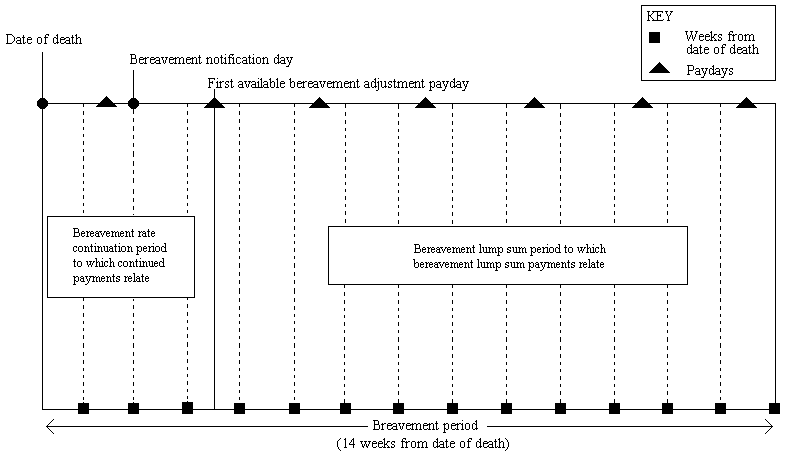
2.11 The significant points on the diagram are:
- •
- bereavement notification day - the day on which the DSS becomes aware of the death; and
- •
- first available bereavement adjustment payday (FABAP) - the first payday after the bereavement notification day for which it is practicable to terminate or adjust payments under the SSA91.
2.12 The first available bereavement adjustment payday effectively divides the bereavement period in two:
- •
- The bereavement rate continuation period (BRCP) to which the continued payments relate. This period ends before the FABAP unless the FABAP occurs on or after the last day of the bereavement period; where the latter occurs, BRCP coincides with the bereavement period.
- •
- The bereavement lump sum period in relation to which a bereavement lump sum may be payable. This period begins on the FABAP and ends on the last day of the bereavement period.
2.13 In regard to the DWS, the modes of payment that the tax treatment of bereavement payments should encompass are set out below.
- •
- Continued payment - Following the death of a recipient of DWS, the surviving partner is entitled to a payment on each of the paydays in the BRCP at the pre-death rate for the deceased (section 470 of SSA91). This payment is exempt from income tax.
- •
- Bereavement lump sum payment to DWS recipient whose partner dies (section 471 of SSA91) - This payment takes into account the continued payments (if any) to which the DWS recipient is entitled during the BRCP (i.e., before the FABAP). All or a proportion of such a bereavement lump sum may be exempt from tax. The exempt bereavement calculator A in section 24ABZB of the Act provides the steps to determine the 'tax-free amount'. Where the tax-free amount is less than the lump sum payment the difference is taxable. Where the tax-free amount exceeds the lump sum payment the excess may be set off against other social security payments received during the bereavement period and which are assessable.
- •
-
Bereavement lump sum paid to person other than the partner.
-
Where:
- •
- a person is qualified for payments in relation to his or her partner; and
- •
- that person dies within the bereavement period; and
- •
- DSS is not notified of the death of the partner until after the person dies; then
- •
- the whole of a lump sum worked out by using the lump sum calculator in section 473 of the SSA91 will be exempt from tax.
- •
- Bereavement payment on death of recipient of DWS - The recipient is not a member of a couple or the recipient's partner is not receiving a social security or service pension (section 475 of SSA91) at the time the recipient dies. This payment is exempt from tax.
- •
- Accrued leave at date of death of recipient of DWS - Where the recipient has accrued recreation or long service leave at date of death, SSA91 treats such amounts as bereavement payments payable under section 476. Under the DWS arrangements accrued holiday and long service leave related to DWS will be exempt from tax.
Application of an exclusion provision
2.14 Where the new single rate of pension received by the surviving partner who is of age pension age exceeds or is equal to the combined rate of pension if the person had not died there is no bereavement payment. In regard to the bereavement period, the excess of the new single rate of pension over the rate that would have been received by the surviving partner if the person had not died is exempt from income tax. The rest of the payment is assessable but would normally be subject to beneficiary rebate.
Explanation of the amendments
2.15 The amendments provide for the taxation treatment of the DWS and make technical amendments to certain provisions of the Act that deal with other payments under SSA91. [Item 7]
2.16 Item 13 inserts a reference to the DWS in the index of payments table in section 24AB of the Act. The index lists payments under the SSA91 covered by Subdivision B of Division 1AA of Part III of the Act.
2.17 Item 15 inserts in the table of supplementary amounts in subsection 24ABA(1) a reference to the DWS. Supplementary amounts, such as rent assistance, are included in the payment of pensions, allowances and benefits. New subsection 24ABJA(1) will provide that supplementary amounts related to DWS will be exempt from tax [item 17]. It is necessary to refer to the table in subsection 24ABA (1) to ascertain the supplementary amounts exempted by new subsection 24ABJ(1).
2.18 The DWS basic payment is the balance after deducting supplementary amounts from the total payment of DWS. Where the recipient is under age pension age, new subsection 24ABJA(1) will exempt the DWS from income tax. [Item 17]
2.19 Where the recipient is of age pension age, the basic payment will be taxable. However, under section 160AAA of the Act the pensioner rebate will automatically extend to recipients of age pension age.
2.20 Supplementary amounts, such as rent assistance, paid to recipients of the DWS, will be exempt from income tax under new subsection 24ABJA(1). [Item 17]
2.21 The Bill proposes to provide for the tax treatment of bereavement payments to recipients of the DWS along the lines of the existing tax treatment for the DSP.
2.22 During the BRCP (see diagram in paragraph 2.10), the surviving partner of a DWS recipient is entitled to a continued payment equal to that which the deceased recipient would have received on each payday before the FABAP (section 470 of SSA91). The amendments will make these payments exempt from income tax under new subsection 24ABJ A(3) of the Act. [Item 17]
2.23 Arthur, a DWS recipient, earns a fortnightly payment of $150 in his job. In addition he receives a DWS of $268 from DSS (under SSA91 he has an income test free area of $152 per fortnight). Beth, his wife, receives fortnightly partner allowance payments of $248 (her income test free area was lower). Arthur dies and. Beth notifies the Department of the death two weeks after the date of death. There is one payday in the BRCP and the second payday in the bereavement period will be the FABAP. Beth will be entitled to $268 continued payment in relation to the BRCP (all paid by DSS). This amount is exempt from income tax. Beth will continue to be entitled to payment of partner allowance at her pre-bereavement rate, which is not a bereavement payment. The partner allowance payments will continue to be assessable and subject to beneficiary rebate under section 160AAA of the Act.
Bereavement lump sum payment to DWS recipient whose partner dies
2.24 The amendments provide that the part of a bereavement lump sum payment under section 471 of SSA91 that does not exceed the 'tax-free amount' is to be exempt from income tax under new paragraph 24ABJA(4)(a) of the Act. The Exempt Bereavement Payment Calculator A (Calculator A) in section 24ABZB of the Act will determine the tax-free amount relating to any bereavement lump sum payment. [Item 17]
2.25 John is 45 years of age. He receives fortnightly DWS of $268. His partner, Martha, receives partner allowance payments of $248 per fortnight The income test free area for partner allowance is lower than for the DWS. Martha dies and there are six paydays in the bereavement lump sum period. Following Martha's death John becomes entitled to the higher single rate of DWS ($321 per fortnight).
2.26 For the bereavement lump sum period, Calculator A applies as follows:
- Step 1:
- There are six relevant pension paydays .
- Step 2:
- The amount of payments received by John on each relevant pensioner payday that would have been exempt is $268.
- Step 3:
- The amount derived in this step is $1,608 ($268 x 6).
- Step 4:
- The amount of payments received by Martha on each relevant pensioner payday is $248.
- Step 5:
- The amount derived in this step is $1,488 ($248 x 6).
- Step 6:
- The tax-free amount is $3,096 (step 3 + step 5).
2.27 The tax-free amount is exempt from income tax [item 17, new paragraph 24ABJA(4)(a)]. John would receive, as a lump sum, the amount determined in the lump sum calculator in section 471 of the SSA91 by deducting the after-death single rate from the combined pre-death partnered rate and multiplying the result by the number of pension paydays in the bereavement lump sum period: [($516 - $321) x 6 = $1,170]. The difference between the tax-free amount and the lump sum received amounts to $1,926 ($3,096 - $1,170). This amount is available to set off against any taxable social security income John receives during the bereavement lump sum period.
Bereavement lump sum paid to person other than the partner
2.28 Where a DWS recipient is qualified for bereavement payments in relation to the death of his or her partner and the DWS recipient dies within the bereavement period, a lump sum payment may be made to an appropriate person. This may occur where the DSS is not notified of the death of the partner until after the death of the DWS recipient. The lump sum is determined by use of a lump sum calculator in section 473 of SSA91. The whole of this amount is exempt from income tax. [Item 17, new subsection 24ABJA(3)]
2.29 Harry, a DWS recipient, and his partner, Ilsa, a recipient of partner allowance, are involved in a motor accident in which Ilsa is killed. Harry dies from injuries ten days later and, a week after his death, DSS is notified of both deaths. A lump sum determined by use of the lump sum calculator in section 473 of SSA91 is paid to a person the Secretary of DSS considers to be the appropriate person. This amount is exempt from income tax.
Bereavement payment on death of recipient
2.30 Where a DWS recipient dies and is not a member of a couple or the person's partner is not receiving a social security or service pension the DSS may make a bereavement payment to the person considered to be appropriate (section 475 of SSA91). This payment is exempt from income tax. [Item 17, new subsection 24ABJA(3)]
Accrued leave at date of death of DWS recipient
2.31 Section 476 of SSA91 treats accrued recreation and long service leave at date of death as bereavement payments. New subsection 24ABJA(3) makes such payments exempt from income tax. [Item 17]
Application of an exclusion provision
2.32 Item 8 removes an obsolete reference from subparagraph 24A (a)(v) of the Act and substitutes 'Subdivision A of Division 10 of Part 2.9' in the definition of 'bereavement Subdivision'. Subdivision A effectively provides for an 'exclusion provision' that results in the DWS recipient not being entitled to bereavement payments. It is the bereavement Subdivision relevant to DWS referred to in new paragraph 24ABJA(5)(b) . An exclusion provision applies where the new single pension received by the surviving partner who is of age pension age exceeds or is equal to the combined pension that would have been received if the death had not occurred. In these circumstances there is no bereavement payment. [Item 17]
2.33 Item 11 inserts in the definition of 'exclusion provision' a reference to paragraph 469(1)(e) of SSA91. This reference identifies the provision in SSA91 that determines the exclusion of a DWS recipient from the receipt of bereavement payments. Where this exclusion provision applies, new subsection 24ABJA(5) determines that the excess of the new payment over the surviving partner's pre-death payment, where the surviving partner is of age pension age, is exempt from income tax for the duration of the bereavement period.
2.34 Item 16 repeals existing sections 24ABD and 24ABDAA that deal with the tax treatment of DSP to persons under age pension age and above age pension age respectively. The item substitutes new section 24ABD in which the provisions of former sections 24ABD and 24ABDAA are consolidated. The consolidation omits the reference in old subsection 24ABDAA(4) to section 146P of SSA91 which has now been repealed.
2.35 The consolidation does not extend the exclusion provision to recipients of DSP under pension age [new subsection 24ABD(5)]. This is consistent with existing section 24ABD.
2.36 Because of the consolidation of old sections 24ABD and 24ABDAA as new section 24ABD it is necessary to remove the reference to section 24ABDAA in section 24AB, the index of payments under SSA91 covered under Subdivision B. Item 12 deletes the reference to section 24ABDAA in the table in section 24AB.
2.37 Items 18 and 19 repeal existing sections 24ABR and 24ABRA which deal with the tax treatment of special needs DSP to persons under age pension age and above age pension age respectively. The item substitutes new section 24ABR in which the provisions of existing sections 24ABR and 24ABRA are consolidated.
2.38 The new section 24ABR, like the two sections it replaces, does not contain any provisions for the tax treatment of bereavement payments. The tax treatment of bereavement payments for all special needs pensions is included in existing section 24ABV.
2.39 The consolidation of former sections 24ABR and 24ABRA provides that the exclusion provision only applies to recipients of special needs DSP of age pension age [new subsection 24ABR(3)] . This is consistent with existing section 24ABR.
2.40 Because of the consolidation of former sections 24ABR and 24ABRA as new section 24ABR, it is necessary to remove the reference to section 24ABRA in section 24AB, the index of payments under SSA91 covered under Subdivision B. Item 14 deletes the reference to section 24ABRA.
2.41 Items 9 and 10 remove obsolete references to sections in the SSA91 from the definition of 'exclusion provision' in section 24A.
2.42 Item 20 inserts a table of application dates:
- •
- the effective date of consolidation of former sections 24ABR and 24ABRA [items 14, 18 and 19] in relation to the special needs DSP is to be retrospective to 12 November 1991;
- •
- the effective date of consolidation of former sections 24ABDA and 24ABDAA [items 12 and 16] in relation to the DSP is to be retrospective to 12 November 1991;
- •
- the effective date of the provisions for DWS [items 13, 15 and 17] to apply is to be 1 July 1994;
- •
- the effective date of removal of obsolete references [items 9 and 10] in the definition of exclusion provision is to be 12 November 1991;
- •
- the effective date for extending the definition of 'bereavement Subdivision' to include the Subdivision relevant to DWS [item 8] is to be 1 July 1994; and
- •
- the effective date for extending the definition of 'exclusion provision' to include DWS [item 11] is to be 1 July 1994.
2.43 The retrospectivity of the application dates in paragraph 2.42 to 12 November 1991 will not disadvantage anyone. This is because the amendments made are beneficial to taxpayers and reflect the administrative arrangements of the DSS.
Chapter 3 - Cost price of natural increase of live stock
Overview
3.1 Part 3 of Schedule 1 of the Bill will make amendments to section 34 of the Income Tax Assessment Act 1936 (the Act) to ensure that natural increase of live stock for which no minimum value is prescribed is valued at its actual cost where taxpayers elect to value such stock at cost. [Item 21]
Summary of the amendments
3.2 The purpose of the amendments is two fold:
- •
- to eliminate an inappropriate deferral of tax that gives advantages to existing producers over new producers. The amendments ensure that, where taxpayers elect to value natural increase of live stock for which no minimum value is prescribed at cost, such stock is brought to account at the actual cost of production;
- •
- to clarify the valuation rules in respect of natural increase of live stock.
3.3 The effect of the amendments is to eliminate an inappropriate deferral of tax under the present law. The existing law gives an unintended tax advantage to those primary producers that opt for valuation at cost and may use a value which once was the cost of production. For classes of live stock for which no minimum value is prescribed, some existing producers are in a position to use historical costs that have become negligible compared to actual costs. This substantially defers tax, and gives these producers a corresponding advantage over commercial competitors who must use costs at or close to actual costs as the value of such stock.
3.4 The amendments will apply to natural increase occurring after 30 June 1994. [Item 24]
Background to the legislation
3.5 Where a taxpayer carries on a business, changes between the value of trading stock on hand at the beginning and at the end of a year of income are taken into account in determining the taxpayer's taxable income for that year (section 28). Where the value of trading stock on hand at the end of the year is greater, the excess is added to assessable income. Where the value of trading stock on hand at the end of the year is less, the reduction is an allowable deduction from assessable income. For tax purposes, taxpayers may value live stock at either cost price or market selling value (subsection 32(1)).
3.6 Where a primary producer has adopted cost price as the basis for valuing live stock, special arrangements exist for valuing natural increase of some classes of live stock. Minimum values are prescribed in the Income Tax Regulations for the natural increase of cattle, horses, pigs, sheep, deer and goats. If a minimum value is prescribed, the natural increase cannot be brought to account at a cost less than the prescribed minimum, unless the lesser cost is the actual cost (section 34).
3.7 If no minimum value is prescribed for a particular class of live stock, the natural increase may be brought to account at the value used previously or at actual cost of production (section 34).
3.8 The effect of the present law is that natural increase of classes of live stock for which no minimum value is prescribed can be valued at a one-off actual cost price and this cost price can be rolled over each year as the nominated cost price on an indefinite basis. After some years the value at which the natural increase is brought to account may be considerably less than the actual cost of producing the stock. This undervaluation gives rise to an inappropriate deferral of taxation revenue - the expenses associated with natural increase in stock are fully allowed as deductions (subsection 51(1)) but the costs are not reflected in the value of closing stock (subsection 28(2)).
3.9 The deferral of tax does not benefit all taxpayers with live stock of a particular class equally. One taxpayer may be a company using a cost of production that dates back to the 1920s. That cost may be less than a twentieth of actual cost now. That taxpayer's competitor may have commenced operations only a few years ago, and be using a cost hardly less than actual cost now. So the deferral of tax could operate to give one taxpayer a commercial advantage over another, as well as a tax benefit at the expense of the revenue generally.
Explanation of the amendments
3.10 The amendments ensure that natural increase of a class of live stock for which no minimum value is prescribed is brought to account at the actual cost of production for that year of income. This is in accordance with the Assistant Treasurer's Press Release (No.78) of 30 June 1994. The valuation method announced has been slightly modified so that natural increase for which no minimum value is prescribed is valued at the actual cost of production, rather than at the greater of the actual cost of production or the value used in a previous year of income. The modified method is a simpler basis of valuation than was announced and will produce values no higher, and in some cases lower, than the basis announced. The actual cost of production is calculated for income tax purposes on a full absorption cost basis. This method involves taking account of both fixed and variable costs, absorbing capital expenditure at an appropriate rate. This method of costing is the same basis of costing as must be used in other industries.
3.11 Amended subsection 34(1) operates so that it will only apply in valuing natural increase of a class of live stock for which a minimum cost price is prescribed [item 22, new subsection 34(1)] . The provision will operate as follows.
- •
- A taxpayer who has adopted cost price as the basis of valuation of live stock and who has previously brought to account natural increase of a particular class, will be required to continue to bring in natural increase at the same value or at the minimum prescribed value in respect of that class whichever is the greater (subparagraph 34(1)(a)(i)).
- •
- Alternatively, a taxpayer may obtain leave from the Commissioner to adopt some other value for valuing a class of natural increase providing the value is not less than the minimum prescribed value (subparagraph 34(1)(a)(ii) and (1)((b)(i)).
- •
- A taxpayer may also use actual cost to value the natural increase of a class of live stock provided the taxpayer elects to do so and the actual cost price per head of natural increase of that class is less than the prescribed minimum value (subparagraphs 34(1)(a)(iii) and (1)(b)(ii))
3.12 New subsection 34(2B) ensures that if no minimum value is prescribed in respect of a class of live stock, the cost price per head of natural increase of that class of live stock for tax purposes is the actual cost price per head of natural increase of that class [item 23, new subsection 34(2B)] . The cost price is the full absorption cost, as for other valuations of trading stock at cost by taxpayers in other industries. The full absorption cost includes appropriate costs associated with bringing the natural increase into existence.
3.13 Taxpayers affected by new subsection 34(2B) should consider whether a more desirable option would be to establish prescribed minimum values for those classes of live stock that currently have none. Establishing such values would reduce compliance costs as taxpayers would not be compelled to calculate actual costs of natural increase each year provided the cost they use is no less than the prescribed minimum.
3.14 In the past there have been cases where a one-off increase in the valuation of stock has been written-off over a number of years. No transitional measure exists for bringing natural increase of live stock for which no minimum value is prescribed to account at actual cost. Such measures have only been brought in, in situations where the changed rules for valuing stock have affected all taxpayers in the industry in the same way. However, the current live stock anomaly benefits long established producers to the disadvantage of new producers and therefore to phase out the anomaly would be to maintain an unfair advantage over competing producers.
Farmer Brown incurs certain expenditure in the 1994-95 income tax year in respect of her ostrich breeding business including:
| Artificial insemination costs | $1 000 |
| Feeding costs | 1 000 |
| Veterinary costs | 500 |
| Labour costs | 600 |
| Travel costs incurred transporting eggs from farm to incubator | 50 |
| Insurance of ostriches for damages | 200 |
| Ostrich registration fees | 600 |
| Total Cost | $3 950 |
Natural increase for the 1994-95 year is 20 ostriches. If natural increase is valued at cost the cost price per head of ostriches for this year will be calculated for tax purposes as being,
$3 950 / 20 ostriches = $197.50 per ostrich
The cost price per head at which Farmer Jones last took his natural increase of deer into account for tax purposes was at $18 per head from a previous year of income. For the 1994-95 income year the actual cost price per head of natural increase under absorption costing for deer is $16. The minimum value of deer prescribed in the regulations is $20.
Farmer Jones makes an election under subparagraph 34(1)(a)(iii) of the Income Tax Assessment Act 1936 and can therefore value the natural increase of his deer for tax purposes at $16 per head.
If Farmer Jones does not make any election under section 34 then his natural increase of deer will be valued at $20 per head. This value is the minimum cost price prescribed in the regulations for natural increase of deer. Subparagraphs 34(1)(a)(i) and 34(1)(a)(ii) ensure, in effect that a value less than the prescribed minimum value may be used only if it is the actual cost.
Chapter 4 - Panel vans and utility trucks
Overview
4.1 Part 5 of Schedule 1 of the Bill amends the Income Tax Assessment Act 1936 (the Act) to ensure that panel vans and utility trucks that carry one tonne or more are treated in the same manner across in the tax law for depreciation, capital gains and related 'rollover' provisions irrespective of whether or not they are derived from passenger motor vehicles.
Summary of the amendments
4.2 The amendments propose to remove a tax disadvantage to locally produced 'one tonners' by ending inconsistent treatment of 'one tonners' in the tax law. These vehicles will no longer be treated differently depending on whether they are derived from passenger vehicles. This measure will allow these vehicles to qualify for accelerated depreciation rates rather than general rates. It also amends related capital gains and miscellaneous 'rollover' provisions to maintain consistency of the language. [Items 36-42]
4.3 The amendments will apply to assessments from the 1993-94 year of income. [Item 43]
Background of the legislation
4.4 This measure follows an amendment of the general investment and development allowance provisions by the Taxation Laws Amendment Act (No. 2) 1993, which allowed panel vans and utility trucks to qualify for these allowances if designed to carry one tonne or more, irrespective of whether or not the vans or trucks are derivatives of motor cars. The relevant provision was subparagraph 82AF(2)(a)(i). It was amended by adding the phrase "other than panel vans or utility trucks designed to carry loads of one tonne or more". So the subparagraph now mentions some vehicles, 'one tonners', which are not covered by the subparagraph.
4.5 In some respects, panel vans and utility trucks designed to carry at least one tonne still are treated differently depending on whether they were derived from passenger motor vehicles or not. For example, the depreciation provisions apply less favourably to vehicles, such as the Ford Longreach, derived from passenger motor cars. In order to achieve a consistent treatment of 'one tonners', they will now be treated by the tax law provisions in the same manner.
4.6 At the same time the definition of 'asset' for capital gains purposes in section 160A was amended to reflect the changes to subparagraph 82AF(2)(a)(i). However, subsection 160MA(3) has not been changed. It still refers to the definition of asset in section 160A not including vehicles 'mentioned in' paragraph 82AF(2)(a), but not 'covered by' it as should be the case. Panel vans and utility trucks designed to carry one tonne or more, which are treated as assets for the purpose of section 160A, need not be specifically treated as if they were such assets for the purposes of subsection 160MA(3).
4.7 In several areas of the Act, 'rollover relief' is allowed to taxpayers when it is provided for under Part IIIA ('CGT rollover relief'). An example is section 58. For the purpose of the operation of this 'rollover relief' in relation to non CGT provisions, 'CGT rollover relief' is notionally extended to motor vehicles 'mentioned in' paragraph 82AF(2)(a). The practical effect of these provisions is to ignore the exclusion of certain motor vehicles from the definition of 'asset' in section 160A. 'One tonners' are not excluded from the definition of 'asset' in section 160A, and so need not to be specifically included. As a consequence of the earlier amendments to subparagraph 82AF(2)(a) and section 160A, the reference to 'mentioned in' in the 'rollover' provisions no longer mirrors the language used now in section 160A. Section 160A now refers only to vehicles 'covered by' subparagraph 82AF(2)(a). The amendment is necessary to maintain consistency of the language between these 'rollover' provisions and section 160A.
Explanation of the amendments
4.8 The Bill amends the definition of 'eligible motor vehicle' in subsection 55(9) to exclude from its scope panel vans and utility trucks that carry one tonne or more, even if they are derived from passenger motor vehicles. It amends paragraph 55(9)(a) of the definition by adding at its end a phrase "other than a panel van or utility truck designed to carry loads of one tonne or more". As a result, this class of vehicles ('one tonners') will qualify for accelerated depreciation rates under subsection 55(5) rather than general rates under subsection 55(6). The definition of an 'eligible motor vehicle' in paragraph 55(9)(a) will, therefore, mirror the language of paragraph 82AF(2)(a). [Item 36]
Capital gains and related 'rollover' provisions
4.9 The Bill changes the words 'mentioned in' to 'covered by' in the miscellaneous 'rollover' provisions, where CGT 'rollover' relief applies to motor vehicles. These provisions are as follow:
- •
- subsection 58(8);
- •
- subsection 73E(12);
- •
- subsection 122JAA(23);
- •
- subsection 122JG(13); and
- •
- subsection 124AMAA(19).
4.10 The Bill also changes the words 'mentioned in' to 'covered by' in subsection 160MA(3).
4.11 Section 160A no longer excludes vehicles 'covered by' paragraph 82AF(2)(a), and the ones which will now be 'covered by' subsection 55(9). 'One tonners' continue to be mentioned in paragraph 82AF(2)(a), and will continue to be mentioned in subsection 55(9); they are mentioned so as to be excluded from being covered by these provisions. Thus panel vans and utility trucks designed to carry one tonne or more are already assets for the purpose of the capital gains provisions.
4.12 In order to maintain consistency of language between the above provisions and section 160A, and to enhance the conceptual clarity of these provisions, they are amended to reflect the changed language in section 160A. The provisions need expressly include only those vehicles which would not otherwise be assets for the purpose of capital gains tax 'rollover' relief. These amendments will ensure that they do this, consistently with the law. [Items 37-42]
Chapter 5 - Deductions for gifts
Overview
5.1 This Chapter explains the amendments to the income tax gift provisions contained in Part 6 of Schedule 1 . The gift provisions list those funds, authorities and institutions which qualify for tax deductible gift status both by reference to the appropriate table headings and specifically in the tables.
Summary of the amendments
5.2 The amendments propose to allow income tax deductions for gifts of $2 or more made to certain organisations or funds. [Item 44]
5.3 The amendments will apply as shown in the summary below:
| Organisation/Fund | Deduction available from (inclusive) | Deduction available until (inclusive) |
|---|---|---|
| Ararat War Memorial Restoration Trust Fund | 4 April 1994 | 3 April 1996 |
| Mount Macedon Memorial Cross Restoration, Development and Maintenance Trust | 24 April 1994 | 24 April 1996 |
| The Brisbane RAAF Memorial Fund | 17 June 1994 | 16 June 1996 |
| Constitutional Centenary Foundation Incorporated | 28 June 1994 | no limit set |
| Australian and New Zealand College of Anaesthetists | 27 October 1994 | no limit set |
Background to the legislation
5.4 Broadly, section 78 of the Income Tax Assessment Act 1936 provides deductions for gifts of $2 or more to various funds and organisations. A deduction is allowable in the year of income in which the gift is made.
5.5 A fund or organisation can be granted tax deductible gift status in two ways. Firstly, a fund or organisation may qualify under one of the general categories listed in section 78 such as a public benevolent institution or a public hospital. Secondly, a fund or organisation may be specifically listed in section 78 or in a register kept for the purposes of that section as having tax deductible gift status.
5.6 In some circumstances, deductibility for a gift to a fund or organisation may only be available if made during a period specified in the law.
Explanation of the amendments
5.7 Gifts of $2 or more made to the Ararat War Memorial Restoration Trust Fund will be eligible for tax deductions under item 5.2.4 of table 5 in subsection 78(4). However, under the same item, the tax deductibility of gifts made to the Fund under item 5.2.4 will be limited to those gifts that are made after 3 April 1994 and before 4 April 1996. [Item 52]
5.8 Gifts of $2 or more made to the Mount Macedon Memorial Cross Restoration, Development and Maintenance Trust will be eligible for tax deductions under item 5.2.6 of table 5 in subsection 78(4). However, under the same item, the tax deductibility of gifts made to the Trust under item 5.2.6 will be limited to those gifts that are made after 23 April 1994 and before 25 April 1996. [Item 52]
5.9 Gifts of $2 or more made to The Brisbane RAAF Memorial Fund will be eligible for tax deductions under item 5.2.5 of table 5 in subsection 78(4). However, under the same item, the tax deductibility of gifts made to the Fund under item 5.2.5 will be limited to those gifts that are made after 16 June 1994 and before 17 June 1996. [Item 52]
5.10 Gifts of $2 or more made to the Constitutional Centenary Foundation Incorporated will be eligible for tax deductions under item 2.2.15 of table 2 in subsection 78(4). However, under the same item, the tax deductibility of gifts made to the Foundation under item 2.2.15 will be limited to those gifts that are made after 27 June 1994. [Item 51]
5.11 Gifts of $2 or more made to the Australian and New Zealand College of Anaesthetists will be eligible for tax deductions under item 1.2.13 of table 1 in subsection 78(4). However, under the same item, the tax deductibility of gifts made to the College under item 1.2.13 will be limited to those gifts that are made after 26 October 1994. [Item 50]
Chapter 8 - Eligible investment income of registered organisations
Overview
6.1 Part 7 of Schedule 1 of the Bill will amend Division 8A of the Income Tax Assessment Act 1936 (the Act) to include income derived from certain assets in the assessable income of a friendly society or other registered organisations.
6.2 The purpose of the amendment is to ensure that the provisions of Division 8A of the Act are not circumvented by the holding of assets separate from the eligible insurance business of the organisation (for instance by the establishment of a separate fund) as a result of the High Court decision in Independent Order of Odd Fellows of Victoria v FC of T (91 ATC 5032) ( 22 ATR 783) (the IOOF case).
6.3 The amendments apply to income derived from eligible investment assets derived or purchased on or after 1 July 1994 by a registered organisation.
Background to the legislation
6.4 'Registered organisation' is defined in subsection 116E(1) to mean a trade union, a friendly society or an employees' association, which is exempt from tax under either paragraph 23(f) (as a trade union or employees' association) or subparagraph 23(g)(i) (as a friendly society).
6.5 Section 116F states that Division 8A overrides all other provisions of the Act in determining the assessable income of a registered organisation. Accordingly, section 116G sets out classes of assessable income of registered organisations; assessable income of registered organisations is limited to income falling within these classes. The classes of assessable income are non-complying superannuation, complying superannuation/roll-over annuity and eligible insurance business.
6.6 The amount of assessable income of a registered organisation to be included in each class is determined by section 116GD. The amount of assessable income in the eligible insurance business (EIB) class comprises assessable income allocated under certain sections relating to the disposal of relevant assets and any other EIB assessable income (subsection 116GD(2)).
6.7 The terms 'EIB', 'EIB assessable income' and 'EIB asset' are defined in subsection 116E(1). 'EIB' means the business of, or relating to, the issuing of, or the undertaking of liability under, eligible insurance policies. 'EIB assessable income' means so much of the total income (other than premiums) of the organisation as is derived from EIB of the organisation. 'EIB asset' means an asset that relates to the EIB.
6.8 In the IOOF case, the High Court examined the definition of 'EIB' in subsection 116E(1). In that case, the taxpayer, a friendly society, had transferred monies from the 'benefit fund' into which premiums were paid, into a 'tax provision repository fund' to cover any tax liability arising from its EIB. The High Court held that investment income derived from the fund which was specifically established to meet income tax obligations was not income derived from EIB and, therefore, was exempt. This was because the investment of monies in the 'tax provision repository fund' was not relevantly related to the issuing of or the undertaking of liability under eligible insurance policies.
6.9 The Court said that although the EIB of the friendly society included all the activities relating to the issuing of and undertaking of liabilities under eligible insurance policies, including making provisions for tax liabilities and making investments in the course of carrying on EIB, it did not include the investment of moneys held in a separate fund and which could be applied for purposes other than EIB. It followed that the investment income derived from the 'tax provision repository fund' was not income from EIB.
6.10 As a result of the IOOF case, Division 8A could be circumvented by holding assets separate from the EIB of the organisation, for instance by establishing a separate investment fund the income from which, on the basis of that case, may not be derived from the business of or in relation to the issuing of or undertaking of liability under eligible insurance policies.
6.11 To overcome that result, the definition of EIB assessable income is to be broadened to include all income derived from certain specified assets.
6.12 Legislation for this purpose was originally included in Taxation Laws Amendment Bill (No 3) 1994. However, to allow for consultation with industry, the amendments were withdrawn from the Bill. The amendments now proposed have been prepared in consultation with industry.
Explanation of the amendments
6.13 These amendments are necessary to ensure that all income derived by a registered organisation relating to EIB, such as income derived by a friendly society from the investment of premiums held separately from its benefit fund, is subject to income tax.
6.14 The definition of 'EIB assessable income' includes the following amounts in the assessable income of registered organisations:
- (a)
- if the registered organisation is a friendly society - income derived from eligible investment assets not included in a benefit fund of the society and income derived from EIB; and
- (b)
- if the registered organisation is not a friendly society - income derived from eligible investment assets regardless of where they are held and income derived from EIB.
[Item 54 - new definition of EIB assessable income]
6.15 'Eligible investment asset' means:
- (a)
- premiums and other amounts derived in carrying on EIB (regardless of whether such premiums or amounts are transferred from one fund into another); for example, the earnings or surplus of a friendly society's benefit fund, whether held in that fund or not;
- (b)
- income or profits derived from eligible investment assets, for example, interest derived on premiums or on the surplus of a friendly society's benefit fund, whether held in such a fund or not; and
- (c)
- assets purchased with amounts included in (a), (b) above or in (c). For example, equities or real estate purchased with premiums or with interest derived on premiums whether held in a benefit fund or transferred from the benefit fund into another fund.
[Item 55 - definition of eligible investment asset]
6.16 The definition of eligible investment asset applies to assets whether held in the original fund into which they were paid or credited, or whether transferred out of that fund, including if they were transferred into another fund or into a series of funds. Therefore, transferring assets (such as premiums or assets acquired with those premiums, or income derived thereon) between funds does not exclude them from the definition of eligible investment assets.
6.17 However, the definition of EIB assessable income excludes income derived from eligible investment assets which are held in or transferred to a benefit fund of a friendly society. Transfers of assets between benefit funds are made on an arm's length basis or at market value because of the fiduciary duty that friendly societies have towards their members, both of the transferor and the transferee funds. Therefore, there would be no reduction in the overall assets of the insurance business which generate assessable income.
6.18 A benefit fund (or member fund) is a common term used by the friendly society industry and is also defined in most State legislation governing friendly societies. Essentially, a benefit fund is established for each class of benefit that a friendly society confers and contains all the premiums of that class or the assets that it represents, plus the income generated from those assets.
6.19 The effect of the amendment is that income derived from eligible investment assets not included in a benefit fund of the society is included in EIB assessable income regardless of how such income is used (eg whether the income is capitalised or reinvested, used to pay expenses relating to insurance business, used to pay bonuses to policyholders or members, etc). Thus investment income derived from a fund specifically established to meet tax obligations in circumstances similar to those examined by the High Court in the IOOF case will come within the new definition of 'EIB assessable income'.
6.20 That effect is achieved by the amendment regardless of the number of funds which may be interposed between the fund in which the premiums or other amounts derived in carrying on the EIB are initially placed and the fund in which the EIB assessable income is derived.
6.21 As a consequence of these amendments, the definition of 'EIB asset' has been changed. EIB assets are:
- (a)
- if the registered organisation is a friendly society - eligible investment assets not included in a benefit fund of the society and assets that relate to its eligible insurance business; and
- (b)
- if the registered organisation is not a friendly society - assets that relate to its eligible insurance business and eligible investment assets.
[Item 54, new definition of EIB asset]
6.22 Subsection 116GA(4) is also amended. The provision currently refers to the business of the classes of income. The reference to 'the business of' is being deleted because of the inclusion of eligible investment assets in the definitions. [Item 56]
Chapter 7 - Privatised State Bank of New South Wales
Overview
7.1 The amendments in Part 7 of Schedule 1 of the Bill will deal with some transitional tax issues arising out of the sale of the State Bank of New South Wales (NSW State Bank) to private interests. This chapter explains how those amendments will apply following the NSW State Bank's change from exempt to taxable status.
Summary of the amendments
7.2 The amendments will:
- •
- ensure appropriate gains and losses accrued in assets and liabilities of the NSW State Bank at the time of its sale are not taken into account in determining its post sale taxable income;
- •
- deny deductions for superannuation contributions in respect of liabilities accrued during the time when the bank was exempt from tax; and
- •
- disallow deductions for bad debts written off after the bank's sale where the debt was known to be doubtful before the sale.
7.3 The amendments will have effect from the time when the NSW State Bank is sold and becomes a taxable entity. As a technical matter, the amendments will commence on the same day as the State Bank (Privatisation) Act 1994 of New South Wales commences [item 58] . That Act formally allows for the sale of the bank.
Background to the legislation
7.4 Because it is presently owned by the State of NSW, the NSW State Bank is exempt from tax as a "public authority" within the meaning in paragraph 23(d) of the Income Tax Assessment Act 1936 (the Act). The sale of the bank to private interests means that it will no longer qualify for that exemption. Because of the bank's move from exempt to taxable status a number of transitional tax issues need to be resolved. The amendments proposed in Part 7 of Schedule 1 will modify the operation of the Act to deal with some significant transitional issues. This will make clear how the law is to apply in respect of these issues.
Explanation of the amendments
Deemed disposal and re-acquisition of assets
7.5 First, the amendments will generally treat the assets of NSW State Bank as having been disposed of immediately before the bank becomes taxable and re-acquired when it becomes taxable [new subsection 121EN(1)] . This will ensure that gains and losses accrued in assets during the time when the bank was exempt will not be taken into account in determining the tax consequences of subsequent disposals of these assets.
7.6 For instance, an asset which was purchased by the bank for, say, $100 but has a market value of $120 at the time when the bank is sold, will be taken for income tax purposes to have been acquired by the bank for $120. If the asset is sold for $125, the maximum amount that could be assessable in respect of the sale is $5.
7.7 The deemed acquisition of assets may also affect the amount of income derived from an asset, e.g., from a discounted security held by the bank. If such a security cost $100 before the sale of the bank and on maturity after the sale will return $150, the amount assessable would ordinarily be $50. However, because the security will be taken to have been sold and re-acquired at its market value on the day when the sale of the bank takes place, say, $130, the amount assessable will be $20.
7.8 There are some exceptions to the general rule established in new subsection 121EN. The general revaluation of assets provided for in that subsection will not apply for the purposes of sections 54 to 62AAV and Divisions 10 to 10D of Part III of the Act [subsection 121EN(2)] . This will simply make it clear that depreciation and other capital allowance deductions will be based on the original cost of the particular items of plant or other property.
Deemed cessation and re-assumption of liabilities
7.9 Secondly, the amendments will treat the liabilities of the NSW State Bank as having been satisfied immediately before the sale of the bank and then assumed again when it is sold [new section 121EO] . The bank will be taken to have received consideration in return for taking on these liabilities equal to the market value of the corresponding asset or right held by the person to whom the liability is owed. This is because it is not strictly possible to talk about a liability as having a market value of its own. In broad terms, liabilities will be valued at the amount the bank would have had to pay to meet those liabilities immediately before the bank's sale.
7.10 The deemed re-assumption of liabilities could have an effect, for instance, where the bank subsequently satisfies a liability that it had before the bank was sold. Assume that the bank originally received $900 from the issue of a discounted security and is required to pay $1000 to the holder on maturity. If half of the discount period had elapsed at the time of the bank's sale then, in broad terms, half of the discount expense would have accrued during that period. In that case, the bank could expect to obtain a deduction after the bank's sale of $50, in respect of the remaining discount expense. However, if the market value of the security at the time of the sale was, say, $940, the effect of new section 121EO would be to allow a deduction of $60, being the difference between the consideration deemed to have been received at the sale date and the amount required to be paid on maturity ( i.e., $1000-$940 ).
Effect of unfunded pre-first taxing time superannuation liabilities
7.11 The Bill ensures that superannuation contributions made after the NSW State Bank becomes taxable are not tax deductible to the extent that they are in respect of liabilities that had accrued during the period when the bank was exempt from tax [new section 121EP] . This is achieved in two steps. First, no deduction at all will be allowable to the bank under section 82AAC of the Act unless it obtains a certificate from an actuary, stating the actuarial value of any unfunded superannuation liabilities at the time of the bank's sale [new subsections 121EP(2) and (3)] . The certificate must be obtained before the bank lodges its tax return for the year in which the sale takes place or within such further time as the Commissioner allows [new subsection 121EP(4)].
7.12 Secondly, if there is an amount of unfunded liabilities, deductions for superannuation contributions will be denied until, in total, they exceed the amount of the unfunded liabilities [new subsections 121EP(5) and (6)]. This is achieved by providing for a threshold amount of superannuation contributions that must be made in a year before a deduction will be available. The threshold is called the 'unfunded liability limit' [new subsection 121EP(7)] . In its first year of operation the limit will be the certified amount of unfunded liabilities. If the limit is not exceeded in the first year, it will be reduced in the second year by the amount of superannuation deductions denied under section 121EP in the first year. The limit will be progressively reduced in this way until it is extinguished.
7.13 Because it is possible to make more than one contribution in a year and each separate contribution is potentially deductible, where the sum of all superannuation contributions in a year exceeds the deduction limit subsection 121EP(6) allocates a part of the deduction limit to each superannuation contribution made in the year. This has been done purely as a technical matter and simply has the effect of allowing a deduction for the amount of contributions, in total, that exceed the deduction limit.
Effect of pre-first taxing time provision for doubtful debts
7.14 After the NSW State Bank becomes taxable it will be entitled to tax deductions in respect of bad debts. The Bill will deny deductions for bad debts written off by the bank to the extent the debts were known to be doubtful before the bank's sale [new section 121EQ] . In effect, deductions will be denied for the amount of doubtful debts identified in specific provisions for doubtful debts in the final accounts being prepared under the contract for the sale of the bank. This special rule will not apply to the general provision for doubtful debts shown in those accounts. The general provision covers non-specific, unidentified risks inherent in the bank's total portfolio. Among other things, it enables the bank to satisfy Reserve Bank prudential guidelines. Because the general provision bears no relationship to any particular debt, it would not be appropriate to take it into account in denying deductions in respect of any debts written off after the bank's sale.
7.15 The Bill deals with two types of debts covered by specific provisions for doubtful debts. The first type are those debts where a specific provision is made against an individual debt. Where such a debt is written off after the bank's sale, whether in whole or part, a deduction will not be available until the amount or amounts written off exceeds the amount of the specific provision for doubtful debts in the accounts immediately before the bank is sold. [New subsections 121EQ(1), (2) and (3)]
7.16 The second type are those debts of a particular class which are covered by a specific provision for doubtful debts against the class of debts. An example is where a specific provision is made against all credit card debts. In such a case the Bill will allocate the amount of the specific provision among all of the debts of that class in existence at the time when the bank is sold, in proportion to the amount of each debt [new subsection 121EQ(4)] . This will allow the rules established in subsections 121EQ(1) to (3) to apply when such a debt is subsequently written off.
Chapter 8 - Capital gains tax
Overview
8.1 The amendments made in Part 9 of Schedule 1 of the Bill will subject certain transactions which effectively assign non-corporeal interests to appropriate capital gains tax (CGT) treatment.
Summary of the amendments
8.2 To ensure that certain transactions involving the creation of assets which effectively assign non-corporeal interests are subject to appropriate CGT treatment. [Item 59]
8.3 This amendment will apply to assets created after 12.00 midday Eastern Summer Time on 12 January 1994. [Item 71]
Background to the legislation
8.4 Currently subsection 160M(6) of the Income Tax Assessment Act 1936 (the Act) ensures that if a person creates an incorporeal asset which, on its creation, is vested in another person, there is a disposal of the asset to that other person for CGT purposes.
8.5 If the created asset is held by the creator as trustee of a discretionary trust, subsection 160M(6) would not apply. This is the case even though subsection 160M(6) could apply if the created asset was vested in another person to hold as trustee.
8.6 The identity of the trustee of a trust is generally not important as far as the beneficiaries are concerned. This is because it is the position of trustee rather than the identity of the trustee which is important. The functions of a trustee, and the trustee's relation to the trust property and the beneficiaries of the trust is the same, irrespective of the personal identity of the trustee. Therefore the application of CGT should be indifferent to whether the relevant interest is vested in the creator of an asset as trustee or in another person as trustee.
8.7 The proposed amendments will ensure that in circumstances where subsection 160M(6) would apply but for the fact that the asset is held by the creator as trustee, there will be a deemed disposal and reacquisition of the asset by the creator. An example of where this deemed disposal and reacquisition rule would apply is in the case of an assignment of a prospective interest in a partnership, also known as a pre-admission Everett assignment.
Pre-admission Everett assignments
8.8 A partner has a vested beneficial interest in partnership assets and in the future income of the partnership. The assignment of a partnership interest to another person (the assignee) has the effect that the partner holds his or her partnership interest on trust for the assignee. This means that the assignee holds the beneficial interest in the partnership interest while the partner holds the legal title to the interest in the partnership. This was established by the High Court in FC of T v Everett (1980) 143 CLR 440 at 448; 80 ATC 4076 at 4080; 10 ATR 608 at 612.
8.9 A person may enter into an agreement before becoming a partner. Under such an agreement, the prospective partner agrees, for nominal consideration, that upon becoming a partner he or she will hold a share of the partnership interest on trust for another person, or will assign that share to the person. These arrangements are known as pre-admission Everett assignments.
8.10 A pre-admission Everett assignment is a purported assignment of a mere expectancy. The effect of such an assignment is determined by the principles set out in Norman v FC of T (1963) 109 CLR 9; 13 ATD 13 and Booth v FC of T (1987) 164 CLR 159; 87 ATC 5100; 19 ATR 514. Those principles establish that when a person agrees, for value, to assign property to be acquired in the future, the assignor becomes trustee of the property for the assignee as soon as that property comes into existence. In the context of a pre-admission Everett assignment, the property to be acquired in the future is the assigned share of the partnership interest. Since the assignment is for value, the share is held on trust by the partner for the assignee as soon as that share comes into existence (when the prospective partner joins the partnership).
What were the CGT consequences of pre-admission Everett assignments before these amendments?
8.11 The share of the beneficial interest in the partnership which is effectively assigned in a pre-admission Everett assignment is the relevant incorporeal asset for the purposes of subsection 160M(6). It is created by the partner when he or she becomes a partner. If the assignment is made to a particular person, then the beneficial interest vests in that person. Therefore subsection 160M(6) would apply to deem a disposal of the beneficial interest by the partner. If the parties are not dealing with one another at arm's length, subsection 160ZD(2) deems the consideration given for the disposal to be the market value of the asset.
8.12 However, the partner may hold the share as trustee for a discretionary trust. In such a case the partner holds the interest on trust for the beneficiaries, but the beneficial interest does not vest in the beneficiaries themselves. It is arguable that the beneficial interest in this situation is not vested in another person as required by subsection 160M(6) so that the subsection would not apply.
What are the CGT consequences of pre-admission Everett assignments under the proposed amendments?
8.13 Pre-admission Everett assignments will be liable to CGT regardless of whether the interest created is held by the partner as trustee of a discretionary trust or by a third person as trustee.
8.14 If the share in the partnership subject to the assignment is held by the partner as trustee of a discretionary trust, the partner is deemed to have disposed of the asset and then reacquired it. The partner is deemed to have received consideration equal to the market value of the asset for that disposal.
8.15 The current application of subsection 160M(6) to pre-admission Everett assignments where the assignment is to a particular person is unchanged.
Explanation of the amendments
Pre-requisites for deemed disposal and reacquisition rule to apply
8.16 The deemed disposal and reacquisition of a created asset will be triggered where the following four elements contained in new subsection 160M(6BA) are satisfied.
(a) A person creates an asset that is not a form of corporeal property
8.17 A person must create an asset that is not a form of corporeal property. In this context, a person includes a company. 'Corporeal property' is undefined and takes its ordinary meaning. [Item 60 - new paragraph 160M(6BA)(a)]
8.18 As with current subsection 160M(6), the deemed disposal and reacquisition rule may apply whether or not there is an existing asset from which the asset is created, and whether or not there is an actual disposal of an asset at the time of the creation [Item 60 - amended subsection 160M(6C)]
(b) The asset is held by the creator as trustee
8.19 At the time of its creation, the asset must be held by the creator in the creator's capacity as trustee of a trust estate. This may be an express, implied or other type of trust. For instance, in the context of a pre-admission Everett assignment, it would include a trust which automatically comes into existence because of the operation of the principles referred to in Norman's case (cited above). [Item 60 - new paragraph 160M(6BA)(b)]
(c) The beneficial interest is not held by beneficiaries
8.20 At the time of the asset's creation, the beneficial interest in the asset should not be held by a beneficiary or beneficiaries of the trust. This would be the case in a discretionary trust, where the beneficiaries have no beneficial interest in the trust property. [Item 60 - new paragraph 160M(6BA)(c)]
8.21 The beneficial interest in an asset is itself an asset for the purposes of Part IIIA. Therefore, if it is held by a beneficiary or beneficiaries, current subsection 160M(6) applies to the beneficial interest in the created asset. The proviso in new paragraph 160M(6BA)(c) ensures that there will be no deemed disposal and reacquisition of the created asset under new subsection 160M(6BB) if subsection 160M(6) applies to the beneficial interest in that asset.
8.22 For example, if a prospective partner enters into a pre-admission Everett assignment by which a 50% share of his or her interest in the partnership is to be held on trust for the trustee of a family trust, subsection 160M(6) would apply. This is because the beneficial interest in the share is vested in the trustee of the family trust (it does not matter that it is vested in the trustee for the benefit of other beneficiaries). The effect of new paragraph 160M(6BA)(c) is that the deemed disposal and reacquisition rule would not apply, since a beneficial interest in the assigned share is held by the trustee of the family trust. If, on the other hand, the prospective partner agrees to enter into the partnership and hold the share as trustee of a discretionary trust, no beneficial interest in the asset is held by the beneficiaries of the trust and therefore the deemed disposal and reacquisition rule will apply.
8.23 However, new paragraph 160M(6BA)(c) will not have the effect of allowing a taxpayer to overcome the application of proposed new subsection 160M(6BA) by simply declaring him or herself to be the trustee of an interest in a partnership under both a fixed trust and a discretionary trust. For example, a prospective partner may declare that she will hold 50% of her interest in a partnership on trust; 10% under a fixed trust as described at paragraph 8.22 above, and 40% as the trustee of a discretionary trust.
8.24 In this example, the 10% held on the fixed trust would be taken to be an asset disposed of under existing subsection 160M(6). The remaining 40% interest would also be taken to be a separate asset subject to a deemed disposal and re-acquisition pursuant to new subsection 160M(6BB) . That is, each interest in the partnership will be a newly created asset, separate from other interests in the partnership, and will be subject to CGT only once.
(d) Consideration received in respect of the creation of the asset
8.25 The deemed disposal and reacquisition will only apply if consideration (ie. an amount of money or property) is received in respect of the creation of the asset. In this regard, an amount received for entering into a contract to create an asset is an amount received for creation of that asset. This is consistent with current subsection 160M(6) since the creator of an asset will only have a capital gain under that subsection if he or she actually receives as consideration an amount of money or property for creating the asset. [Item 60 - new paragraph 160M(6BA)(d)]
Application of the deemed disposal and reacquisition rule
8.26 The deemed disposal and reacquisition rule which is triggered if the above prerequisites are met is contained in new subsection 160M(6BB) .
8.27 Under this rule, the person creating the asset is taken to have acquired and commenced to own the asset at the time immediately before the making of the contract or, if the asset was not created under a contract, at the time of its creation. [Item 60 - new paragraph 160M(6BB)(a); items 64 and 68 - amended subparagraph 160U(6)(a)(ii) and new subparagraph 160U(6)(b)(iv)]
8.28 The person is then deemed to have disposed of the asset and immediately to have reacquired the asset. The disposal is taken to have occurred at the time of the making of the contract or, if the asset was not created under a contract, immediately after the time of its creation. [Item 60 - new paragraph 160M(6BB)(c); items 67 and 68 - amended subparagraph 160U(6)(a)(iii) and new subparagraph 160U(6)(b)(v)]
8.29 In relation to that disposal, the cost base, reduced cost base or indexed cost base of the asset is restricted to expenditure incidental to the disposal. The amendment effects this by providing that, in respect of the creation of the asset, the person is taken not to have paid or given any consideration or incurred any costs or expenditure referred to in certain paragraphs of section 160ZH. However, this applies only in respect of the creation of the asset (which gives rise to the acquisition referred to in new paragraph 160M(6BB)(a) ) and not to any subsequent disposal of the asset after its creation (ie. after the deemed disposal and reacquisition of the asset). [Item 60 - new paragraph 160M(6BB)(b)]
8.30 Subsection 160ZH(7A) (as amended) provides what costs are incidental to the disposal of the asset. [Item 70 - amended subsection 160ZH(7A)]
8.31 The person is deemed to have received consideration equal to the market value of the asset for the disposal. This amount is also taken to have been paid for the deemed reacquisition of the asset. Therefore it will be included in the cost base, indexed cost base or reduced cost base for the purposes of a later disposal of the asset. [Item 60 - new paragraph 160M(6BB)(d)]
8.32 The market value of the asset is to be determined at the time of its disposal. The time of disposal for assets created under a contract is the time the contract was made. Since the asset does not exist at that time, the relevant market value is the amount that would have been the market value of that asset if it had existed then. For example, in a pre-admission Everett assignment, the market value of the assigned share at the time of contract is the market value that an identical share in the partnership would have had if it had existed at that time. In this regard, the calculation of market value of a created asset is no different from subsection 160M(6).
Application of amendments to non-residents
8.33 Paragraph 160T(1)(l) of the Act provides that, where the specified conditions are satisfied, there will be a disposal of a taxable Australian asset if, because of the application of subsection 160M(6), there is a disposal of an asset under paragraph 160M(6A)(b). Paragraph 160T(1)(l) is to be amended so that it also applies to a disposal under new subsection 160M(6BB) because of the application of new subsection 160M(6BA) . Therefore a non-resident will be liable to CGT under new subsection 160M(6BA) if consideration received for creating the asset is derived from a source in Australia. [Item 62 - amended paragraph 160T(1)(l)]
Chapter 9 - Payment of instalments by companies
Overview
9.1 Legislation governing the payment of company tax instalments, which was inserted in the law by the Taxation Laws Amendment Act (No. 2) 1993, provides for quarterly payments of company tax commencing from the 1994-95 year of income for small and medium taxpayers and the 1995-96 year of income for large taxpayers.
9.2 Amendments made by Part 10 of Schedule 1 of the Bill will repeal the existing general anti-avoidance provision of that legislation, which is contained in Division 1C of Part VI of the Income Tax Assessment Act 1936 (the Act), and replace it with measures that target specific types of instalment deferral or avoidance arrangements . The Bill will also make a technical amendment to that Division which will provide that where a taxpayer's instalments are based on an earlier year's tax liability, the amount of that liability can be varied by regulation if tax rates have changed from the earlier year to the current year.
9.3 The Bill will also make consequential amendments to the provisions which impose penalty for late payment and interest on underpayments so that the penalty and interest calculations commence on the final instalment due date.
Summary of the amendments
9.4 The amendments will:
- •
- replace the existing anti-avoidance provision with one that applies specifically to schemes to defer or reduce instalments by shifting income or deductions between associated taxpayers;
- •
- ensure that where a taxpayer lodges an estimate of liability after paying any instalment, including the third instalment, the taxpayer is required to pay the shortfall in the instalment at the time of lodging the estimate;
- •
- ensure that where a taxpayer lodges a downwards estimate of tax liability for the purpose of delaying instalments through being classified as a smaller taxpayer the estimate will not have that effect;
- •
- where a taxpayer's current year's instalments are based on an earlier year's tax liability, allow the amount of that liability to be varied by regulation for instalment purposes if tax rates have changed from the earlier year to the current year.
9.5 The Bill will make consequential amendments to the provisions which impose penalty for late payment and interest on underpayments so that the penalty and interest calculations commence on the final instalment due date.
9.6 The amendments generally apply from the 1994-95 year of income for small and medium instalment taxpayers and from the 1995-96 year of income for large instalment taxpayers. [Subitems 85(2), (3) and (4)]
Background to the legislation
9.7 The Act was amended in 1993 to reintroduce quarterly payments of company tax . Under the new company tax instalment regime, the timing, and amount, of payments differ depending upon the amount of the instalment taxpayer's likely tax for the year of income.
9.8 Broadly, the new regime will bring forward instalments, with concessions available depending on the amount of tax likely to be payable. For example, small instalment taxpayers will be required to make only one payment of tax five months after the end of the year of income. Medium and large instalment taxpayers will be required to make four payments with some payments due during the relevant year of income.
9.9 Instalment taxpayers to which the new regime applies are companies and the trustees of certain trusts and funds.
Explanation of the amendments
9.10 This Bill will repeal section 221AZU, which is the existing general anti-avoidance provision for Division 1C. It will be replaced with several specific anti-avoidance measures. The first deals with arrangements entered into by associated taxpayers seeking to defer or reduce instalments by shifting income or deductions between them. [Item 84, new section 221AZU]
9.11 By lodging a downwards estimate the company losing the income or receiving a deduction can reduce instalments payable. The other company receiving the income or losing the deduction does not have to pay compensating increased instalments as its instalments are based on a previous year's tax assessed and it is not required to lodge an upwards estimate of its tax liability.
9.12 For the purposes of the new anti-avoidance provision the term 'arrangement' is defined in a manner similar to 'arrangement' for the purposes of section 221AX of Division 1B of Part VI of the ITAA [new subsection 221AZU(9)] . The definition recognises that an arrangement may involve more than one taxpayer. It not only refers to the carrying out of an arrangement by a person but also refers to the carrying out of an arrangement by a person together with other persons [new subsection 221AZU(10)] .
9.13 New section 221AZU can only be applied where the following four objective tests are satisfied:
- •
- the taxpayer has entered into or carried out an arrangement;
- •
- (a) an amount has been included in the assessable income of the instalment taxpayer (where the instalment taxpayer is a company) or in the assessable income of a fund or unit trust (where the instalment taxpayer is a trustee of the fund or unit trust) being an amount which but for the arrangement, would, or might reasonably be expected not to have been included in the assessable income; or
- (b) a deduction is not allowable to the instalment taxpayer (where the instalment taxpayer is a company) or a fund or unit trust (where the instalment taxpayer is the trustee of a fund or unit trust) and the whole or part of that deduction would have been so allowable, or might reasonably be expected to have been allowable, if the arrangement had not been entered into or carried out;
- •
- the arrangement has the effect of reducing the sum of the instalments (but not including the final instalment) payable by the taxpayer and another taxpayer or taxpayers for the current year;
- •
- income tax has become due and payable by the taxpayer in the current year. [New subsections 221AZU(1), (2), (3)]
9.14 As long as the objective tests outlined above are satisfied, section 221AZU will apply, i.e., it is not relevant that the instalment taxpayer or taxpayers entered into the arrangement for the purpose of reducing or deferring instalments.
9.15 For the purposes of paragraph 221AZU(1)(b) the reference made to a 'deduction (that) is not allowable' also includes a reference to a deduction that is allowable to another taxpayer under section 80G of the ITAA because of the arrangement. Although the transfer of losses between wholly-owned companies is allowable under section 80G, one of the purposes of section 221AZU is to ensure that this provision cannot be used in a manner which would allow wholly owned group companies to defer or reduce instalments of tax. [New subsection 221AZU(8)]
9.16 Where the tests outlined in para 9.13 are satisfied additional tax is payable at the rate of 12% on the amount by which the sum of instalments, other than the final instalment, payable by the taxpayer and the other taxpayer or taxpayers is exceeded by the sum of instalments that would have been payable or might reasonably be expected to have been payable had the arrangement not been entered into or carried out. [New subsection 221AZU(4)]
9.17 Where an instalment taxpayer has secured a refund of instalments paid during the year of income the amount on which additional tax is payable is increased by the amount of the refund. [New subsection 221AZU(5)]
9.18 The Bill will also permit the Commissioner of Taxation to remit penalties under this anti-avoidance provision in special circumstances. [New subsection 221AZU(6)]
9.19 For the purposes of this provision the term 'income tax payable' refers to income tax that is payable after deducting certain credits to which an instalment taxpayer may be entitled under the ITAA. [New subsection 221AZU(7)]
Example
Companies A, B & C are members of a wholly owned group. Companies A & C both have a taxable income of $1m (before deducting any loss transferred from another member of the group) in both the previous and current years. Company B incurs a loss of $1m in each of these years. Under an arrangement Company B transferred its loss to Company A in the previous year and transfers it to Company C in the current year.
Although the group as a whole has a combined 'taxable income' in the current year of $1m, there is no amount payable until the final instalment date. This is because both Companies A & C have a 'likely tax' of nil:
- -
- Company A's 'likely tax' is the previous year's tax amount, which is nil;
- -
- Company C is able to lodge an estimate of the current year's tax liability reducing its 'likely tax' to nil by claiming an expected deduction for the loss to be transferred to it from Company B.
By moving Company B's losses alternately between Company A & Company C the group ensures that it will not have to pay any instalments.
Under the new anti-avoidance provisions in this Bill, Company A will be liable to a 12% penalty on the difference between the sum of the first three instalments that would have been payable if the avoidance arrangement had not been entered into and the sum of the first three instalments actually paid. The penalty would be $90,000, i.e. $750,000 x 12%.
The penalty could be avoided if Company C did not lodge a downwards estimate or if Company A lodged an upwards estimate.
Amounts to be payable to the Commissioner as a result of lodging an upwards estimate after the third instalment
9.20 Subsection 221AZO(1) provides that an instalment taxpayer can lodge up to two estimates for any year. Where an estimate is made, the amount of an instalment due, for a medium or large instalment taxpayer, is based on the latest estimate. If a company has not lodged an estimate, the amount upon which instalments are levied will be the previous year's tax amount or the tax amount of the most recent earlier year.
9.21 Where a company lodges an estimate after paying an instalment and that instalment was more or less than it would have been if that instalment had been calculated on the basis of the estimate then:
- •
- in the case of an excessive instalment, the Commissioner is required to refund the amount of the overpayment (subsection 221AZQ(1));
- •
- in the case of an underpayment of an instalment, the taxpayer must pay the difference to the Commissioner (subsection 221AZR(1)).
9.22 Subsections 221AZQ(3) and 221AZR(3) currently provide, however, that where an estimate is lodged after the third instalment no refunds are payable by the Commissioner nor are any amounts payable by an instalment taxpayer to the Commissioner as a result of the estimate having been lodged.
9.23 These provisions can operate in such a way that a taxpayer can obtain a refund for all or part of instalments already paid without fear of penalty by lodging an artificially low first estimate immediately before the due date of the third instalment and then lodging a realistic estimate immediately after the date.
9.24 Any penalty that results from the lodgement of the artificially low estimate will only be for the period between the lodgement of the first and second estimates.
9.25 This Bill will repeal subsection 221AZR(3) so that an instalment taxpayer will be required to pay any outstanding amounts where an estimate is lodged after the third instalment date. [Item 83]
Temporary estimates designed to put a taxpayer in a smaller class
9.26 Under subsection 221AZK(3) of the new instalment provisions, an instalment taxpayer is classified as 'small', 'medium' or 'large' according to the taxpayer's likely tax for the current year, calculated on the first day of month 9 (the test date). Months are reckoned from the start of the current year so if the current year starts on 1 July 1995 then month 9 will be March 1996.
9.27 An instalment taxpayer can receive the more concessional instalment due date schedules for small or medium companies by lodging an artificially low estimate before the test date. Penalties which are applied under section 221AZP for the under-estimation of tax can be minimised if the taxpayer lodges an upwards estimate shortly after the test date.
9.28 To remove any undue advantage that can be obtained from lodging estimates in this manner this Bill will insert a provision into Division 1C to ensure that for the purposes of determining an instalment taxpayer's classification, where:
- •
- a second estimate is lodged not more than 2 months after the test date; and
- •
- had the tax liability estimated in the second estimate been the taxpayer's likely tax at the test date, the taxpayer would have been classified larger than it was classified on the basis of the first estimate,
a taxpayer's classification will be based on the second estimate. In addition, all instalment amounts will be based on the second estimate. [Item 80, new subsections 221AZKA(1),(2),(3) and (4)]
Example
This example illustrates row 4 of the table in section 221AZKA(2). An instalment taxpayer lodges a downwards estimate before or on the test date. If the taxpayer had not lodged the estimate, its classification would be based on a previous year's tax amount which would have resulted in it being classified as 'large'. [Column 2] As a result of lodging the estimate, the instalment taxpayer is classified as 'small'. [Column 1] Within 2 months of the classification date the instalment taxpayer lodges a second estimate, which, if it had been the likely tax at the test date, would have caused the taxpayer to have been classified as 'large'. [Column 3] As a result of section 221AZKA, the instalment taxpayer will be reclassified as 'large' [Column 4].
9.29 Where new section 221AZKA operates to reclassify a taxpayer and recalculate the amount of instalments payable, a late payment penalty as well as a penalty for the underestimation of tax under section 221AZP may be applied. In the example set out in paragraph 9.27, the instalment taxpayer will be liable for a late payment penalty on any instalments, recalculated as a result of subsection 221AZKA(4), which have not been paid in accordance with the 'large' instalment taxpayer schedule. In addition, a penalty under section 221AZP will be applied for the underestimation of tax, for the period between the 2 estimates, assuming that the taxpayer's tax assessed is not substantially smaller than the previous year's tax amount.
9.30 The operation of this provision is subject to section 221AZMA which broadly operates to treat a medium instalment taxpayer which is a member of a large group as a large instalment taxpayer. Therefore, if section 221AZKA operates to change the classification of an instalment taxpayer from small to medium then section 221AZMA can operate to change its classification to large. [New subsection 221AZKA(5)]
Previous year's tax amount to be changed by regulation
9.31 As explained in paragraph 9.18 a company's instalments are ordinarily based on the tax payable for a year before the current year.
9.32 There is no provision which allows these amounts to be varied by regulation to take into account tax rate increases or decreases from the earlier year to the current year. The current company tax collection provisions - Division 1B of Part VI - contain such a provision.
9.33 This Bill will insert subsection 221AZN(3A) which will allow the 'previous year's tax amount' or the 'earlier year's tax amount' to be so varied by regulation. [Item 82, new subsection 221AZN(3A)]
Classification time on test date
9.34 Under subsection 221AZK(3) of the new instalment provisions an instalment taxpayer is classified according to the taxpayer's 'likely tax' for the current year, calculated on the first day of month 9. The 'likely tax' will generally be the previous year's tax amount.
9.35 It is possible for a taxpayer to have more than one amount of 'likely tax' on the first day of month 9. This may happen where an estimate is lodged during that day. Accordingly, to make it clear which 'likely tax' is used when classifying an instalment taxpayer, subsection 221AZK(3) will be amended so that an instalment taxpayer will only be classified at the end of the first day of month 9. [Item 79]
9.36 Section 221AZMA which broadly operates to treat a medium instalment taxpayer which is a member of a large company group as a large instalment taxpayer will be amended in order to bring the timing of the classification into line with the amendment to subsection 221AZK(3). Paragraph 221AZMA(b) which refers to an instalment taxpayer being classified as medium at the beginning of the first day of month 9 will be amended so that it refers to the classification time as being the end of the first day of month 9. [Item 81]
Consequential amendments
Additional tax and interest on late payments; payment of interest where assessment amended
9.37 Sections 207 and 207A of the ITAA provide that where tax remains unpaid after the time when it becomes due and payable, the taxpayer becomes liable to pay as penalty additional tax and interest on the unpaid tax. For the purpose of calculating these penalties under the current company tax collection regime (Division 1B), the date when the final payment of tax assessed is due and payable is specified as the statutory date by which a taxpayer's final tax payment is required to be made and not a later date on which the company might lodge its return. Certain credits and offsets can be taken into account when determining the amount of tax subject to penalties.
9.38 Section 170AA of the ITAA provides that, where a taxpayer's liability to tax is increased as a result of an amended assessment, interest is payable on the increase in the tax payable. Again, under Division 1B, the interest is calculated from the statutory date when final payments of tax are required to be made, whether or not the particular taxpayer is required to make a final payment.
9.39 When the new company tax instalment regime - Division 1C - was introduced, equivalent modifications were not made to sections 170AA, 207 and 207A.
9.40 This Bill will make the equivalent amendments to sections 170AA, 207 and 207A to modify their operation for instalment taxpayers to which Division 1C applies. [Items 74, 75, 76 and 77]
Chapter 10 - Deemed assessments of companies
Overview
10.1 Section 166A of the Income Tax Assessment Act 1936 (the Act) sets out when the Commissioner of Taxation is deemed to have made an assessment for a taxpayer to which either the existing or the new company tax instalment arrangements (Division 1B and Division 1C of Part VI of the Act) apply. Part 10 of Schedule 1 of the Bill will amend section 166A to deem such an assessment to be made on the day on which the taxpayer lodges a return.
Summary of the amendments
10.2 The purpose of the amendment is to ensure that where a refund is payable on assessment to a taxpayer to which Division 1B or 1C applies, the taxpayer will be entitled to be paid the refund on lodging its return early rather than having to wait until the due date for lodgement.
10.3 The amendment will apply to assessments for the 1994-95 and subsequent years of income where the return is lodged after this Bill has received Royal Assent. [Subitem 85(1)]
Background to the legislation
10.4 Section 166A deems the Commissioner of Taxation to have made an assessment of taxable income or net income, and of the tax payable on that income, being those respective amounts as specified in a taxpayer's return. Section 166A applies to companies and the trustees of certain funds who are liable to make payments of tax under Divisions 1B and 1C of Part VI of the Act.
10.5 Under the existing company tax instalment regime of Division 1B of Part VI, the taxpayers are known as 'relevant entities'. Under the new company tax instalment regime of Division 1C of Part VI, the taxpayers are known as 'instalment taxpayers'.
10.6 Under section 166A the earliest date an assessment can be deemed to have been made by the Commissioner for a relevant entity under Division 1B is the date the taxpayer is required to lodge its return and make a final payment of tax, which is, unless the entity has a substituted accounting period or has elected to make a single payment of tax, 15 March following the end of year of income.
10.7 Similarly, for instalment taxpayers under Division 1C, the earliest date upon which an assessment of an instalment taxpayer can be deemed to be made is the due date for lodgement of its return and payment of the final instalment. This is five months after the end of the year of income for small and large taxpayers and eight months after the end of the year of income for medium taxpayers.
10.8 Prior to the introduction of section 166A companies were assessed in the same way as other taxpayers. Refunds were sent with the notice of assessments. An early lodgement of a return would tend to result in the early receipt of a refund.
10.9 As a result of the wording of section 166A, taxpayers who are entitled to a refund of tax and lodge their return early cannot now receive this refund until the statutory date on which the assessment is deemed to have been made, five to nine months after the end of the year of income.
Explanation of the amendments
10.10 To enable relevant entities and instalment taxpayers to receive early refunds of excess credits when their returns are lodged early, section 166A is being amended to deem the Commissioner to have made an assessment on the day the return is lodged whether the lodgement is before, on or after the due date for lodgement and final payment of tax (Division 1B) or final instalment date (Division 1C). [Items 72 and 73]
Chapter 11 - Passive income of controlled foreign companies
Overview
11.1 The amendments contained in Part 11 of Schedule 1 of the Bill will amend the controlled foreign company (CFC) provisions of the income tax law relating to general insurance companies to replace the definitions of 'tainted calculated liabilities' and 'calculated liabilities' with definitions that reflect the concept of 'outstanding claims' - a concept used in the 'general' insurance industry as opposed to the 'life' insurance industry.
Summary of the amendments
11.2 The amendments propose to replace the definitions of 'Tainted calculated liabilities' and 'Calculated liabilities' in section 446 of the Income Tax Assessment Act 1936 (the Act) which currently apply to general insurance companies with definitions that reflect the concept of 'outstanding claims'. [Item 86]
11.3 The amendments will apply to statutory accounting periods of CFCs that commence on or after the date of introduction of the Bill into Parliament. [Item 89]
Background to the legislation
11.4 Special rules are contained in the CFC measures of the income tax law to provide concessional treatment to Australian taxpayers who are shareholders of offshore 'general' insurance companies and 'life' insurance companies which are CFCs. The concessional treatment reduces the amount of passive income that may be attributed to those shareholders under the CFC measures.
11.5 More specifically, in relation to a CFC which is a 'general' insurance company, these rules provide for the passive income to be reduced by a proportion of its 'calculated liabilities' which relate to policies owned by non-residents of Australia who are unrelated to the CFC. However, the expression 'calculated liabilities' is defined in terms of actuarial valuations which is very appropriate for 'life' insurance companies but inappropriate for 'general' insurance companies. Therefore the Government will replace the concept of 'calculated liabilities' with the concept of 'outstanding claims' because the latter concept specifically relates to the operations of general insurance companies.
Explanation of the amendments
11.6 The amendments will replace the definitions of 'Tainted calculated liabilities' and 'Calculated liabilities' with the definitions of 'Tainted outstanding claims' and 'Outstanding claims' in subsection 446(4) of the Act because the concept of outstanding claims is more appropriate for general insurance companies. [Item 87]
11.7 Also, the amendments will delete the definition of 'calculated liabilities' in subsection 446(5) because the concept of calculated liabilities will not now be used in subsection 446(4). The concept of calculated liabilities is appropriate for 'life' insurance companies but not 'general' insurance companies. [Item 88]
11.8 The 'amount' of outstanding claims is to be taken to mean the amount which is necessary to be set aside by a company at the end of its statutory accounting period, which, when invested by the company, will provide sufficient funds (i.e., the amount needed) to pay the outstanding claims of the statutory accounting period. Furthermore, in relation to a particular company, the 'amount' of outstanding claims is not to include the amount that will be subject to reinsurance recoveries. The following example demonstrates the concepts of outstanding claims and reinsurance recoveries. [Item 87]
Example
This example is based on a single case to demonstrate the concepts of outstanding claims and reinsurance recoveries.
Assume during a statutory accounting period (SAP) ending on Year 1, the insured had a motor vehicle accident and that, in 5 years time, the general insurance company is expected to pay out $20,000 to the insured for litigation and health claims. The $20,000 is Year 5 dollars, not Year 1 dollars.
Let us also assume that the general insurance company has covered $5,000 of that expected $20,000 and the remainder, i.e., the $15,000 coverage, has been taken out by the general insurance company with another company, i.e., a reinsurance company.
The $5,000 cover is expressed in Year 5 dollars, i.e., the expected pay out in Year 5. The outstanding claim in relation to that $5,000 pay out is the amount of Year 1 dollars which, when invested at the end of year 1, will accrue to an amount of $5,000 in Year 5. Let us assume in this example that that amount is $4,000. Thus, in relation to the general insurance company, the outstanding claim is $4,000. The amount of the outstanding claim, in relation to the general insurance company, is not to include the amount of Year 1 dollars which, when invested, by the reinsurance company would accrue to $15,000, i.e., the reinsurance coverage.
Of course, in this example, if the reinsurance company were also a CFC, in calculating its passive income for the purposes of subsection 446(4), its outstanding claims would include the amount of Year 1 dollars which, when invested by the reinsurance company, would accrue to $15,000 in Year 5.
Chapter 12 - Civil penalties and taxation offences
Overview
12.1 These amendments to section 8ZE of the Taxation Administration Act 1953(TAA) by Part 1 of Schedule 2 are primarily a consequence of recent changes to the penalty tax and offence provisions of the Income Tax Assessment Act 1936 (the Act). The amendments will also give effect to a recommendation of the Joint Parliamentary Committee of Public Accounts (JCPA) Inquiry into the Australian Taxation Office (ATO). [Item 1]
Summary of the amendments
12.2 The amendments will ensure that taxpayers are not subject to an administrative penalty under taxation laws for an act or omission which gives rise to a prosecution of the taxpayer under these laws. The amendments restore the full effect of the complementary relationship between the administrative penalty provisions in the Act and the prosecution provisions which had been partly nullified by recent changes to the penalty provisions. [Item 1]
12.3 The amendments also give effect to the JCPA recommendation that an administrative penalty should not be reimposed where a prosecution is withdrawn.
12.4 The amendments will apply where a prosecution is either instituted or withdrawn on or after the day on which Royal Assent is received. [Item 7]
Background to the legislation
12.5 The then Treasurer circulated an Information Paper in August 1991 titled 'Improvements to Self Assessment - Priority Tasks' in which he stated that the prosecution provisions would be reviewed to ensure that they are supportive of a self assessment environment. The proposed amendments are the result of that review.
12.6 Prior to the introduction of the self assessment system of taxation in 1986, taxpayers were required to make a full and complete statement of all relevant details in their return forms so that the Commissioner could make an assessment of their taxable income. Full factual disclosures by taxpayers were fundamental to the Commissioner making a correct assessment and the administrative penalties in the Act and the taxation offence provisions reflected this. Taxpayers were exposed to a penalty and possible prosecution where they made a false or misleading statement.
12.7 Since the introduction of self assessment, tax return forms have required taxpayers to provide less information. Taxpayers are able to apply for private binding rulings under Part IVAA of the TAA where they are in doubt about the way the law applies. Effectively taxpayers are required to consider how the law applies to their facts and to record only this conclusion on the return form. Since the Commissioner generally accepts the statements made in the return, the taxpayer effectively self assesses.
12.8 The administrative penalty provisions in Part VII and the record keeping prosecution provisions of the Act have been amended with effect from the 1992-1993 year of income to better reflect the behaviour expected of taxpayers under self assessment (see Taxation Laws Amendment (Self Assessment) Act 1992). The penalty for false or misleading statements, section 223 of the Act, has been removed. In its place the new administrative penalties focus generally on the effort a taxpayer has made to try to get their taxable income right, which includes reaching correct conclusions of law based on the complete facts, rather than on whether the taxpayer has made a false or misleading statement.
12.9 A taxpayer could now be subject to an administrative penalty through the manner in which records have been kept. In order to ensure that taxpayers are not exposed to both an administrative penalty and a prosecution for the same act or omission it is proposed to amend section 8ZE of the TAA to reflect the new penalty tax regime. The proposed amendments, rather than simply inserting in section 8ZE references to the new administrative penalty provisions, will rewrite the section so that it protects taxpayers in every instance where a taxpayer may be subject to both administrative penalty and prosecution for the same act or omission. The amendments will render certain of the administrative penalty provisions in the Act redundant. These provisions will be repealed.
12.10 The JCPA Report No. 326 'An Assessment of Tax - A Report on an Inquiry into the Australian Taxation Office' was released in November 1993. One of the recommendations of the JCPA was to amend the TAA to remove the power of the Commissioner to reimpose an administrative penalty in circumstances where a prosecution is withdrawn. That recommendation was accepted by the Government and these amendments give effect to the recommendation.
12.11 The effect of the existing section 8ZE is that an administrative penalty is not payable where a prosecution is instituted against the person for an offence against section 8C (failure to comply with a requirement of a taxation law), subsection 8K(1), sections 8N or 8P (false or misleading statements) of the TAA, or section 262A (record keeping) of the Act in relation to the same act or omission, unless and until the prosecution is withdrawn.
12.12 Subsection 8ZE(1) applies to the situation where a person has not paid the penalty, in which case the penalty is not payable unless and until the prosecution is withdrawn. Subsection 8ZE(2) applies to the situation where the person has paid some or all of the penalty amount. The amount paid must be refunded or applied against a tax liability where a prosecution is instituted. Under both subsections, where a prosecution is withdrawn the person becomes liable again for the penalty amount.
Explanation of the amendments
12.13 New section 8ZE will be amended to reinstate statutory protection against civil penalty where a prosecution is instituted. Rather than referring to specific provisions the new wording effectively includes all provisions in Acts administered by the Commissioner where a taxpayer may be subject to penalty and prosecution for the same act or omission. [Item 2]
12.14 The amendment maintains the principle that a penalty is to be refunded if a prosecution is instituted for an offence constituted by the act or omission that gave rise to the penalty. [New paragraph 8ZE(d)]
12.15 The amendment removes the power given the Commissioner by the existing subsections (1) and (2) to impose or reimpose administrative penalty where a prosecution is withdrawn. The new section does this by stating that, whether or not the prosecution is withdrawn, the civil penalty is not payable if a prosecution is instituted against a person for the same act or omission. [New paragraph 8ZE(c)]
12.16 The amendments also repeal certain administrative penalty provisions which are no longer needed because of the scope of the new section 8ZE. [Items 3-6]
Chapter 13 - Superannuation guarantee
Overview
13.1 The amendments made in Part 2 of Schedule 2 of the Bill will ensure that the annual superannuation contribution requirement applying until 30 June 1994 under the superannuation guarantee regime is retained until the regime is more established.
Summary of the amendments
13.2 The amendments to the Superannuation Guarantee (Administration) Act 1992 (SGAA) will ensure that contributions made at any time during a year or by the 28th day following the end of the year satisfy an employer's obligations to make superannuation guarantee contributions for that year. The effect of the amendments is to defer quarterly contributions and extend the present annual contribution requirement to the 1994-95 year and later years. [Item 12]
13.3 The amendments will apply from 1 July 1994. [Subclause 2(3)]
Background to the legislation
13.4 The Treasurer's Superannuation Policy Statement of 28 June 1994 announced that the SGAA would be amended to defer the introduction of quarterly superannuation guarantee contributions and extend the annual contribution requirement.
13.5 For superannuation guarantee purposes the level of superannuation support that an employer is required to make is measured on the basis of a 'contribution period'. Subsection 6(1) of the SGAA defines a contribution period for the 1993-94 year or any later year as:
'a period of three months commencing on 1 July, 1 October, 1 January, or 1 April...'.
13.6 Currently subsections 23(6) and 23(6A) allow such contributions to be made annually for the 1992/93 and 1993/94 years.
13.7 The obligation for employers to make superannuation guarantee contributions quarterly rather than annually would add to the current problem of small superannuation amounts because it would increase substantially the number of small superannuation contributions required to be paid into superannuation funds.
13.8 Therefore the SGAA is to be amended to extend an employer's entitlement to make annual contributions until the superannuation guarantee regime is more settled and established. The obligation for superannuation contributions to be made by employers on a quarterly basis will then be introduced with 12 months notice to employers.
Explanation of the amendments
13.9 Contributions made in the period starting on the first day of a year and ending 28 days after the end of the year can be taken into account as if they had been made in any of the contribution periods in the year. [Item 12; new subsection 23(6A)]
13.10 The entitlement to make annual contributions contained in the amendment to subsection 23(6A) applies to the 1993-94 year and later years. [Item 12; new subsection 23(6B)]
13.11 The Bill will make a consequential amendment to subsection 23(7) to remove the entitlement to treat contributions made within 28 days after the end of a contribution period as having been made during that contribution period. [Item 13]
13.12 Under the annual contribution regime proposed by new subsection 23(6A) , contributions made 28 days after the end of a year are treated as having been made during any contribution period during that year. The extension of time to make contributions in the existing subsection 23(7) was included solely to accommodate the requirement to make quarterly superannuation guarantee contributions.
13.13 The Bill will also make consequential amendments to subsections 23(2), (3), (4) and (5). These amendments will ensure that in calculating the amount under these subsections by which the charge percentage for an employer under section 20 or 21 is reduced, one or more superannuation guarantee contributions made under new subsection 23(6A) are treated as if they were made during the contribution periods in that year. [Items 8 to 11]
Chapter 14 - Miscellaneous amendments
Overview
14.1 This chapter explains provisions of the Bill which propose to make amendments to the Taxation Administration Act 1953 (TAA):
- -
- to provide for the Gazettal of public rulings; and
- -
- to round down amounts payable to the Commissioner of Taxation.
14.2 The chapter also covers an amendment to the Ombudsman Act 1976.
14.3 Each of these amendments is covered in a separate section of this chapter.
Section 1 - Notice of rulings
Summary of the amendments
14.4 The amendments contained in Division 1 of Part 3 of Schedule 2 will remove any uncertainty about when a public ruling is made. Under section 14ZAAJ of the TAA, a public ruling is made when it is published. However, 'published' is not defined and the requirements for publication are uncertain.
14.5 The amendments will change the rules for making a public ruling so that a public ruling is made when it is published and notice of the ruling is published in the Gazette. This means that a public ruling cannot come into effect until it is published and gazetted.
14.6 The amendments will apply to public rulings made on and after 1 July 1995. [Item 18]
Background to the legislation
14.7 The Joint Committee of Public Accounts (JCPA) made two recommendations concerning the publication of public rulings made under Part IVAAA of the TAA in its Report No. 326 'An Assessment of Tax', tabled in November 1993. To remove any uncertainty about when a public ruling is made, the Committee recommended that notice of public rulings be published in the Commonwealth Gazette (Recommendations 32 and 33).
14.8 The Government accepted these recommendations as part of its response to the Report, announced by the Assistant Treasurer in Press Release No. 91 of 9 August 1994.
Explanation of the amendments
How will a public ruling be made?
14.9 Two steps will be necessary to make a public ruling:
- (i)
- the ruling must be published; and
- (ii)
- notice of the ruling must be published in the Commonwealth Gazette. [Item 14]
What must a public ruling include?
14.10 A public ruling will include a reference number and a subject heading, so that the ruling can be easily identified [item 15, new paragraph 14ZAAI(2)(b)] . This requirement reflects the current practice of the Australian Taxation Office (ATO).
What must the Gazette notice include?
14.11 The Gazette notice will include the number and subject heading of the ruling and a brief description of the ruling. [Item 15, new subsection 14ZAAI(3)]
When will a public ruling be made?
14.12 A public ruling will be made at the later of the time when the ruling is published and the time when notice of the ruling is published in the Gazette [item 16] . The effect of this amendment is that a public ruling will not be made, and therefore not be effective, until it has been published and gazetted.
Withdrawal notices must be published in Gazette
14.13 If the Commissioner of Taxation withdraws a public ruling, a notice of withdrawal must be published in the Gazette. [Item 17]
Section 2 - Rounding down of tax liabilities
Summary of the amendments
14.14 The amendments propose to insert a new section 16B into Part V of the TAA. This section will provide the legislative authority for the Commissioner to round down any amount of taxation liability to the nearest multiple of five cents. [Item 19]
14.15 The amendments will apply to tax liabilities arising on or after 1 July 1995. [Item 20]
Background to the legislation
14.16 When copper coins were withdrawn from circulation in 1992 many taxpayers were unable to pay the exact amounts shown on their assessment notices. The ATO has put in place administrative arrangements as a temporary measure to allow amounts of tax payable to be rounded down to the nearest five cents at the time of payment. Any small sums outstanding as a result are written off under sub-section 70C(2) of the Audit Act 1901. Rounding up has not been carried out as it may amount to the imposition of some additional tax without legislative authority.
14.17 Refunds of tax are not rounded down as these can be negotiated through a payee's bank account.
Explanation of the amendments
14.18 Division 2 of Part 3 of Schedule 2 of the Bill will introduce new section 16B into Part V of the Act. New section 16B contains the provisions for the rounding down of tax liabilities to the nearest multiple of five cents.
14.19 New subsection 16B(1) will enable the Commissioner of Taxation to decrease an amount of tax liability to the nearest multiple of five cents if that amount of liability is not a multiple of five cents. The amount to be rounded down will be the amount ultimately payable after taking into account such amounts as tax instalment deductions, rebates and other credits. This will mean that affected taxpayers will be able to pay the exact liability shown on the assessment notice or other payment notice without being concerned about small amounts which they cannot pay (due to the withdrawal of one and two cent coins from circulation). Refunds, which must be negotiated through a bank account, will not be rounded down.
14.20 New subsection 16B(2) defines tax liability. It encompasses all liabilities to the Commonwealth arising under any Act or Regulation which the Commissioner administers.
Section 3 - Taxation Ombudsman
Summary of the amendments
14.21 The amendment of the Ombudsman Act 1976 will allow the Commonwealth Ombudsman, if he or she chooses, to be called the Taxation Ombudsman when dealing with concerns from taxpayers about the administrative operations of the ATO.
14.22 The amendment will apply from the date the Bill receives the Royal Assent.
Background to the legislation
14.23 The JCPA made a number of recommendations concerning the establishment of a Taxation Ombudsman in its Report No. 326 'An Assessment of Tax'. These recommendations were generally aimed at redressing a perceived imbalance of power between the ATO and taxpayers.
14.24 In order to provide an independent and easily recognisable avenue of review for taxpayers it was recommended that a statutory position of Taxation Ombudsman be created.
14.25 The Government substantially accepted this recommendation. However, in its response to the Report, the Government announced that the position was not to be a statutory position.
Explanation of the amendments
14.26 The amendment will allow the Commonwealth Ombudsman to be called, or known as, the Taxation Ombudsman when conducting reviews or investigations of the administrative actions of the ATO. [Item 21]